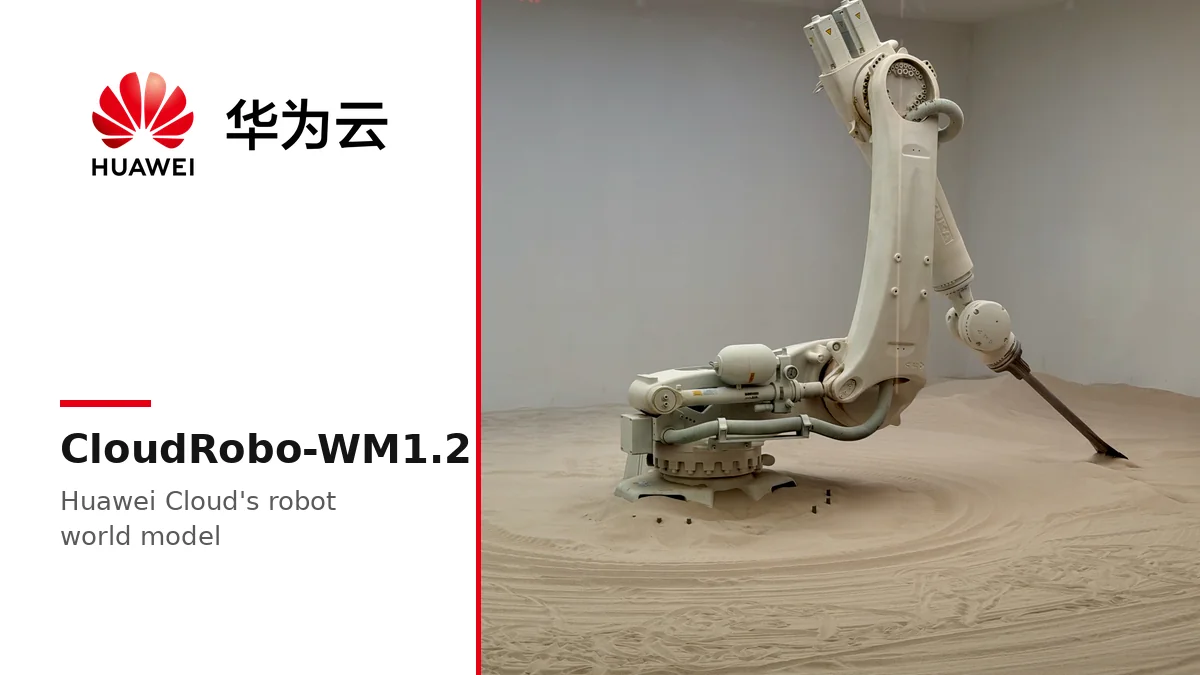
Huawei Cloud has launched CloudRobo-WM1.2, a world model for robots built for its Ascend chips, and released it as open source. The company unveiled the model at an online event on November 16, after announcing the launch date on November 12, according to a report citing the Science and Technology Daily.
A world model helps a robot predict how its surroundings might change in response to an action, which lets it plan a task in simulation before trying it on real hardware. CloudRobo-WM1.2 is Huawei Cloud’s first world model built natively for Ascend, the company’s own AI computing platform, and the first such model under its Industry AI Dream Factory platform.
What Was Announced
The launch event ran from 14:00 to 15:30 Beijing time on November 16. Wu Xiaodong, who leads Huawei Cloud’s embodied AI product line and its Embodied AI Lab, presented the model, and Liu Liu, the lab’s chief model expert, explained its architecture and capabilities, according to the pre-event agenda.
Huawei Cloud describes the model as trained on Ascend computing power. It uses a shared world model backbone network to build a predictive representation of the world, and generates actions through a native architecture Huawei Cloud calls DualAct. The company says the model ranked first on both the RoboTwin 2.0 and LiberoPro 2.0 evaluation benchmarks, two suites that test robot manipulation in simulation. Those rankings are vendor-reported and have not yet been independently verified.
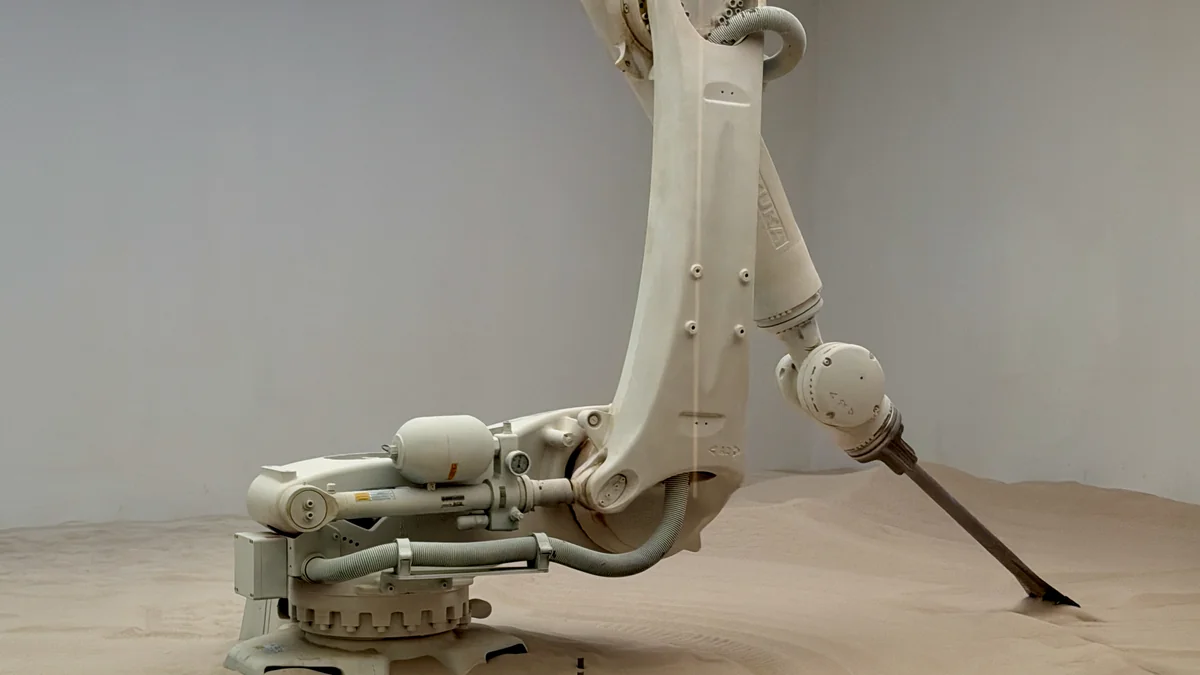
An industrial robot arm at work. Image: Wikimedia Commons (CC BY-SA)
The release fits a pattern Huawei Cloud set out in June 2025, when it introduced the CloudRobo embodied AI platform. The platform gives robotics developers tools for training data, model development and testing in simulation, and the company has said it will not build robot bodies itself, leaving hardware to partners. CloudRobo-WM1.2 is the model layer of that platform: a shared world model that partner hardware can build on.
Why It Matters
World models have become one of the most contested parts of robotics. A robot that can predict the result of an action can rehearse a task thousands of times in simulation, which cuts the cost of collecting real-world demonstrations. The open-source release matters because it gives developers working on Huawei’s Ascend hardware a ready-made world model, instead of building one from scratch or depending on models designed for Nvidia hardware.
The timing also places Huawei Cloud in a fast-moving field. Xiaomi recently open-sourced its first-generation robot model, Xiaomi-Robotics-0, and research labs are publishing open world-action models at a rapid pace. Huawei Cloud’s move is different in one respect: it ties the model to Ascend, so the release doubles as a showcase for China’s domestic AI chip stack at a moment when access to advanced foreign chips is restricted.
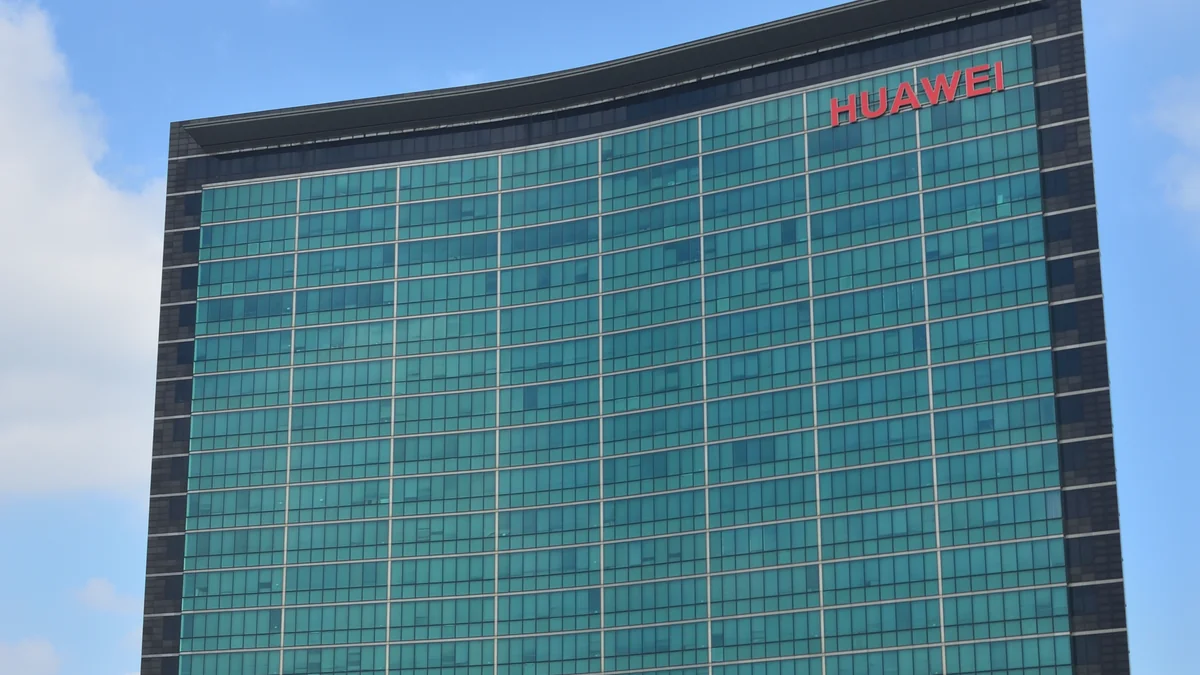
Huawei’s headquarters in Shenzhen. Image: Wikimedia Commons (CC0)
What is still unknown matters as much as what was announced. The reports read so far disclose no parameter count, no license terms and no pricing or availability details for the open-source release, and the open-source repository was not yet indexed in public search at the time of writing. The practical test will be whether robotics developers adopt the model and whether its benchmark lead holds up on real hardware, not just in the simulation suites Huawei Cloud cites.
For now, the launch confirms that Huawei Cloud intends to compete in embodied AI as a platform provider: models, data tooling and compute on Ascend, with robot bodies left to partners. If developers pick it up, CloudRobo-WM1.2 could become the default world model for the growing fleet of Chinese robots built on domestic chips.
Sources
- KuCoin News, “Huawei Cloud launches and open-sources CloudRobo-WM1.2, a native embodied world model,” November 16, 2026
- TechNode, “Huawei Cloud plans to open-source its Ascend-based world model for robots,” November 16, 2026
- aiaffairs, “Huawei Cloud schedules 16 November launch of Ascend-native robot world model,” November 13, 2026
- arXiv, “Open-HumanWAM: An Open Recipe for Scaling Human and Robot Experience for Embodied Foundation Models,” November 10, 2026 (RoboTwin 2.0 comparison table)