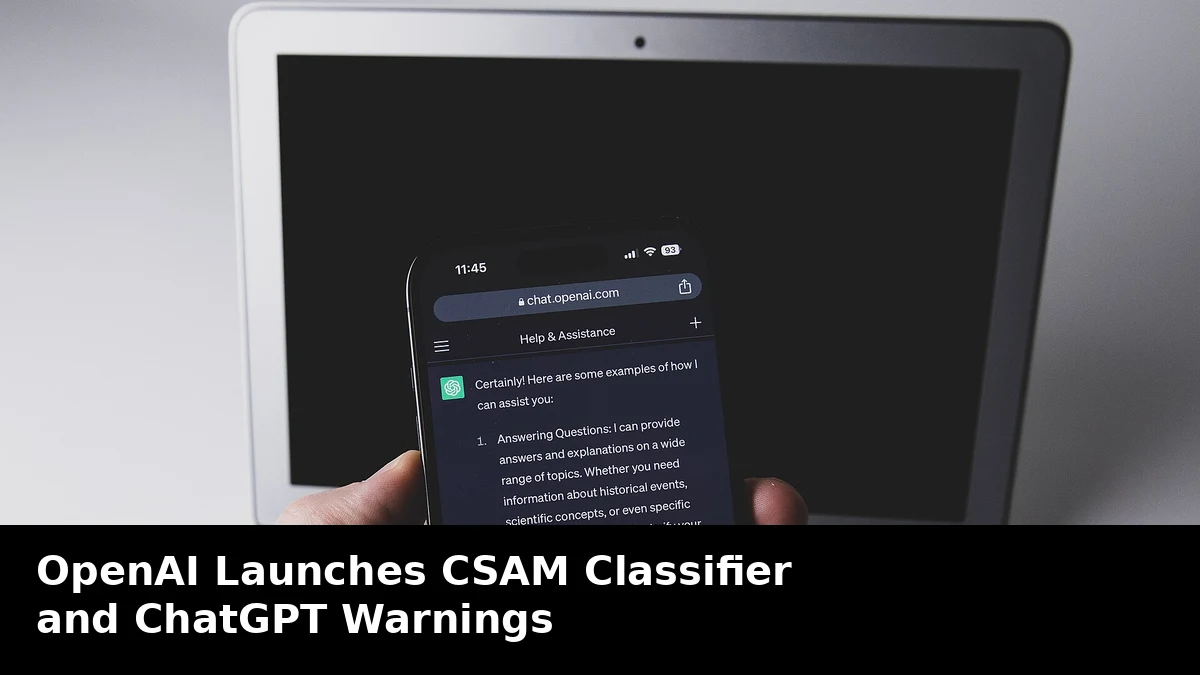
OpenAI announced on Monday a new CSAM classifier that detects child sexual abuse material, including images generated by AI, and new warnings in ChatGPT for users who try to access material that sexualizes children. The company said the tools are part of a broader child safety package that also includes new guidance for developers and new tools for law enforcement investigators.
“We’re releasing a free new tool to vetted organizations to help detect child sexual abuse material, including AI-generated images. We’re also adding ChatGPT warnings, publishing guidance for developers, and supporting child safety investigators,” OpenAI said. The announcement comes as the company faces growing scrutiny over how its tools are used, including lawsuits blaming its technology for harming users, especially children.
How the CSAM Classifier Works
The new CSAM classifier looks for visual signs of abuse in images, which means it can flag material that has never been seen or catalogued before, rather than relying only on matching known images against a database. It assigns a score to each image to give human reviewers an indication of which cases need attention first. OpenAI said it developed the classifier with the National Center for Missing and Exploited Children (NCMEC), and it is working with the Tech Coalition and ROOST to share access with other companies.
OpenAI is giving select companies access to the classifier through its API at no cost. In early testing with partners, the company said the classifier flagged 48% fewer images while finding the same number of abusive images, reducing the work of human reviewers, and that images it flagged were twice as likely to be abusive images. Those figures come from OpenAI’s own partner testing, not an independent audit, and the company did not disclose the test size, the number of partners or any miss rate.
ChatGPT Warnings and 24-Hour Suspensions
ChatGPT will now show a warning to users who attempt to access material that sexualizes children, direct them toward specialized support to stop the harmful behavior, and suspend the account for 24 hours as a warning. The app already blocked CSAM content and requests related to it. OpenAI said repeated offences could lead to the account being removed permanently.
OpenAI said it formed the warning messages and guidelines with organizations and researchers including Protect Children, the Lucy Faithfull Foundation, and Joel Scanlan at the University of Tasmania, who independently evaluated a trial of deterrent messages. The company is also publishing guidelines for developers using OpenAI tools to prevent, detect and help users report CSAM content. It said that in early testing, the guidelines have helped a number of developers adopt child safety tooling and register to report CSAM to NCMEC.
Tools for Law Enforcement
OpenAI is also equipping law enforcement dealing with child safety with AI-powered features such as dedicated plugins, investigative tools and complex data analysis, with access managed by program administrators. It is providing training to investigators along with a field guide on how to use AI in child safety investigations.
The scale of the problem gives the announcement its context. According to NCMEC, its CyberTipline received more than 400,000 reports involving generative AI in 2025. Safety-focused nonprofit Common Sense Media labeled OpenAI’s technology an “unacceptable risk” for teens, and other AI chatbots have been used to create nonconsensual sexualized imagery, including of children. GPTOnline previously reported on young victims pressing xAI in court over Grok-generated sexual images.

Why It Matters
The classifier matters because it shifts detection from hash-matching known images to spotting abuse in images no database has ever seen, including images generated by AI. That is the category of material that has grown fastest as image generation has improved, and it is the category existing tools are worst at catching. Offering the tool free to vetted organizations, through an API, puts the same capability in the hands of smaller platforms that could not build it themselves.
The test will be adoption and real-world accuracy. OpenAI’s early numbers show efficiency gains for reviewers, but they say nothing about how many abusive images the classifier misses, or how it performs outside the partner tests. The ChatGPT warnings are a deterrent aimed at behavior, not just content, and their effect will depend on whether the warnings and suspensions change what users attempt. For now, the announcement is a concrete step from the company most associated with the technology that created the problem, and it arrives as regulators, courts and parents are all asking the same question about what AI companies owe children.