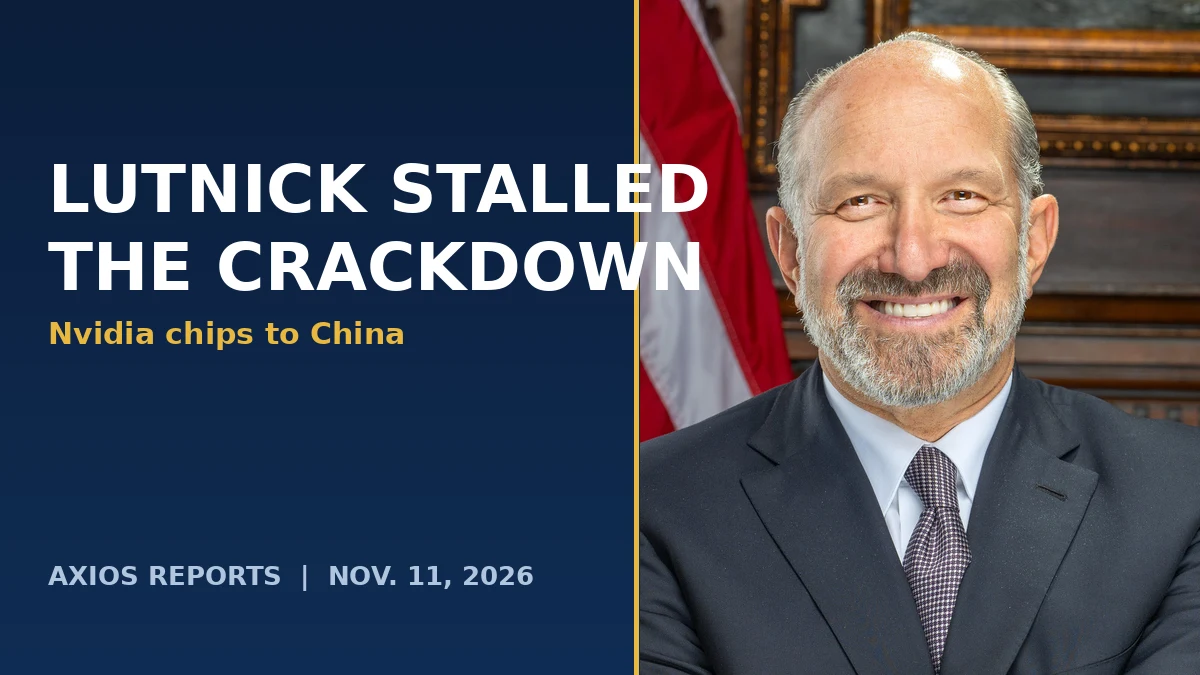
U.S. Commerce Secretary Howard Lutnick has repeatedly stalled President Donald Trump’s crackdown on companies suspected of diverting Nvidia’s artificial intelligence chips to China, Axios reported on Wednesday, citing high-level sources. The report exposes a sharp split inside the administration over how aggressively to enforce export controls on the advanced hardware at the center of the AI race.
Trump authorized the crackdown last Thursday, November 5, the third time this year he has done so, Axios reported. The president consulted billionaire Elon Musk before giving the go-ahead, according to the report. But Lutnick, whose department enforces the controls, “repeatedly stood in the way,” Axios said.
What happened in the Situation Room
The confrontation came into focus at a Situation Room meeting last Thursday, attended by Treasury Secretary Scott Bessent, Defense Secretary Pete Hegseth, Trade Representative Jamieson Greer and Secretary of State Marco Rubio. Bessent challenged Lutnick over his department’s resistance to carrying out the controls, Axios reported, and the New York Times reported the same confrontation in a separate account on Wednesday.
Lutnick appeared to agree in the meeting but said he needed to check with Trump first, according to Axios. He also warned that new restrictions “will start a trade war with China,” the Times reported. Trump later told Lutnick “let’s get it done,” Axios reported, but Lutnick replied that he would “develop some options and come back,” a response that angered the other officials in the room. One official told Axios: “He’s stalling it out.”
A Commerce Department spokesperson, Kristen Eichmeier, denied that Bessent confronted Lutnick, and the administration denied to both Axios and the Times that any confrontation took place. The spokesperson did not comment on the other allegations in the Axios report, according to the Times.
Megaspeed and the Entity List
At the center of the dispute is Megaspeed, a Singapore-based company accused of funneling Nvidia chips into China. The New York Times reported that Megaspeed has bought about $4.8 billion worth of Nvidia chips since mid-2024, although no wrongdoing by the company has been established. The Financial Times reported on Tuesday that Lutnick’s department has been holding up efforts to add Megaspeed to the Entity List, the Commerce Department’s trade blacklist, even as the State, Energy and Treasury departments and the Pentagon pushed for the listing.
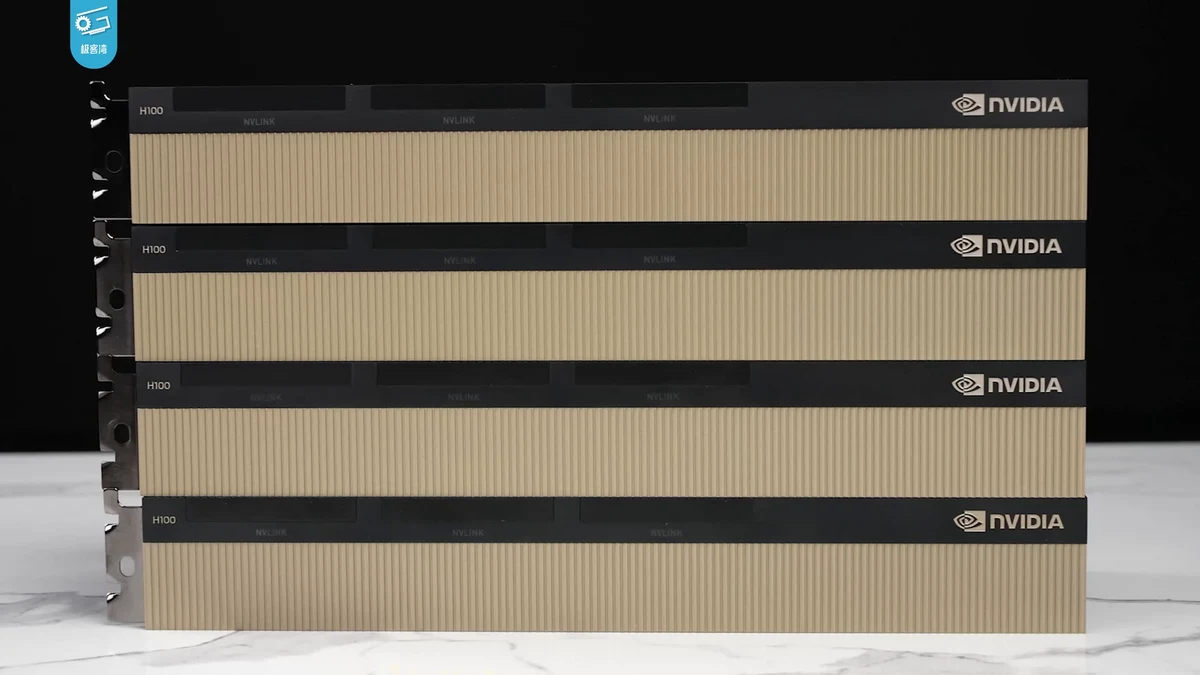
Nvidia H100 GPUs, the type of advanced AI hardware at the center of the U.S. export-control dispute. Photo: Geekerwan, CC BY 3.0, via Wikimedia Commons.
The Entity List is the government’s main tool for cutting off a foreign company from sensitive U.S. technology. Companies on the list need special licenses to receive controlled exports, which the government can deny. Commerce chairs the interagency panel that decides listings, which gives Lutnick’s department effective control over whether Megaspeed is added.
Nvidia says it did not wait for Washington to act. The company placed Megaspeed on its own block list in June 2025, prohibiting further sales or shipments, and says that voluntary block remains in place. Megaspeed has been under investigation by Singapore police since October 2025, and a Commerce Department investigation into the company dates back to 2024.
According to a summary of the Axios report, Lutnick has until December 1 to provide accountability on the issue.
Why it matters
Enforcement of chip export controls sits with the Commerce Department’s Bureau of Industry and Security, which licenses exports and polices diversion. A delay at Commerce can slow enforcement even after the White House has signed off, leaving a gap that third-country buyers can exploit. Diversion typically runs through buyers in countries such as Singapore, who resell restricted chips into China.
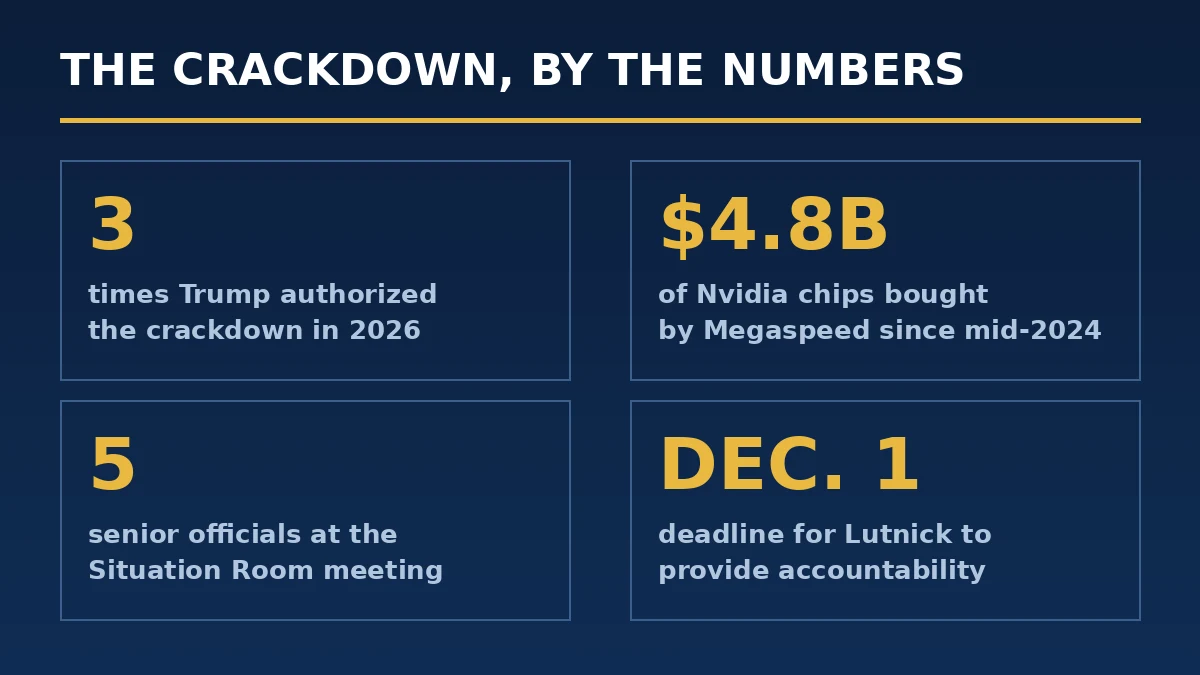
The crackdown, by the numbers. Graphic: GPTOnline, based on Axios, New York Times and Financial Times reporting.
The standoff also fits a wider pattern. The administration has scaled back its use of the Entity List against China this year as trade relations improved, and in May it cleared about ten Chinese companies to buy Nvidia’s H200 chips, according to Reuters. In June, the Commerce Department moved to close a loophole that may have let overseas units of Chinese companies obtain top-end Nvidia processors.
The dispute lands in the middle of the Nvidia scandal that has consumed Washington for a week. Nvidia’s board opened an independent investigation on November 8 into reports that chief executive Jensen Huang was targeted by a foreign intelligence effort, and the Wall Street Journal reported on Wednesday that the board is preparing to oust him. Trump has said the FBI is probing Huang’s relationship with Alice Huang, a Megaspeed executive identified by U.S. officials as a Chinese intelligence asset, while also backing the chief executive. GPTOnline previously reported on the board’s investigation and on the allegations against Alice Huang.
For now, the question is whether the crackdown Trump authorized three times will actually be imposed, and whether Lutnick follows through before the December 1 deadline. If he does not, the split inside the cabinet will remain the story, and the chips will keep moving.
Sources
- Reuters, “Lutnick stalled Trump crackdown on diversion of Nvidia chips to China, Axios reports”
- Gizmodo, “Howard Lutnick Doesn’t Want to Stop the Flow of Nvidia Chips Overseas: Report”
- The Times, “US commerce secretary accused of stalling Trump’s Nvidia-China crackdown”
- Crypto Briefing, “Howard Lutnick stalls Trump’s Nvidia chip curbs on China after Oval Office talks”
- InvestingLive, “Lutnick stalls Trump’s third Nvidia chip diversion crackdown this year, Axios says”