

The Nvidia board is preparing to oust Jensen Huang, the Wall Street Journal reported late Wednesday, in the most serious escalation yet of the scandal surrounding the chief executive of the world’s most valuable chipmaker. The board plans to meet as soon as Wednesday to determine his future, according to people familiar with the matter cited by the Journal.
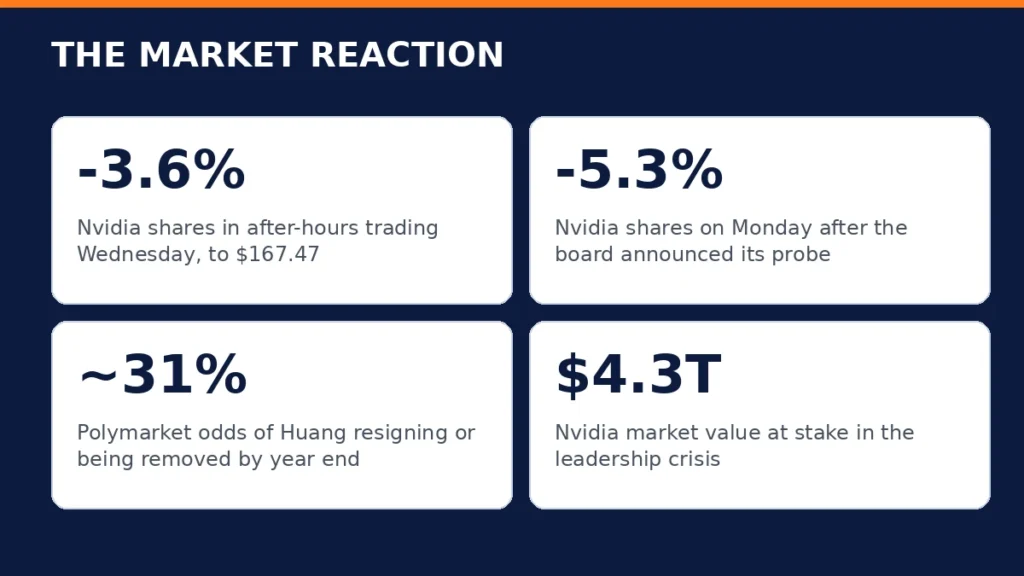
The report landed hours after the New York Times reported that Huang, 63, had a second extramarital affair, this time with Kimberly Powell, 48, Nvidia’s vice president of health care, who reports directly to him. The two developments pushed Nvidia shares down 3.6% in after-hours trading on Wednesday, to $167.47, according to CNBC data cited by MarketSpeaker.
No final decision has been made and no official announcement has been confirmed, the Journal noted. Its story, published at 22:32 UTC on November 11, described the board as “preparing to oust” Huang after he had two extramarital affairs, including one with a suspected Chinese spy. Nvidia declined to comment on the latest report.
What the Times reported about Powell
The Times reported that Huang had an extramarital relationship with Powell, citing five people who worked at the company, speaking on condition of anonymity. Powell joined Nvidia in 2008 and was appointed vice president of health care in late 2017. Both Huang and Powell are married to other people.
Two of the people told the paper that the pair were captured on video being affectionate at a San Jose hotel in March, during GTC, Nvidia’s annual developer conference. A bystander filmed the moment on a phone, three people briefed on the incident said, and Huang’s security team sequestered the bystander and offered a nondisclosure agreement. The Times said it has not seen the video.
When the paper reached Huang by phone on Wednesday and asked about Powell, he replied: “I don’t think you should be talking to me directly.” He then hung up. Nvidia declined to provide a statement, and Powell did not immediately respond to a request for comment. The relationship has been discussed inside the company, the five people said.
The alleged relationship would breach Nvidia’s own code of conduct, which tells employees to “avoid situations where our actions create conflict” including “personal relationships,” and states that the company “promptly investigates reports of misconduct.”
How the scandal reached this point
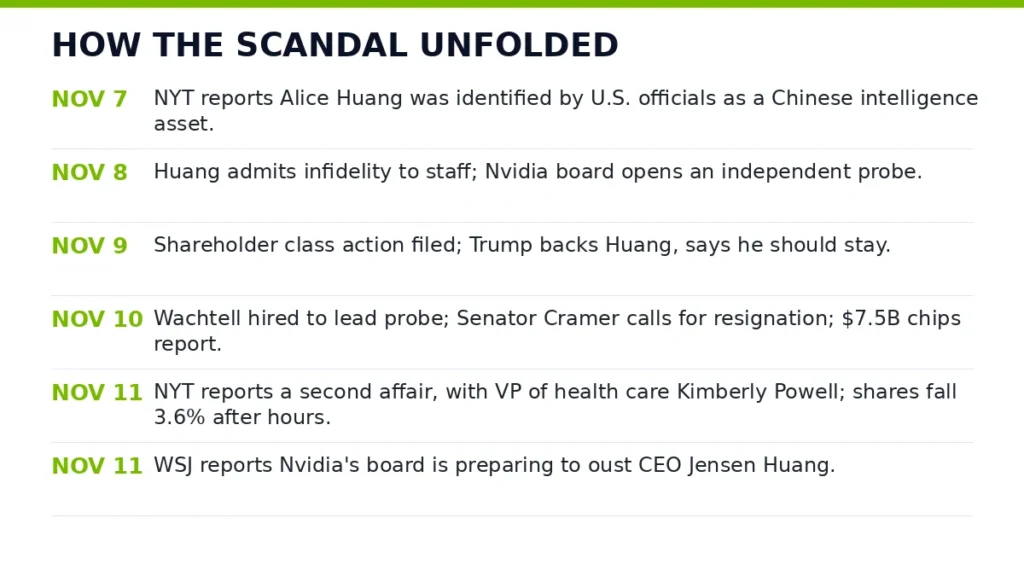
The crisis began last month, when the Times reported that a Chinese executive Huang had become close to, Alice Huang, had been identified by U.S. officials as a Chinese intelligence asset. Alice Huang, no relation to the chief executive, was a former executive of Singapore-based Megaspeed International. China has denied the espionage claims. On November 8, Huang told Nvidia employees he had been unfaithful to his wife, without naming the other person, and the board opened an independent investigation into reports that the CEO had been targeted by a foreign intelligence effort. The board said at the time that it had “no reason to believe” either U.S. national security or company secrets were compromised, and it expressed confidence in Huang and his leadership team.
Since then the pressure has built almost daily. A proposed class action was filed on November 9 in federal court in San Jose, accusing Nvidia and Huang of defrauding shareholders by concealing the alleged relationship. On November 10, the board retained the law firm Wachtell, Lipton, Rosen and Katz to lead the probe, with former acting U.S. Attorney for the Southern District of New York Joon Kim in charge, according to Reuters. The same day, The Information reported that Huang’s affair had facilitated the shipment of at least $7.5 billion worth of Nvidia chips to Chinese firms, and Republican Senator Kevin Cramer of the Senate Banking Committee called on Huang to resign.
President Donald Trump has said the FBI is probing Huang’s relationship, while also backing the chief executive. Three House committee chairmen have asked Huang to appear for a closed-door briefing on November 18 about his interactions with Alice Huang. Nvidia reports third-quarter earnings on November 17, the day before that briefing.
Market and political reaction
Investors have grown steadily more nervous. Nvidia shares fell 5.3% on Monday after the board announced its investigation, and Wednesday’s after-hours drop followed the Times report on Powell. Prediction market odds of Huang announcing his resignation or removal by year end jumped to roughly 31% after the new allegations, according to Crypto Briefing. Baird analysts wrote in a research note that Huang “might have to step down as CEO of Nvidia,” and the firm downgraded the stock, the Journal reported.
The political pressure is also mounting. Senator Cramer told Politico late Tuesday that Huang should step down, Reuters reported, while Senate Democratic Leader Chuck Schumer has called on Congress to pass new legislation giving it power over advanced chip exports.
Why it matters
Nvidia sits at the center of the global race for artificial intelligence, with a market value of about $4.3 trillion and a dominant share of the chips that power AI systems. A leadership change would ripple across the entire AI economy, from cloud providers and chip buyers to the U.S. government’s export-control policy toward China.
The scandal has also exposed Nvidia’s unusual governance. The company has no chairman, a rarity among large public companies, and no public succession plan. Huang, who co-founded Nvidia in 1993, owns 3.6% of its shares and has dozens of direct reports. Three of its 10 independent directors have held their seats for 25 years or more, and the board had already declared confidence in Huang before its own inquiry had begun.
For now, the decisive moment is the board meeting itself. If the directors follow through on the plan described by the Journal’s sources, the founder who turned Nvidia into the premier supplier of AI chips would leave the company he built, just as it faces a consequential earnings report. If they do not, the board will have to explain why a second reported affair, this time with a direct report, does not change its earlier vote of confidence.
Sources
- Wall Street Journal, “Nvidia is Preparing to Oust CEO Jensen Huang”
- New York Times (via DNYUZ), “Jensen Huang Said to Have Had Relationship With Nvidia Executive Who Reports to Him”
- Reuters, “Senior Republican on US Senate banking panel calls on Nvidia CEO Huang to resign”
- Reuters, “Wachtell, Nvidia’s pick for Huang probe, built reputation in boardroom battles”
- Reuters, “How Nvidia CEO Jensen Huang got entangled in a China chip and spy scandal”
- MarketSpeaker, “Nvidia Stock Slides After Report Alleges Second Huang Affair”
- Seeking Alpha, “Nvidia CEO Huang may have had relationship with company exec: report”
- GPTOnline, “Nvidia Board Launches Independent Probe Into Reports CEO Jensen Huang Was Targeted by Foreign Spying”
- GPTOnline, “Trump Backs Jensen Huang, Says He Should Stay as Nvidia CEO”
- GPTOnline, “Alice Huang Recruited by China to Spy on Nvidia CEO”




[…] targeted by a foreign intelligence effort, and the Wall Street Journal reported on Wednesday that the board is preparing to oust him. Trump has said the FBI is probing Huang’s relationship with Alice Huang, a Megaspeed executive […]
[…] GPTOnline, “Nvidia Board Preparing to Oust CEO Jensen Huang, WSJ Reports” […]
[…] Nvidia Board Preparing to Oust CEO Jensen Huang, WSJ ReportsNovember 11, 2026 […]