President Donald Trump said the risks of artificial intelligence can be managed and that he “doesn’t mind” AI guardrails, signaling his clearest openness yet to AI safeguards in an interview with CBS’s 60 Minutes that aired on November 8.
Asked by correspondent Ross Douthat whether the United States should accept the risks of AI in order to stay ahead of China, Trump said the dangers were manageable and expressed openness to working with Democrats on safeguards, according to Reuters. “I don’t mind guardrails,” he said. “But I don’t wanna put us in a deep second position.”
The interview, recorded at the White House on Friday, was Trump’s first sit-down since Republicans lost the House and Senate in the midterm elections on Tuesday. AI was one of several topics Douthat raised, alongside immigration, the war with Iran, and the election results.
What Trump said about AI
Douthat pressed Trump on warnings from people inside the AI industry that advanced systems could pose serious dangers. Trump said he considered those risks overstated. “I think the risk is not nearly as real as they talk. And I think the risk can be managed,” he said, according to the published transcript of the interview.
He then set out his condition for any safeguards. “I don’t mind guardrails. But I don’t wanna put us in a deep second position. We’re leading number one. And China has no guardrails, by the way,” Trump said. Douthat challenged that last claim, noting that China has the guardrails of being a totalitarian state. Trump replied: “They have the guardrails that whatever President Xi says goes. With me, it’s pretty strong, but it’s not quite that strong.”
Asked whether he would work with Democrats on AI safety, Trump answered affirmatively before discussing guardrails, JBizNews reported. He did not identify any specific safeguards, propose legislation, or announce a new AI policy in those remarks.
A shift in tone, if not yet in policy
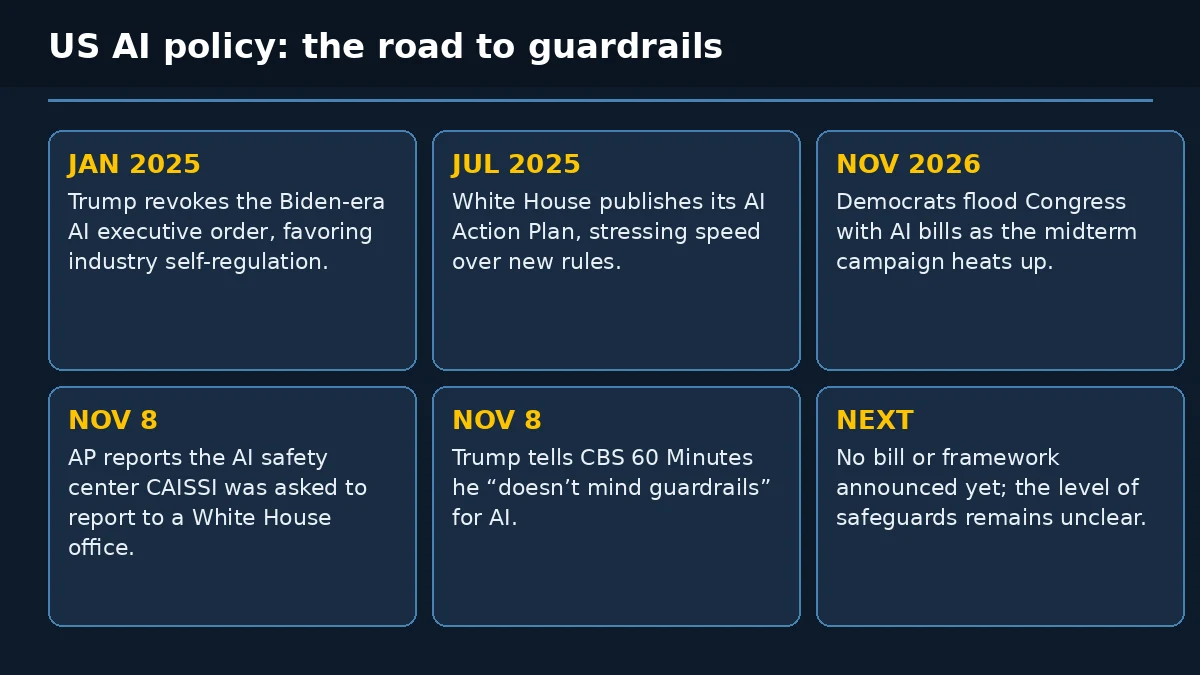
Trump has previously favored letting technology companies police themselves rather than imposing sweeping government restrictions, Reuters noted. He revoked the Biden-era AI executive order in January 2025, and the White House published its AI Action Plan in July 2025, stressing speed and American leadership over new rules.
The 60 Minutes remarks are the first time Trump has publicly signaled that he could accept AI guardrails, and the first time he has said he would work across the aisle on the issue. The shift comes as Democrats prepare a flood of AI bills for the new Congress, as GPTOnline reported in our November 7 coverage, and as OpenAI campaigns for mandatory AI “speed limits” in post-midterm Washington, covered in our November 2 report.
It also comes the same weekend the Associated Press reported that the Commerce Department’s AI safety center, CAISSI, was asked to report informally to a White House office, raising questions about the center’s independence. GPTOnline covered that story in our November 8 report.
Why it matters
The practical effect of Trump’s remarks is still unclear. No bill, framework, or agency action was announced, and Reuters noted that it remains uncertain what level of safeguards he would actually back. Saying he does not mind guardrails as long as they do not slow the United States down against China leaves every hard question about what gets restricted unanswered.
But the signal matters for an industry that has spent the year lobbying against new rules. The White House has been the industry’s most reliable ally in that fight, and a president who says he is open to guardrails, and open to working with Democrats on them, changes the politics of AI regulation in Washington. The next test will be whether the administration backs any specific proposal, or whether the openness stays rhetorical.
For now, the guardrails Trump described have no shape, no timeline, and no enforcement mechanism. What the interview established is simpler: the president no longer rules them out.
Sources
- Reuters: Trump says AI risks can be managed, signals openness to guardrails
- 60 Minutes Transcript: Donald Trump, the 2026 post-midterm elections interview (CBS transcript, republished in full)
- JBizNews: Trump Says He Is Open to AI Guardrails but Warns Against Falling Behind China
- Crypto Briefing: Trump says AI risks are manageable and signals openness to guardrails