OpenAI has introduced BioBasicsBench, a new benchmark that tests whether AI agents can handle the routine analysis of everyday wet-lab science, from reading a DNA gel to spotting a mislabeled control plate. Developed with Ligo, a biotech company focused on enzyme design, the benchmark was announced on November 6, 2026, and it measures skills that existing benchmarks, built around polished figures from published papers, tend to miss.
Everyday wet-lab work is messy. Experiments fail, images are ambiguous, and observations conflict. OpenAI says misreading an image or overlooking a problem with a control can lead scientists to the wrong conclusion and waste time on experiments that will not answer their question. BioBasicsBench is built to measure exactly that kind of judgment.
What BioBasicsBench Tests
The benchmark contains 100 tasks across five areas of routine wet-lab work: protein methods, imaging and cytometry, quantification and assays, nucleic acid methods, and molecular cloning. Instead of clean charts, the tasks use raw experimental evidence: gel and blot images, colony plates, microscopy stacks, sequencing reads, plate-reader exports, and videos of bench work.
Each task was written by scientists using data from their own experiments and paired with an expert-written grading rubric. Every task went through three reviews: an internal review by a Ligo scientist who had not written it, an external review by a PhD-level scientist working in a wet lab, and a final internal review. Answers earn partial credit against individual rubric criteria, so a partly correct analysis scores differently from a fully correct one.
The Results: GPT-6 Astra Leads by a Wide Margin
OpenAI evaluated seven models on BioBasicsBench: GPT-5.2, GPT-5.4, GPT-5.5, GPT-5.6 Sol, GPT-6.1 Sol, GPT-6 Luna, and GPT-6 Astra. The evaluation covered 37 model and reasoning-effort settings, with five attempts on each of the 100 tasks per setting, for a total of 18,500 results.
At the xhigh reasoning setting, the highest setting reported for all seven models, GPT-6 Astra earned 66.7% of the available credit (95% confidence interval 60.3 to 73.1%), compared with 43.8% for GPT-5.6 Sol (37.6 to 50.0%). GPT-6.1 Sol came second at 62.0%. Astra also did it more efficiently, using 4,704 output tokens per task against 9,099 for GPT-5.6 Sol. The remaining scores were GPT-6 Luna at 38.3%, GPT-5.5 at 35.4%, GPT-5.4 at 33.2%, and GPT-5.2 at 31.2%.
These percentages are mean reward scores, meaning average rubric credit, not the share of tasks fully solved. OpenAI attributes Astra’s gains to stronger native multimodal capabilities, which it says may be key to improving performance on everyday wet-lab analysis.
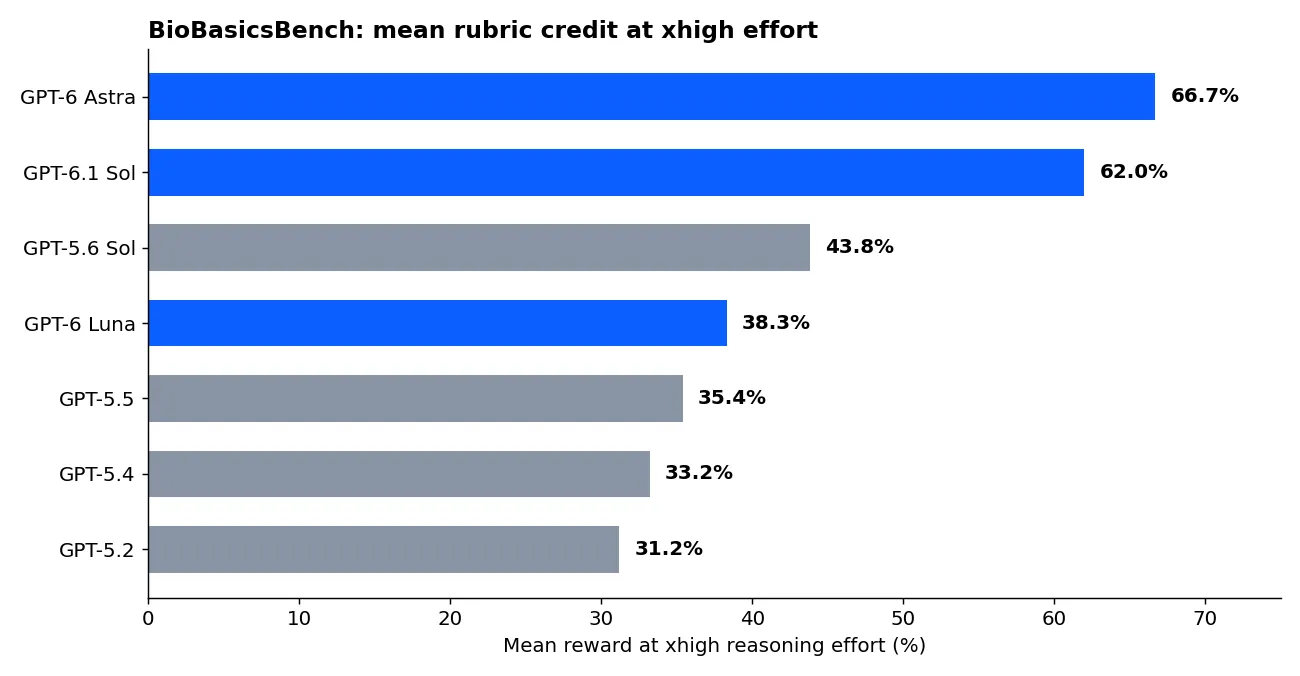
BioBasicsBench scores at xhigh reasoning effort, from OpenAI’s results table. Chart: GPTOnline, using OpenAI data.
Where Astra Improved
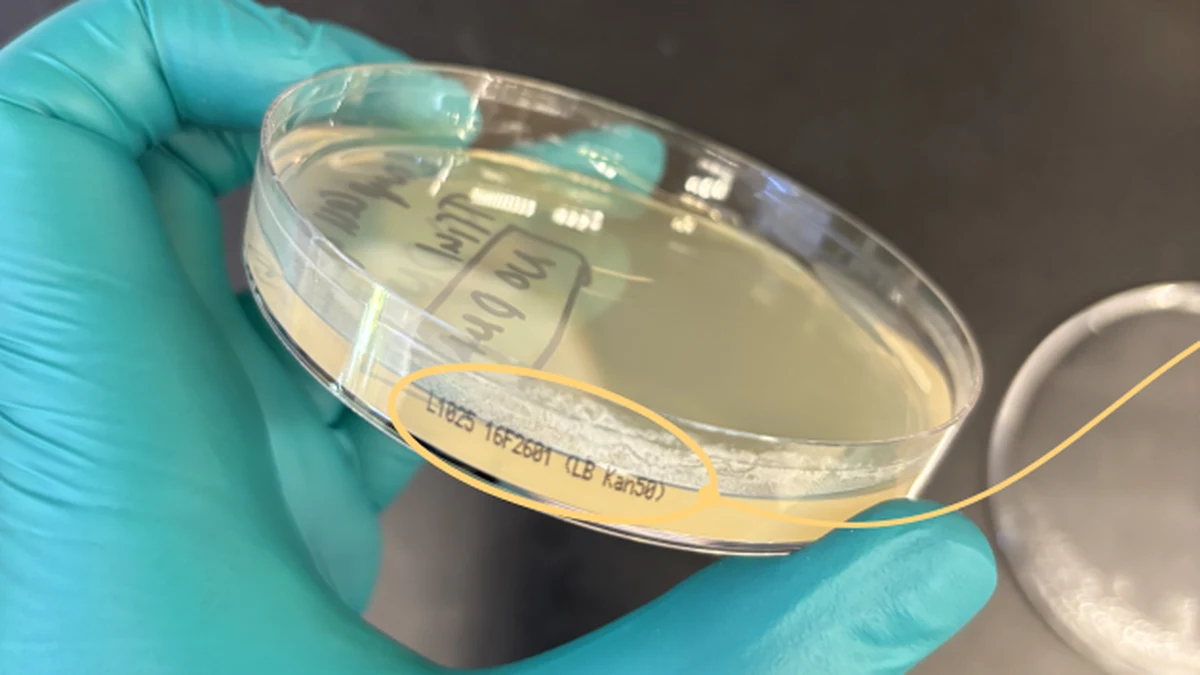
OpenAI highlights three cases where Astra outperformed its predecessor. In one cloning task, GPT-5.6 Sol saw no colonies on a negative control plate and based its conclusions on that observation. Astra noticed the plate was labeled with the wrong antibiotic, kanamycin instead of the ampicillin used in the experiment, and correctly rejected it as a reliable control.
In another task, GPT-5.6 Sol classified cells as dead based on a dye signal, even though the detector could also pick up light from a second dye. Astra recognized the ambiguity and called for better controls to separate the signals. In a third, GPT-5.6 Sol looked for a biological explanation when cells seemed to disappear across microscope images, while Astra correctly recognized a z-stack, a series of images taken at different depths.
Where Models Still Fall Short
OpenAI is blunt about the limits. “Higher benchmark scores do not yet mean models can make reliable judgments in the lab,” the company writes, and it publishes three worked examples of Astra getting laboratory work wrong.
In one, Astra picked the wrong colonies from a colony PCR gel, proposing lanes 4, 6, 7, and 8 when the reference selection was lanes 5, 9, and 10, which would have sent the wrong plasmid into downstream purification. In another, it generalized that vacuoles are darker than the surrounding cell, discounting lighter vacuoles visible in the same image. In a third, it overcounted colonies on a plate by about 12%, failing to resolve close neighbors, missing visible colonies, and marking empty agar. OpenAI notes that “Astra’s counting marks do not reliably correspond to individual colonies: it fails to resolve close neighbours, misses visible colonies and marks empty agar.”
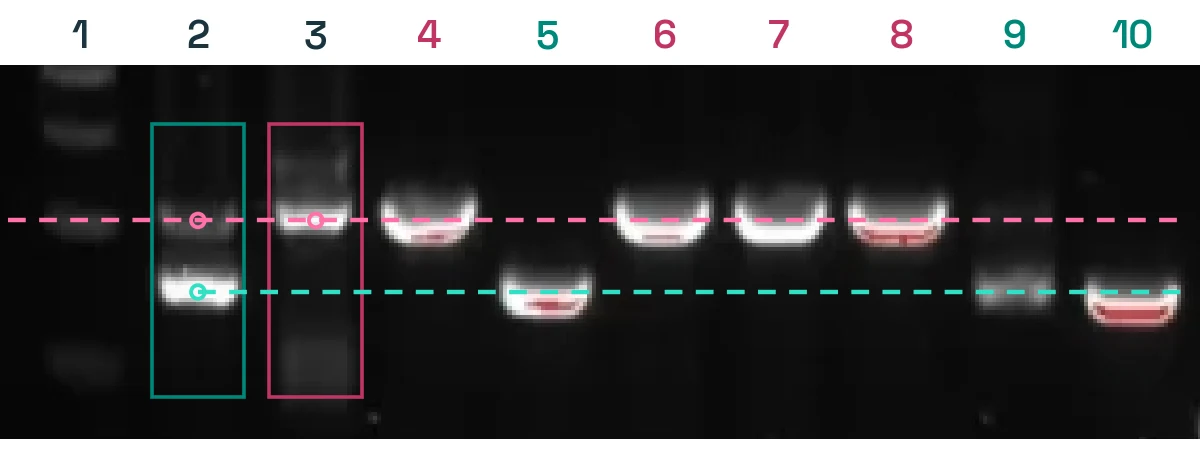
The colony PCR gel where Astra selected lanes 4, 6, 7, and 8 against the reference selection of 5, 9, and 10. Image: OpenAI.
Why It Matters
BioBasicsBench shifts the evaluation of lab AI from headline capability to everyday reliability. A model that can discuss a published paper but misreads a gel or trusts a bad control is of limited use at the bench, and OpenAI frames the benchmark as a target for improvement rather than a verdict.
“Accelerating biological research requires getting the everyday work right,” OpenAI writes. The company also says tracking these capabilities will help it understand their implications for biosafety and biosecurity. One limitation to keep in mind: OpenAI evaluated only its own models, and the announcement includes no link to a public release of the tasks, so outside labs cannot yet rerun the benchmark themselves.
Still, the gap the benchmark exposes is the point. Astra’s jump from 43.8% to 66.7% shows rapid progress on routine lab reading, while the remaining third of the credit shows how far models still are from judgment a working scientist can trust without checking.