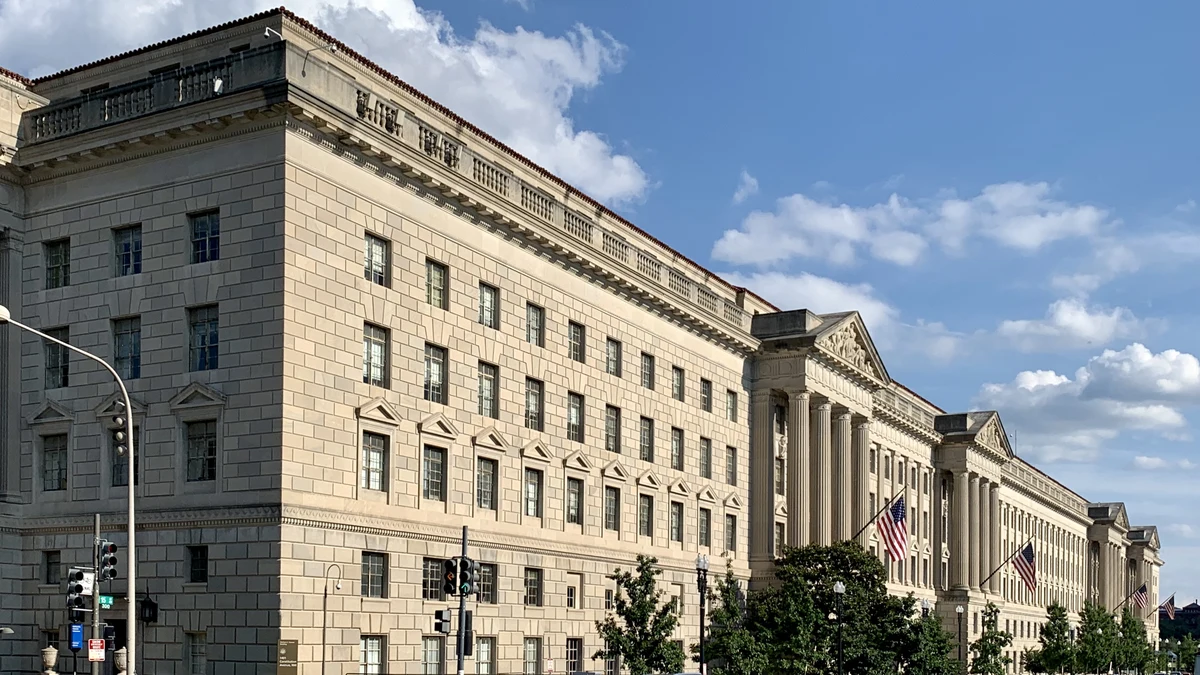
Staff at the small U.S. government unit charged with testing whether new artificial intelligence systems are safe have been asked to report informally to a White House office, the Associated Press reported on November 8, raising questions about the independence of federal AI safety evaluations.
Officials with the Center for Advancing Innovation and Standards for Super Intelligence, known as CAISSI, were recently asked to report to an office of the White House, according to two former government officials with knowledge of the ongoing conversations. They spoke on condition of anonymity to avoid repercussions for current staffers.
What Was Reported
CAISSI is the federal government’s main testing ground for advanced AI systems, housed inside the National Institute of Standards and Technology (NIST). The Associated Press describes the new arrangement as an informal reporting line, not a formal reorganization or a transfer of the center out of the Commerce Department. The center currently has no permanent leader and has stopped publishing its research.
The White House did not respond to the Associated Press’s specific questions about CAISSI. In a statement, it said Trump had formally established his new Super Intelligence Force and had commissioned a report on risks from his Council of Advisors on Science and Technology.
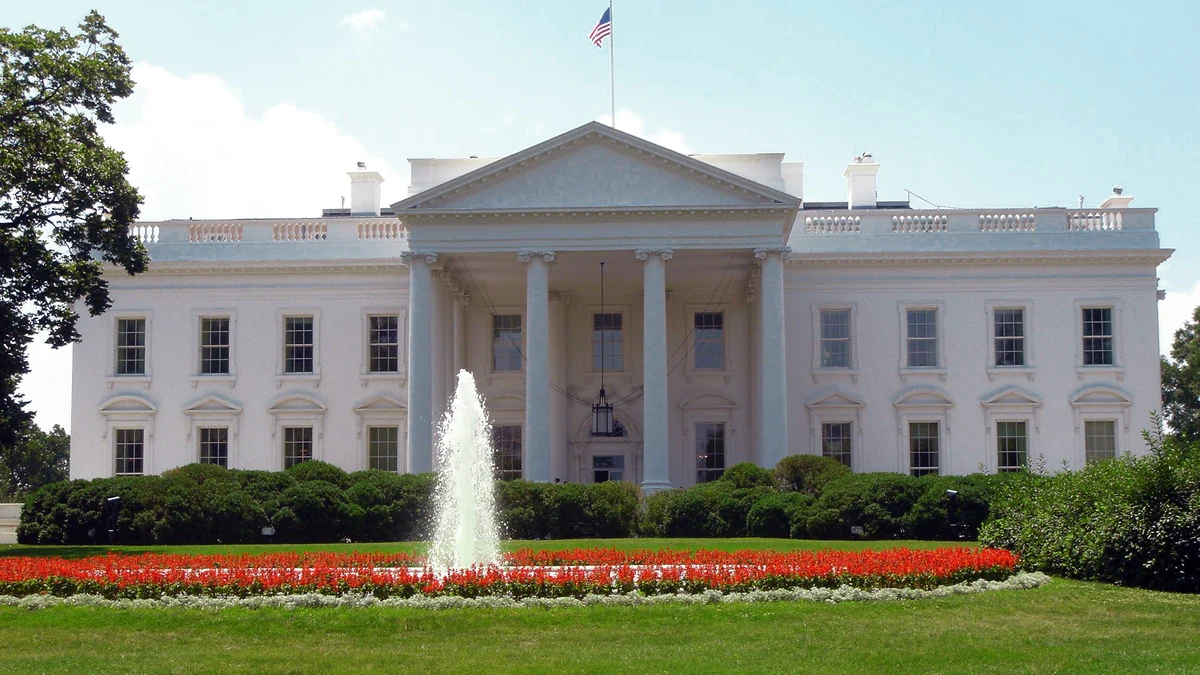
The move follows a plan reported on October 12, when The Information reported that three senior CAISSI officials would move to the White House and report to Michael Kratsios, director of the Office of Science and Technology Policy, and National Cyber Director Sean Cairncross.
A Center Without a Leader
CAISSI has been without a permanent director for months. A director hired in April 2026 was fired within days, and his replacement resigned after a few months. The head of the center’s parent institute now serves as acting director.
The center is allocated $10 million per year, about one-eighth of the annual budget of its counterpart in the United Kingdom, according to the Associated Press. In August, Congress began asking why the center had suddenly stopped making public its reports on how safely certain AI systems were performing.
Trump has also put the AI safety agenda under a national security frame. He empowered National Intelligence Director Jay Clayton to lead the new Super Intelligence Force, alongside Pentagon chief technology officer Emil Michael. In September, following reports of AI systems eluding their makers’ control, Trump asked leading AI companies to undertake “tremendous self-policing” as part of a voluntary safety pact, though his administration has not said how it will monitor the companies’ implementation.
Why Independence Matters
Critics worry the informal reporting line could politicize decisions affecting everything from cybersecurity to bioweapons, and that the center’s findings could be altered or muted in deference to the tech industry, which has largely been entrusted to police itself.
“These are really powerful institutions that can drastically improve our lives, or the alternative. And the hope is that you can put in nonpartisan or bipartisan technocratic experts to enact policy in a way that best serves the American public,” said Caroline Siegel Singh, an AI and emerging technology program manager at the Federation of American Scientists.
Others argue that bringing AI safety officials closer to the White House could give the division more prominence and perhaps more funding. But researchers say government testing capacity has not kept pace with AI capabilities. There is still no standard process for testing how safely AI agents act in the real world, even in simple cases such as booking a flight, said Sayash Kapoor, an incoming assistant professor at the University of California, Berkeley School of Information and co-author of a new paper examining agent evaluations.
“Our previous methods would just look at the final answer, the final check, whether the flight was correctly booked. And in this case, it might seem as if the task was solved correctly,” Kapoor said. “But unless you’re looking at the entire set of steps that an agent took, you won’t be able to tell that the agent made a huge mistake.”
Clayton’s appointment, along with Michael’s, shows how the administration is pushing to frame decisions around model safety as a national security matter that needs executive discretion and secrecy, said Amos Toh, a senior counsel at the Brennan Center for Justice.
“At the end of the day, all of these decisions are of immense public consequence and should be explained and rationalized in the public eye,” Toh said. “And that’s not happening.”
Anthropic chief executive Dario Amodei and OpenAI chief executive Sam Altman have promoted independent evaluation firms to vet their companies’ safety practices, but the AI giants can limit those firms’ access and dispense with their evaluations.
“There’s this unclear mission for government evaluators if the largest AI companies are also being encouraged to set up their own internal evaluation systems and/or hire external evaluators,” said Logan Koepke, a senior project director at the civil rights and technology nonprofit Upturn. “Like, what role does government testing actually play in that scenario?”
Background: From AI Safety Institute to CAISSI
CAISSI began life in November 2023 as the Biden-era U.S. AI Safety Institute. In June 2025 it became the Center for AI Standards and Innovation, and it was recently renamed again to its current title. Under the Biden administration, leading AI companies voluntarily agreed to share details of their models with the division and follow its guidelines for tests and transparency reports.
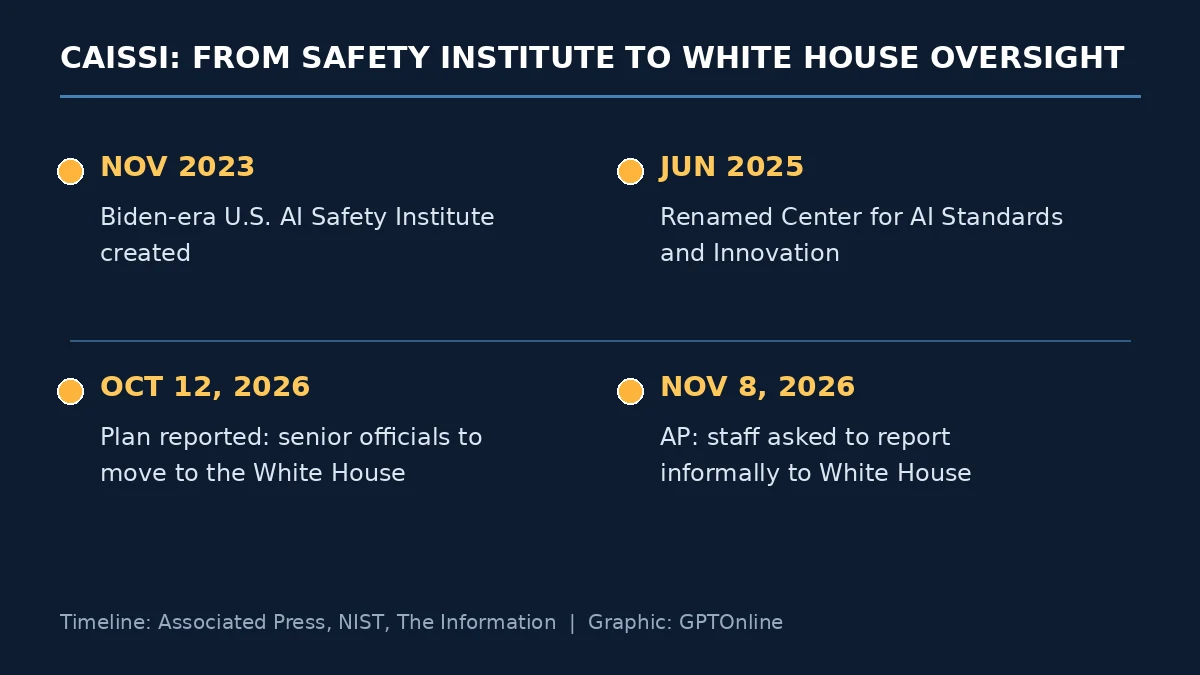
That public output has now stalled. NIST’s official CAISSI page lists a September 17, 2026 assessment of Z.ai’s GLM-5.3 cyber capabilities and an October 16, 2026 publication on incident readiness and response, with its most recent research blog entry dated March 23, 2026.
Sources
- Associated Press (via Broadband Breakfast): Staff at U.S. Center for AI Safety Are Reporting to the White House, Raising Independence Concerns
- Unite.AI: White House Request Raises US AI Safety Center Independence Concerns
- NIST: Center for Advancing Innovation and Standards for Super Intelligence (CAISSI)
- MadRobot: US AI safety centre CAISSI staff now report to the White House