The Rubio memo warned senior Trump administration officials in spring 2026 that Nvidia chief executive Jensen Huang had developed a close relationship with a woman US intelligence agencies concluded was a spy for Beijing, according to a New York Times report published on November 8. Secretary of State Marco Rubio personally oversaw the drafting of the classified document, which circulated among national security officials before President Donald Trump’s state visit to China in May.
The report adds a new and politically charged layer to a story that has already forced Nvidia’s board to open an independent investigation into its chief executive. It also raises fresh questions about how much the White House knew, and when, about the relationship at the center of the affair.
What the Rubio memo said
The memo was based on electronic surveillance of Alice Huang, a senior executive at Megaspeed International, a Singapore-based data center company. Alice Huang is not related to Jensen Huang. US agencies concluded that she had been recruited by China’s Ministry of State Security to gather information on the Nvidia chief and potentially influence the company to push for its most advanced chips to be made available to China, the Times reported.
Megaspeed, which rents computing power from Nvidia chips to Alibaba and other Chinese firms, is under federal investigation over accusations that it helped smuggle restricted Nvidia chips into China. The Justice Department has taken over that investigation. China’s embassy has called the allegations “smears.”
Rubio declined to discuss the memo when asked by reporters in Florida on Sunday, saying he could not comment because of its nature, according to reports of the Times story. The State Department did not say whether Rubio would cooperate with any congressional inquiry.
Photo: US Department of State via Wikimedia Commons
Trump was briefed a year ago, the Times says
According to the report, Trump was briefed on the intelligence about Jensen Huang and Alice Huang roughly a year ago and took no action. Current and former officials told the Times that the close relationship between the two men had impeded efforts to rein in Nvidia’s chip sales abroad, stalling some Commerce Department investigations and proposed trade sanctions involving China or Nvidia.
Few executives have had as much sway over Trump’s approach to AI and China as Jensen Huang. In 2025, Huang persuaded the president to roll back a ban on chip sales to China. The two later struck a deal letting Nvidia sell its second-most-powerful chip there, with the US government taking a 25% cut of the sales. Nvidia has also donated at least $20 million to Trump’s ballroom fund.
The disclosure puts the White House in an awkward position. The administration has made restricting China’s access to advanced AI chips a central plank of its technology policy, while its most prominent chip-industry ally was, according to US intelligence, the target of a Chinese influence operation.
A board probe, an admission, and a congressional deadline
The Times report landed on the same day Nvidia’s board announced an independent investigation into reports that Jensen Huang was the target of a foreign intelligence effort. In a message to staff on November 8, Huang admitted he had been unfaithful to his wife, writing, “I was unfaithful to my wife. My actions hurt her and our children. There is no excuse for what I did. I am deeply sorry.”
The board said it had “no reason to believe that either national security or Nvidia secrets were compromised,” and Huang will remain chief executive during the review. Nvidia said its dealings with Alice Huang had been proper. In October, Huang told Bloomberg News that his dealings with her had been “completely normal.”
The timeline is now crowded with deadlines. The Republican leaders of three House committees have asked Huang to appear at a closed-door briefing on November 18, and he has until November 11 to respond. The board has given no timeline for its own inquiry, saying only that it will provide further updates “as appropriate.”
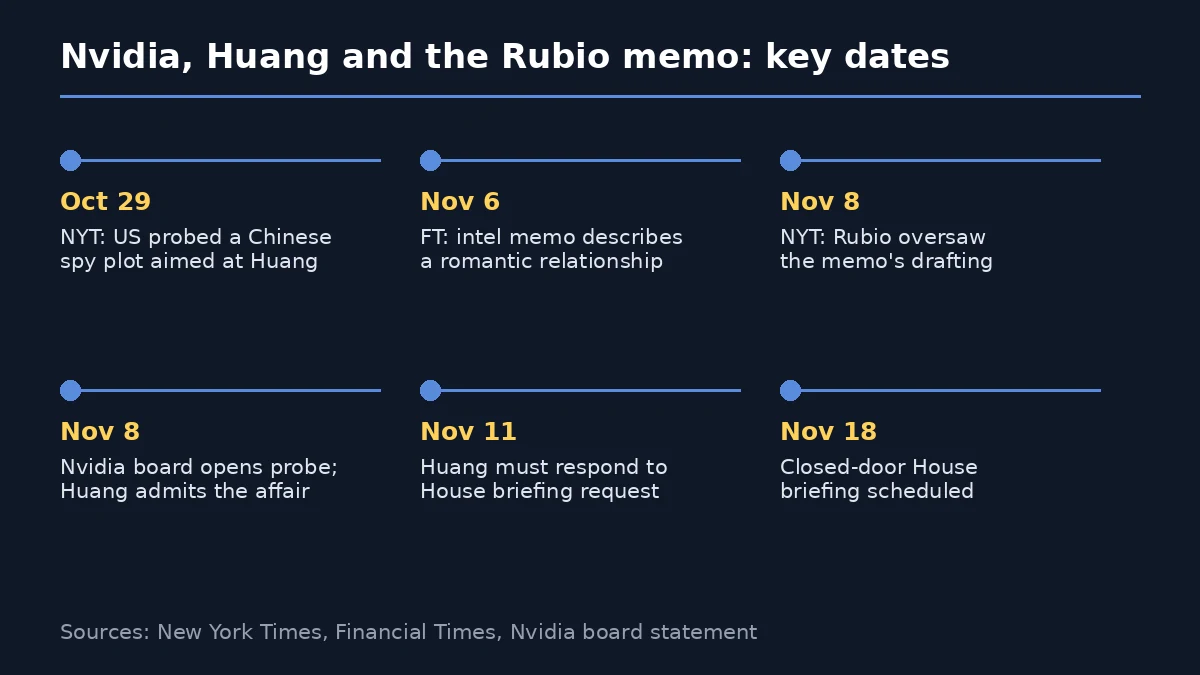
Graphic: GPTOnline, using data from the New York Times, Financial Times and Nvidia
Why it matters
Nvidia is the pre-eminent maker of the advanced graphics processing units that power modern AI, and Washington has restricted sales of the most powerful ones to China since 2022. The Rubio memo shows that concerns about Huang’s relationship reached the highest levels of the US government months before the story became public, and that the warnings did not slow the company’s access to the White House or its push to keep selling chips to China.
For the AI industry, the episode is a reminder that the geopolitics of chips now runs through boardrooms and personal relationships, not just export-control lists. What Congress learns at the November 18 briefing, and what Nvidia’s board finds in its investigation, will shape how much trust Washington places in the company that sits at the center of the AI boom.
GPTOnline previously covered the board investigation and Huang’s admission in our earlier report, and the original recruitment allegation in our November 7 coverage. We will update this story as the investigation and the congressional inquiry develop.
Sources
- The New York Times: Rubio warned officials about Nvidia chief’s entanglement with Chinese spy
- The Straits Times: What to know about Nvidia’s investigation of its CEO Jensen Huang (republishing the Times report in full)
- TRT World: Nvidia CEO faces scrutiny over alleged intelligence links as company opens investigation
- New York Post: Nvidia CEO faces probe over affair with alleged Chinese spy
- Axios: Jensen Huang admits an affair as Nvidia board launches investigation