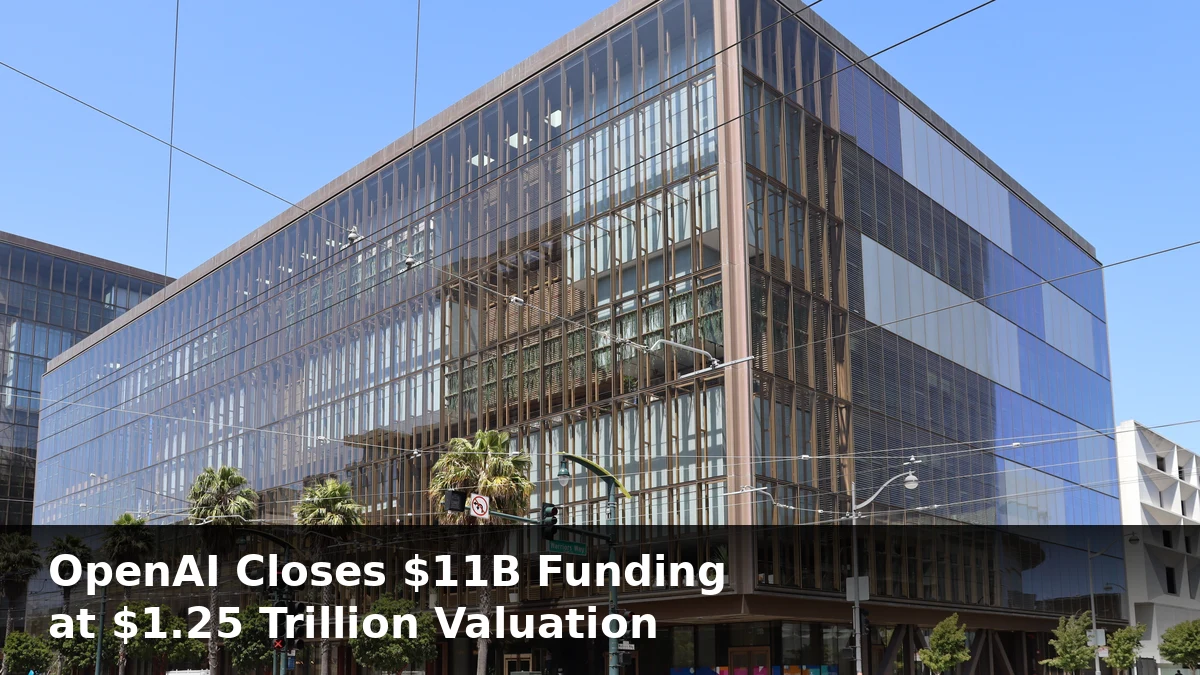
OpenAI has closed the first $11 billion of a new funding round that values the company at $1.25 trillion, Bloomberg News reported on Friday, citing people familiar with the matter. The money was wired to the company on Friday, November 6, according to the report. The OpenAI $11B funding close is the first tranche of a round that could grow to as much as $20 billion in the coming weeks.
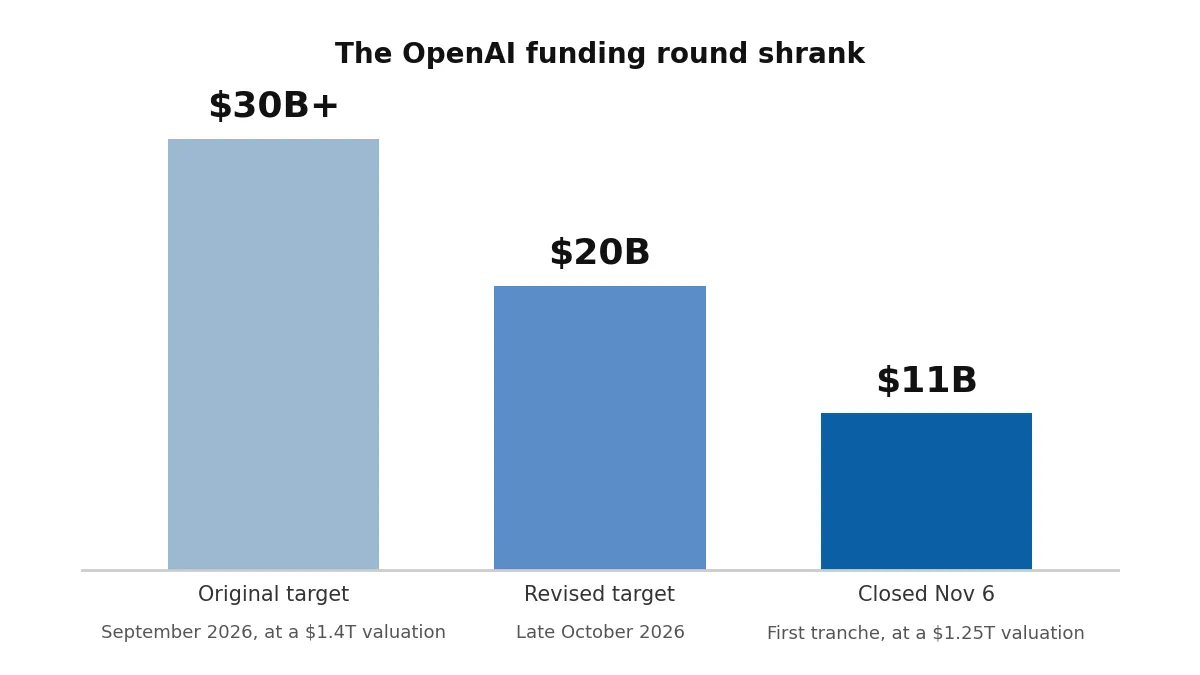
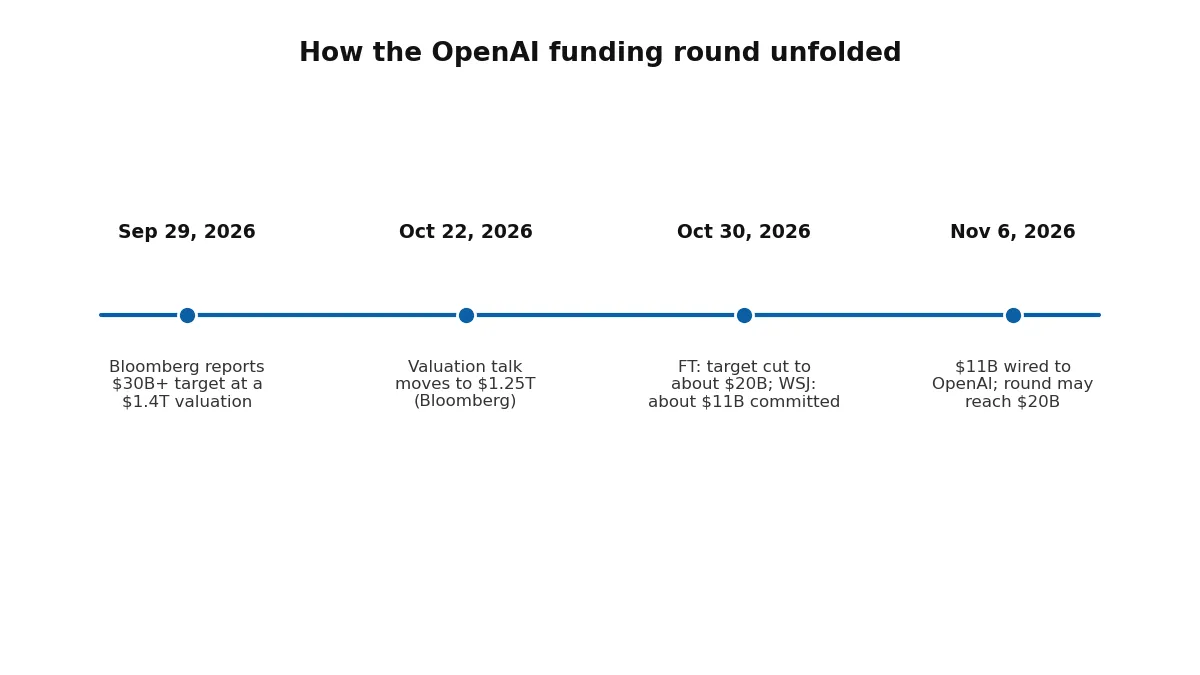
The close lands well below where the round started. OpenAI originally sought $30 billion or more at a $1.4 trillion valuation, Bloomberg reported in September. In late October, the target was cut to about $20 billion after some investors reduced their allocations ahead of a commitment deadline, the Financial Times reported, and the Wall Street Journal reported that only about $11 billion had been committed by that deadline. Investors from the United Arab Emirates are leading the round alongside Coatue, according to reports based on the Bloomberg account.
What was reported
According to Bloomberg, as carried by Reuters, OpenAI has closed on the initial $11 billion portion of the round, with the remainder expected to be completed in the coming weeks. The $1.25 trillion valuation is down from the $1.4 trillion figure OpenAI put in front of investors in early October, a cut of $150 billion.
One detail remains unsettled in the reporting. Early accounts of the round described the $1.25 trillion figure as a pre-money valuation, which excludes the new capital, while later accounts described it as post-money, which includes it. The difference matters for how much of the company the new investors own, and neither OpenAI nor the investors have publicly clarified the basis.
OpenAI has not publicly commented on the terms of the financing. The company had earlier postponed its plans for an initial public offering, Bloomberg has reported, making the private round its main source of new capital for now.
A smaller raise at a lower price
The scaled-back round is the clearest sign yet that even the most valuable private AI company is not immune to the market turn. AI stocks sold off sharply this week: the Nasdaq 100 fell 6.4% on November 5, and companies in the Nasdaq Composite lost a combined $2.5 trillion in market value on Thursday, according to the Wall Street Journal. Investors who were eager to fund AI infrastructure at almost any price a month ago are now asking harder questions about returns.
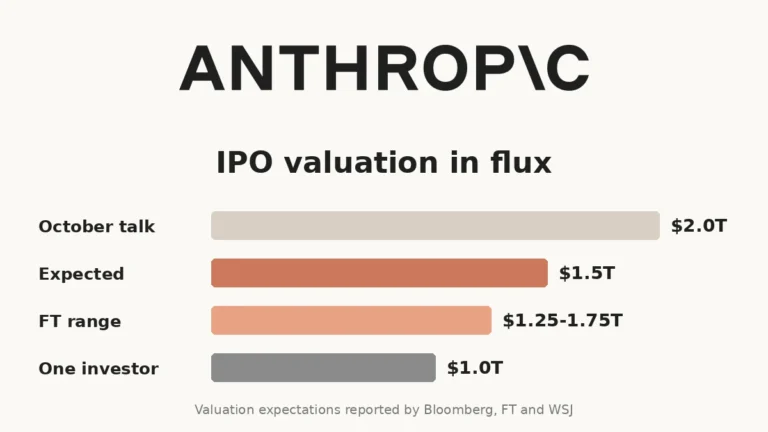
Anthropic, OpenAI’s closest rival, is feeling the same pressure. Major investors have told the Journal that Anthropic’s planned IPO, expected to raise up to $100 billion, will likely have to proceed at a valuation well below the $1.5 trillion first discussed, as GPTOnline reported earlier this week.
Why it matters
Even at $11 billion, the first tranche is one of the largest private financings ever raised, and the $1.25 trillion valuation keeps OpenAI far ahead of every other private AI company. The money arrives as OpenAI continues to spend heavily on computing power, data centers and the infrastructure behind its models, costs that run into the tens of billions of dollars a year.
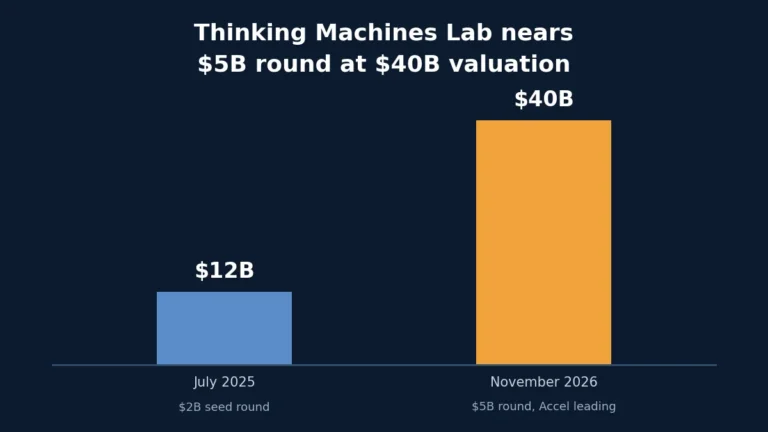
The round also sets the price for the rest of the AI market. OpenAI’s valuation is the benchmark that investors use to judge Anthropic’s IPO, Thinking Machines Lab’s reported $5 billion round at a $40 billion valuation, and a long line of smaller AI startups. A lower price for OpenAI ripples through all of them.
For now, the deal is only partly done. The remaining commitments that would take the round to $20 billion are expected in the coming weeks, and the same market that forced the first cut could still move the terms before the round closes.
Sources
- Reuters: OpenAI secures $11 billion funding at $1.25 trillion valuation, Bloomberg News reports (November 6, 2026)
- Le Private Banker: OpenAI Closes First $11 Billion of Funding at $1.25 Trillion Value (November 6, 2026; sources: Bloomberg, CNBC)
- TradingView / Seeking Alpha: OpenAI completes $11B funding round to reach $1.25T valuation (November 6, 2026; reporting Bloomberg)
- GPTOnline: Anthropic IPO Valuation in Doubt as Investors Balk After AI Selloff (November 6, 2026)
- GPTOnline: Nasdaq 100 Sheds $2.3 Trillion in Worst Day Since 2020 as AI Trade Unwinds (November 5, 2026)