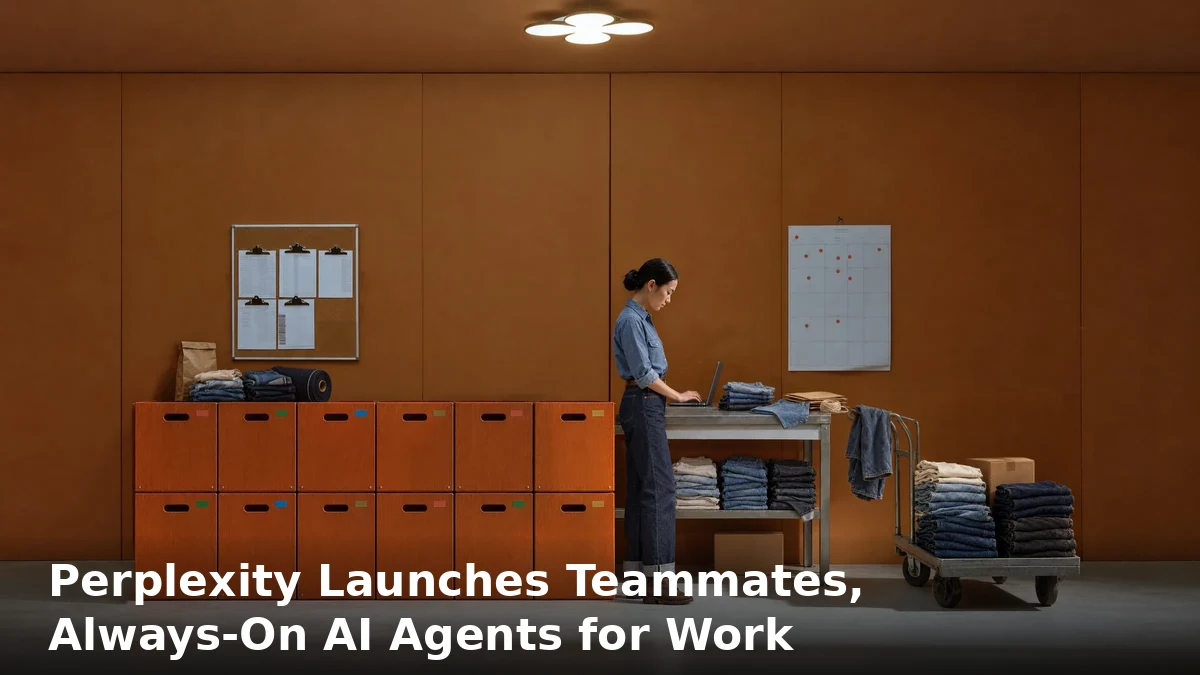
Perplexity has launched Teammates, a set of always-on AI agents designed to take on ongoing work inside a shared workspace, the company announced on November 5. The launch puts Perplexity in direct competition with OpenAI’s Dots and Anthropic’s Claude Duet, the rival products that also promise agents which keep working after the chat ends.
Unlike a chatbot that answers one question at a time, a Teammate is built to own a job over time. Perplexity says Teammates “plan and coordinate projects, switch gears as priorities change, and present results for review.” Each Teammate gets its own thread in the Perplexity app, so users can follow its progress, and colleagues can hand it work or ask for updates through Slack.
What Teammates can do
Teammates build on Perplexity Computer, the company’s system for deploying agents on a user’s device to complete tasks. Where Computer runs individual workflows, Teammates add collaboration and continuity: they draw on a user’s existing Projects, skills and memory, remember project goals and task history across runs, and keep working in the background without waiting for a fresh prompt.
Perplexity gives a concrete example. A sales Teammate notices when a regular customer stops transacting, reviews the customer’s order history and support issues, investigates what changed, and then prepares a relevant offer for approval or flags problems to fix first. An operations Teammate that is told an agency needs two weeks’ notice will factor that lead time into future project schedules. Teammates can also pass work to each other: one finds bugs on a website and hands its findings to another to prepare fixes.
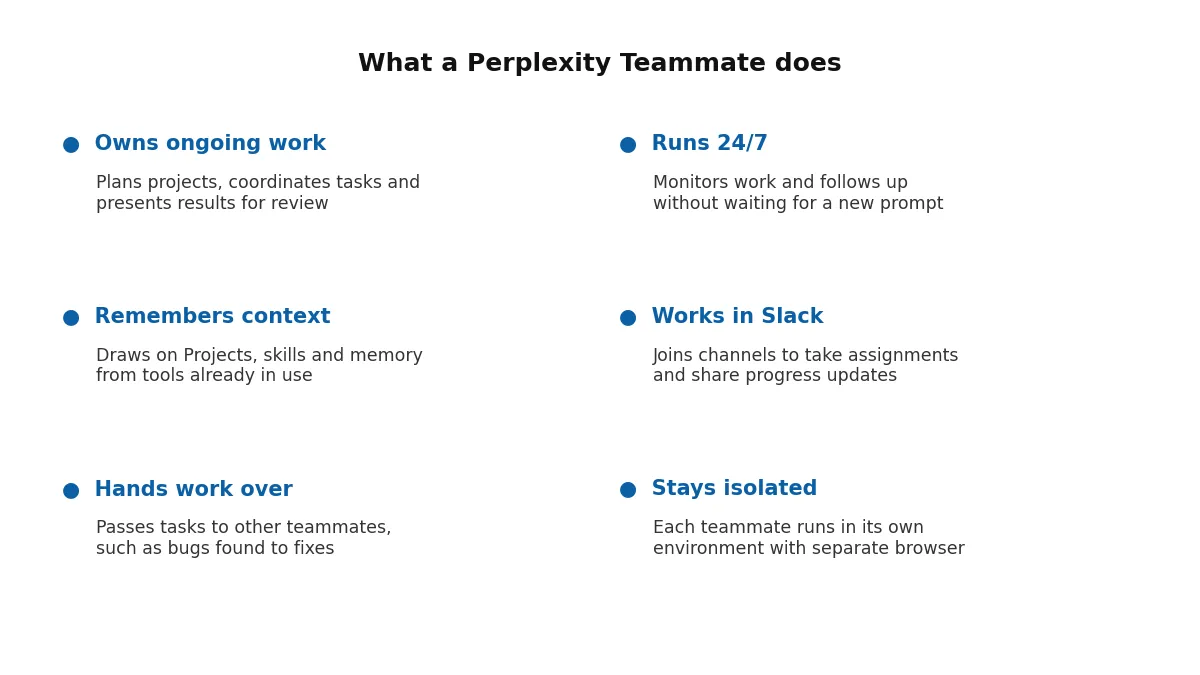
GPTOnline chart based on Perplexity’s announcement and The Verge’s report.
Built for teams, with guardrails
Teammates are designed to work across teams, not just for one person. Add a Teammate to a Slack channel and colleagues can hand it work directly. Each Teammate runs in a separate environment, with browser sessions kept apart from other Teammates, and saved credentials are encrypted and entered securely. Users can review completed work, take over the desktop, or redirect a Teammate while it works.
Perplexity pitches Teammates for work across the business: marketing, sales, customer support, operations and finance. A marketing Teammate manages social posts, email campaigns, ads and search engine optimization, and drafts fixes when results slip. A support Teammate reviews the previous day’s complaints, summarizes trends, and drafts replies for the cases that need a personal response.
Pricing and availability
Perplexity Teammates are available now on the web for subscribers to Perplexity’s Max plan, which costs $200 a month. Perplexity says Max subscribers get free Teammate usage for a promotional period. The feature is coming soon to iOS, with desktop apps to follow, and free and Pro subscribers must upgrade to Max to use it.
The price is the sharpest difference from its rivals. The Verge noted that Perplexity’s take is “much more expensive” than OpenAI’s Dots or Anthropic’s Claude Duet, because Teammates require the $200 a month Max subscription. That positions Teammates as a premium product for people and teams willing to pay top tier prices for an agent that keeps working around the clock.
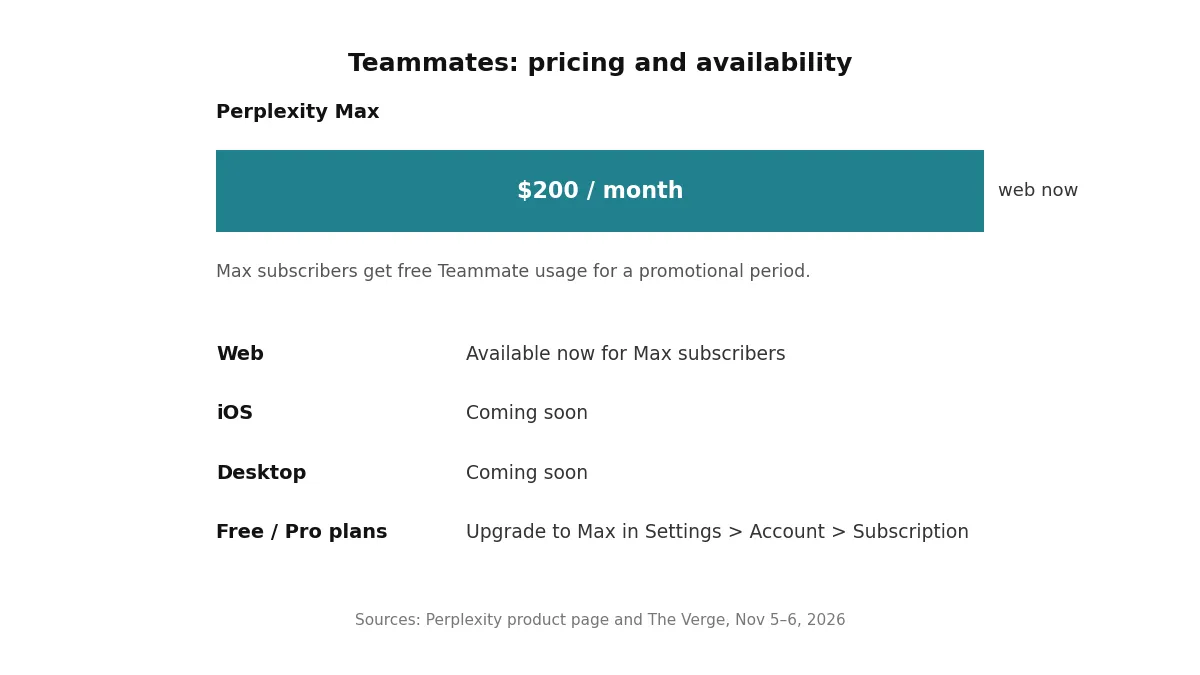
GPTOnline chart based on Perplexity’s product page and The Verge.
The bigger bet
Perplexity chief executive Aravind Srinivas announced Teammates on X, writing that the agents “change the paradigm from writing prompts in a session to giving high-level goals.” He framed the ambition in much larger terms: “Over time, we envision every org having hundreds of teammates working for each person.”
The bet is that the next phase of AI at work is not a smarter chat box, but a staff of persistent agents that hold context, remember what happened last week, and keep a project moving while people do other things. Perplexity is not alone in that bet, which is exactly why the launch matters: the three leading AI labs now each have a persistent agent product, and the competition will be decided by which one actually sustains multi-step work without constant supervision.
Why it matters
Teammates arrive as AI agents move from demos to budget lines. The question for buyers is no longer whether an agent can draft an email, but whether it can own a workflow for days or weeks, remember the context, and know when to ask a human to decide. Perplexity’s answer leans on its Computer system and on continuity: a Teammate starts with the context already sitting in a customer’s workspace rather than from a blank slate.
What to watch next is the rollout to iOS and desktop, whether enterprise access follows, and whether early users find that Teammates finish real work or simply create more threads to check. At $200 a month, the product will be judged quickly, and Perplexity knows it.