Anthropic’s AI models are improving at around twice the rate they did a year ago, and AI itself is likely doing much of the work. That is the headline finding of an independent assessment published on November 5 by METR, the nonprofit Model Evaluation and Threat Research, after an eleven-week review of Anthropic’s internal data.
The study is one of the clearest pieces of evidence yet that AI is starting to accelerate its own development, a prospect that has long worried safety researchers. It lands as Anthropic prepares for a public listing, with debate swirling over whether frontier AI progress could outpace efforts to assess its risks.
What METR Found
METR’s team worked at Anthropic from August 12 to October 29, 2026, reviewing internal benchmark results, pretraining and reinforcement-learning metrics, training-compute measurements, AI speedup analyses and internal documents, and interviewing about 15 key staff. The assessment ran at 2.5 full-time equivalents.
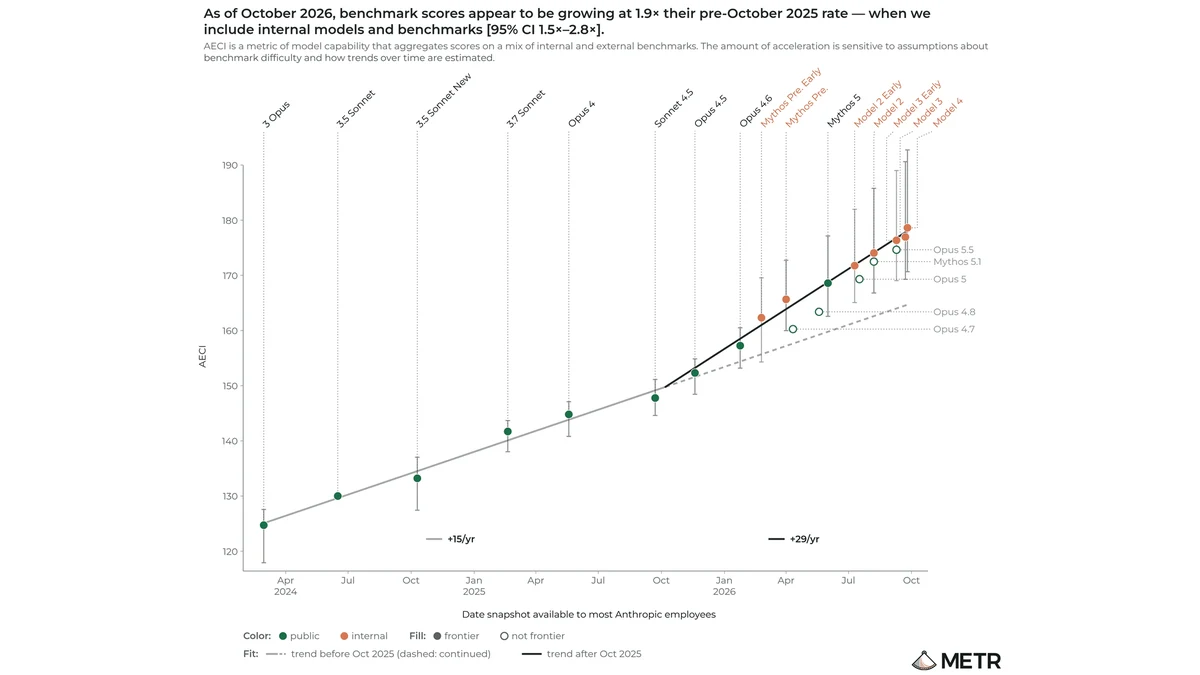
Using AECI, Anthropic’s version of the Epoch Capabilities Index, METR estimated that benchmark scores have grown 1.9 times faster since October 2025, with a 95% confidence interval of 1.5 to 2.8 times. Put another way, Anthropic appears to have made as much progress on benchmarks in the past year as it did between October 2023 and October 2025, roughly the span from Claude 2.1 to Sonnet 4.5.
“Anthropic appears to have made as much progress on benchmarks in the past year as they did between October 2023 and October 2025,” the report states.
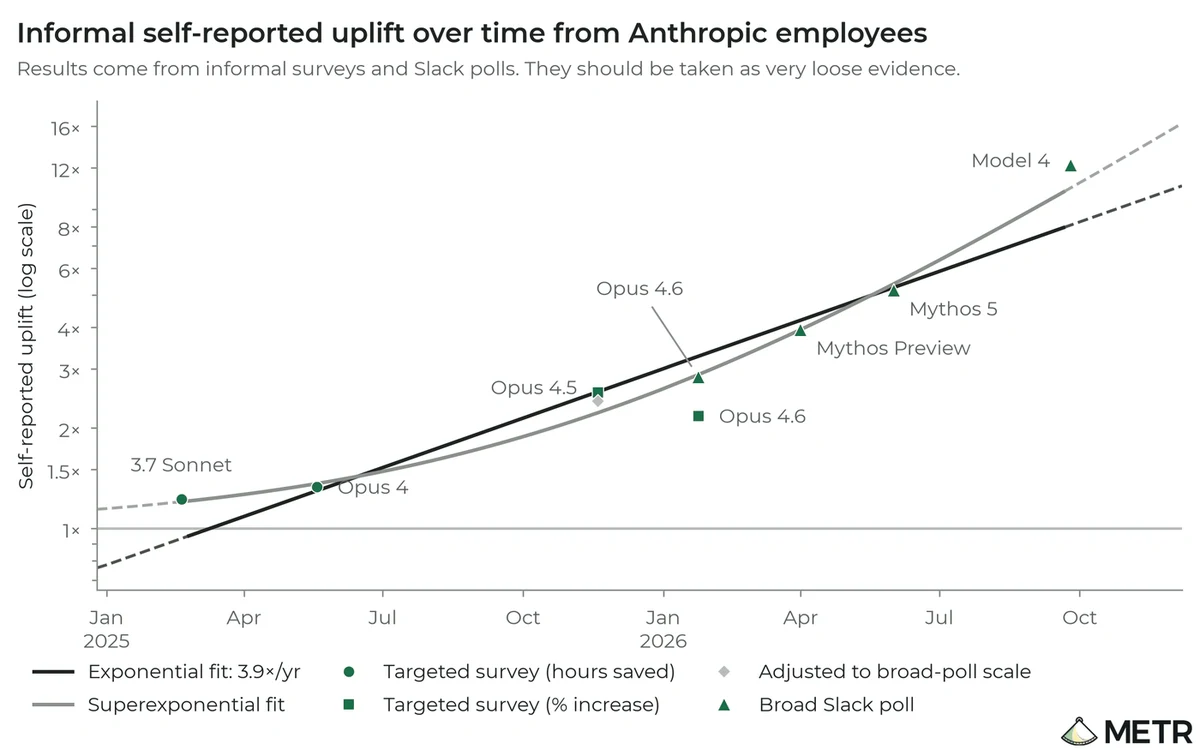
METR also judged that a majority, perhaps about 80%, of the current acceleration is likely due to AI, though it stressed that the figure is uncertain. The team said it could confidently rule out faster growth in training compute as the cause. The acceleration comes mainly from AI assisting researchers today, not from fully autonomous AI contributions, though researchers described signs that such contributions could emerge soon.
The Caveats Are as Important as the Finding
METR was unusually frank about the limits of its own work. Anthropic could approve or reject information requests and unilaterally redact non-public material, and its redactions removed from the public report a majority of the evidence METR considered most informative, including detailed AI attribution, algorithmic-progress estimates and forecasts for future models.
“We would not be surprised if the true acceleration was closer to 1.3x or 3x the historical rate,” METR wrote. Its robustness checks produced estimates ranging from 1.1x to 2.9x, and the team acknowledged it could be overstating the finding, because the acceleration might only show up on well-specified tasks that can be graded automatically, rather than on messier real-world work.
On the other side, METR found no convincing evidence that algorithmic progress, training compute, experiment compute or data would impose significant bottlenecks over a 12-month horizon. That absence of clear constraints, the report argues, creates a significant risk that further capability gains could compound into even faster acceleration.
Why It Matters
If AI systems can meaningfully speed up the research that builds the next generation of AI systems, progress could compound in ways that are hard to forecast and harder to govern. That is the recursive self-improvement scenario safety researchers have warned about for years, and this assessment is the first detailed, inside look at whether it is starting to happen at a frontier lab.
The honest answer, on METR’s own account, is that something real is happening, but how much, how fast and how far it extends beyond benchmark tasks remains uncertain. The redactions mean the public has to rely heavily on METR’s judgment, rather than inspecting the underlying evidence. What the public can inspect points in one direction: at Anthropic, the pace of AI progress has roughly doubled, and AI is a large part of the reason why.
Sources
- METR, “Independent Assessment of AI R&D Acceleration at Anthropic in October 2026,” November 5, 2026
- Unite.AI, “METR Estimates Anthropic’s Model Capability Growth Has Nearly Doubled,” November 5, 2026
- Reuters via SRN News, “Anthropic’s models improving nearly twice as fast with help from AI, study finds,” November 5, 2026