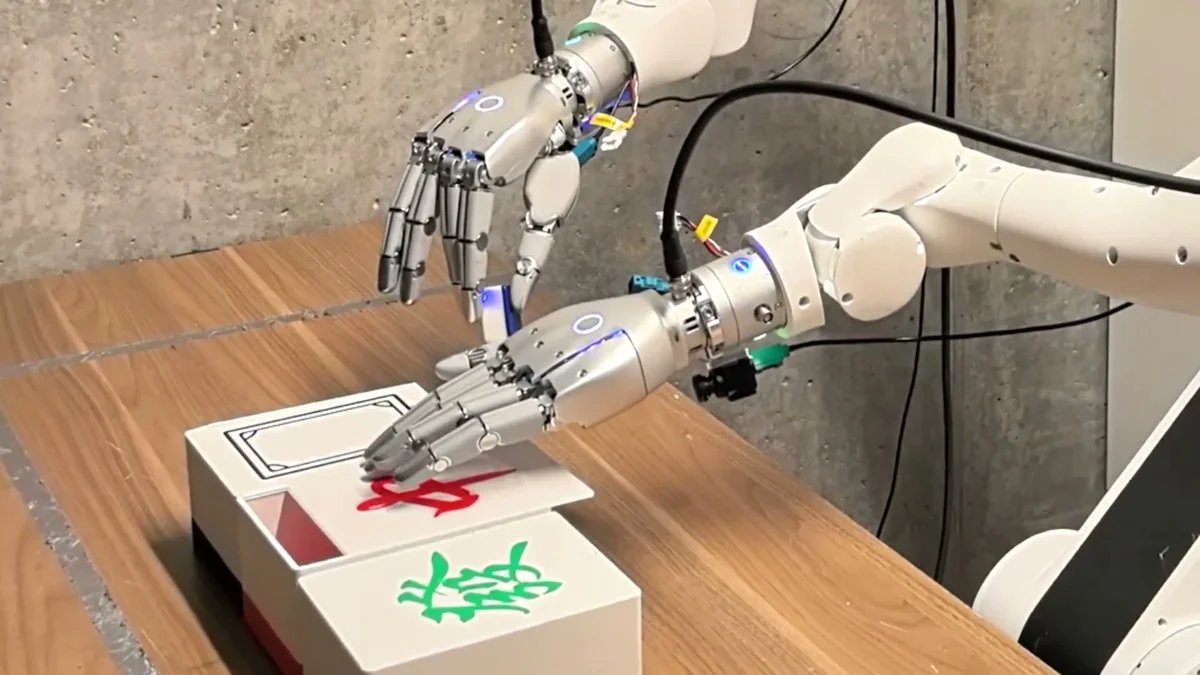
Robots that handle soft, fragile objects have long struggled with a simple human skill: feeling what their fingers are doing. Panasonic and a team of university and industry researchers say they have closed much of that gap. On November 5, 2026, Panasonic Holdings Corporation announced T-Rex, short for Tactile-Reactive Dexterous Manipulation, a robot manipulation AI that performs delicate two-handed tasks by reacting instantly to fingertip touch.
The system was developed by Panasonic Holdings and Panasonic R&D Company of America together with researchers from the University of California, Berkeley, NVIDIA, Stanford University, Sapienza University of Rome and ItalAI. The results will be presented at the Conference on Robot Learning (CoRL) in Austin, Texas, from November 9 to 12, 2026.
Touch as a Real-Time Correction Signal
T-Rex builds on a vision-language-action (VLA) model, which generates robot actions from camera images and natural-language instructions. The difference is that fingertip tactile information is integrated into the model as a live signal, not treated as static input. A motion-generation module processes vision and language at about 5 Hz, while a tactile action-correction module runs at about 20 Hz, fine-tuning each movement as contact conditions change, without rerunning high-latency image recognition.
“T-Rex integrates fingertip tactile information into a VLA (Vision-Language-Action) model, which generates robot actions from visual and language information, and corrects its actions in real time as contact conditions change,” Panasonic said in its announcement.
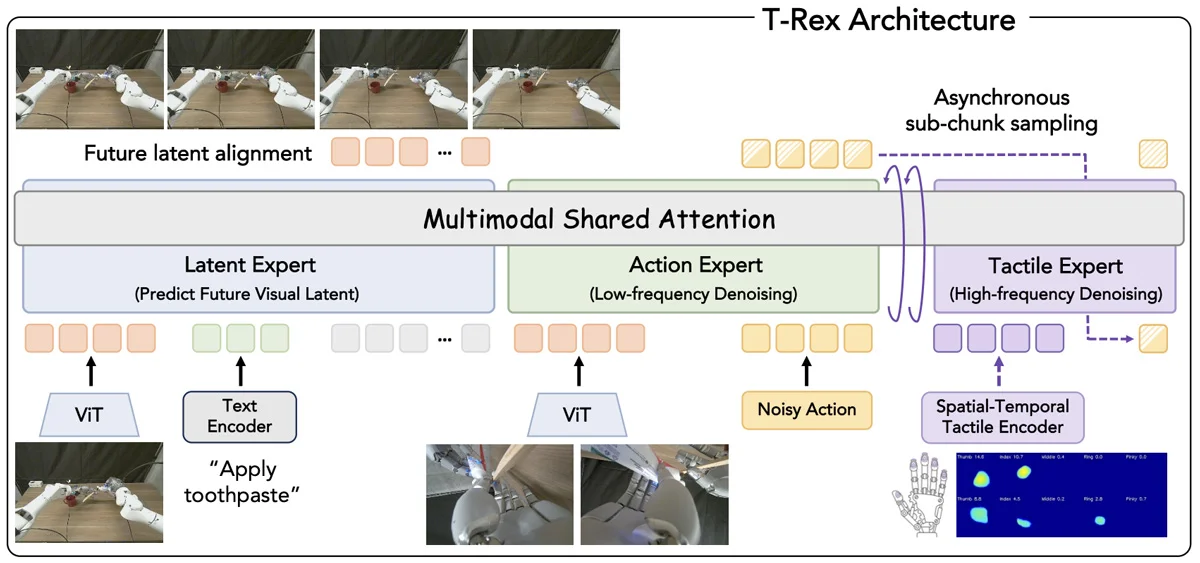
The T-Rex model architecture: low-frequency action generation complemented by high-frequency tactile correction. Image: Panasonic
100 Hours of Touch-Rich Training Data
The team collected more than 7,700 episodes, totaling 100 hours, of two-handed robot manipulation data, combining 207 types of everyday household objects with 22 motor primitives. Each episode synchronously records head and wrist camera video, robot states and actions, force and deformation data from tactile sensors on 10 fingertips, and natural-language instructions. The model first learned broad visual and motion knowledge from 22,889 hours of human egocentric video, then learned contact-rich behavior from the tactile data, and was finally fine-tuned with about 100 demonstrations per task.
The test platform is a two-armed Dexmate Vega-1 robot with two dexterous Sharpa Wave hands, each carrying five fingertip tactile sensors.
Results: 65 Percent Across 12 Real-World Tasks
Across 12 real-world tasks requiring delicate force control and handling of soft objects, the T-Rex robot achieved an average success rate of 65 percent, outperforming the best previous baseline by 30 percentage points. That baseline, EgoScale, scored 35 percent. Without tactile information, T-Rex’s own success rate fell to 42 percent, confirming that the touch signal, not just the model size, drives the gain.
The individual results show where the system is strongest and where it still struggles. Flipping a page succeeded 96 percent of the time, transferring an egg 75 percent, and extracting a card 70 percent. At the other end, screwing in a light bulb succeeded only 35 percent of the time, and refilling a tablet 41 percent. The remaining tasks, including wiping a plate, applying paste, sorting mahjong tiles and opening a lock with a key, fell between 47 and 78 percent.
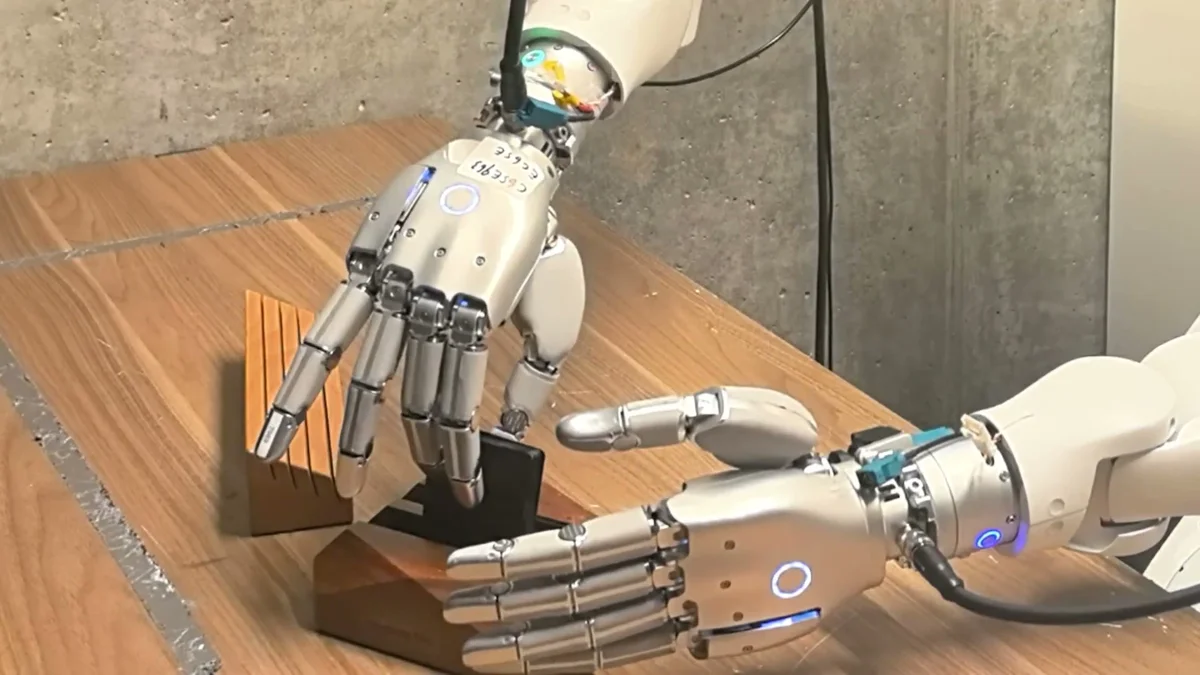
T-Rex extracting a card, one of 12 real-world tasks. Image: T-Rex project (Panasonic, UC Berkeley, NVIDIA, Stanford)
Why It Matters
Dexterous manipulation is one of the main barriers between warehouse robots and robots that can work in homes, factories and logistics lines, where objects are soft, fragile or oddly shaped. A system that can feel slippage and adjust in real time is a step toward robots that handle the fiddly work now left to people, from inserting components on an assembly line to handling delicate goods. T-Rex is still a research system, and a 65 percent average means it fails about a third of the time, but the 30-point jump over the previous best shows that touch, fed back fast enough, is a large part of the answer.