DeepSeek Super-agent, the company’s new open-source coding agent built by its Harness team, launched on October 31 in a release that Bloomberg framed as a direct challenge to Anthropic’s Claude Code. The prototype sits inside a team’s GitHub repository and work chats, picks up coding problems on its own, and turns them into pull requests with minimal human involvement.
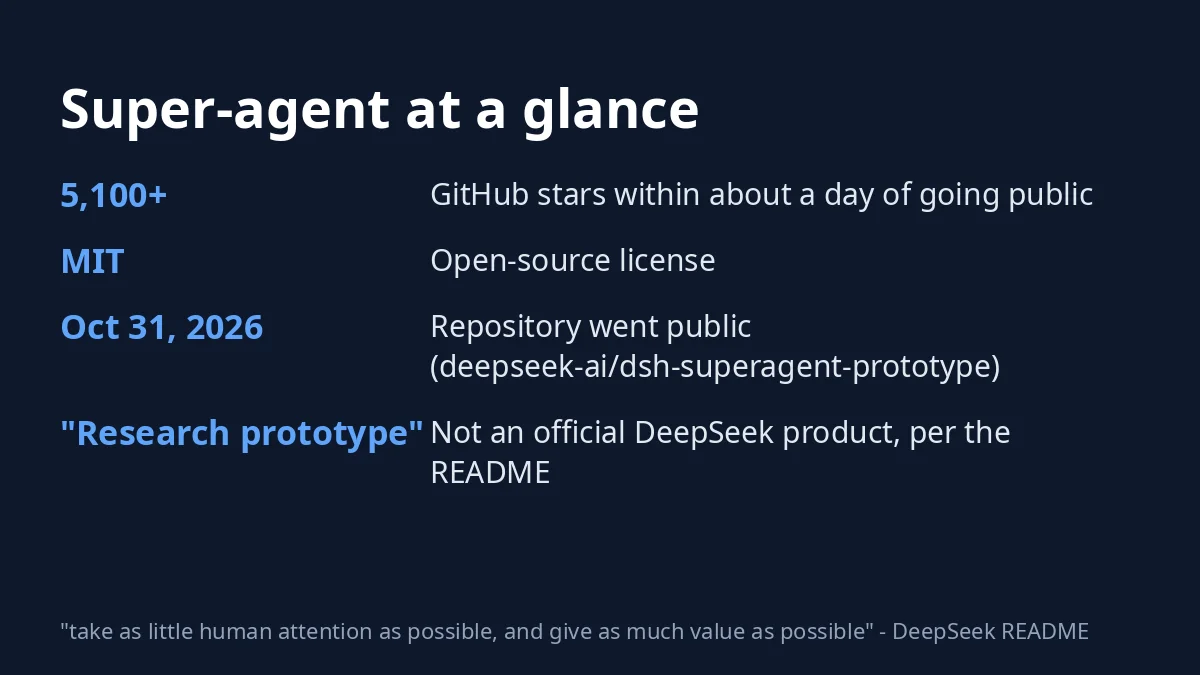
The DeepSeek Harness team announced the release on its official WeChat account on the evening of October 31 (Beijing time), alongside a design essay titled “Super-agent Design Exploration: Towards More Autonomous Agent Systems”, and published the code under the MIT license. The repository, deepseek-ai/dsh-superagent-prototype, collected more than 5,000 stars and nearly 500 forks within about a day of going public, according to GitHub data checked on November 1.
What Was Announced?
Super-agent is described in its README as “a proactive coding agent for one GitHub repository”, packaged as a bundle for DeepSeek Harness, the company’s agent scaffolding. It listens to GitHub and, optionally, Feishu, ByteDance’s workplace chat app sold as Lark outside China. When an approved team member asks the agent for work, it opens a work item, handles it in its own agent session and working directory, and replies in the original conversation, for example with a pull request. A web panel shows what still needs a person.
The design principle, stated verbatim in the README, is to “take as little human attention as possible, and give as much value as possible.” DeepSeek says the agent acts only when asked or when a rule the team wrote allows it, and speaks only when someone must act or can use a result.
 Super-agent is built for development teams that live in GitHub and chat. (Photo: Joonspoon, CC BY-SA 4.0, via Wikimedia Commons)
Key Details and Caveats
DeepSeek is careful about what this release is. The README calls it, verbatim, a “Research prototype for reference only, not an official DeepSeek product.” The company warns that it is “research code, not production-ready software” that “may still contain bugs”, notes that much of the engineering was done by coding agents, and says the published code “is not identical to our internal version or the implementation described in” the design essay.
The internal version described in the WeChat essay goes further than the public prototype: DeepSeek says its own instance reproduces and fixes bugs, responds to code reviews, and helps build DeepSeek Harness itself, reading feedback in public group chats and submitting pull requests with fixes without anyone tagging it. The released prototype is narrower, a single-repository agent that waits for approved requests, and the team flags several open design problems, including how to scale its two-layer router-and-worker architecture.
Setup is developer-grade: a dedicated GitHub user account for the agent, Node.js 22.19 or later, GitHub CLI 2.48 or later, and a model provider configured in DeepSeek Harness, with github.com supported but not GitHub Enterprise Server, according to early coverage of the documentation.
Why It Matters
The Harness team was formed earlier in 2026 with the specific goal of building agents that can compete with coding products from leading US labs, including Anthropic, Bloomberg reported. Super-agent is the first public demonstration of that effort, and it lands at a moment when coding agents are the hottest battleground in AI: developers are choosing between closed products like Claude Code and Codex and an expanding menu of open alternatives.
DeepSeek’s move also fits its established playbook. The Chinese lab has repeatedly released major work as open source, from its R1 reasoning model to its inference stack, and each release has forced incumbents to respond. More than 5,000 GitHub stars in about a day suggests developers are paying attention to this one too.
The honest caveats matter as much as the hype. This is not a finished product, it carries the security trade-offs of any agent that runs commands on a developer’s machine, and the autonomous behaviors described in the essay, agents acting in group chats without being summoned, raise governance questions teams will have to answer for themselves. But as a research artifact that anyone can inspect, fork, and test, Super-agent is one of the most interesting open agent releases of the year.
Sources
- deepseek-ai/dsh-superagent-prototype (GitHub repository and README)
- DeepSeek Harness (official product page)
- The Straits Times: DeepSeek launches Super-agent coding tool to rival Anthropic
- madrobot.blog: DeepSeek Super-agent, free coding agent that fixes bugs unasked
- shiftdelete.net: DeepSeek Coding Agent Super-agent Rivals Claude Code