Photo: HaeB / Wikimedia Commons (CC BY-SA 4.0). Graphic: GPTOnline.
OpenAI will start using session data from Daybreak Blue cybersecurity sessions to train its models on November 29, marking a reversal of its Daybreak Blue training policy that kept those sessions out of training entirely. The change was communicated by email to members of OpenAI’s Trusted Access program and first reported by The Decoder on October 31.
Until now, Daybreak Blue sessions sat outside OpenAI’s training pipeline even when members had turned the general “Improve the model for everyone” setting off. Under the new policy, that blanket exclusion ends for Daybreak sessions on personal accounts. After swift pushback from researchers, OpenAI sent a second email promising a separate opt-out for Daybreak sessions, but the timing, default state and scope of that control remain unpublished.
What Changed
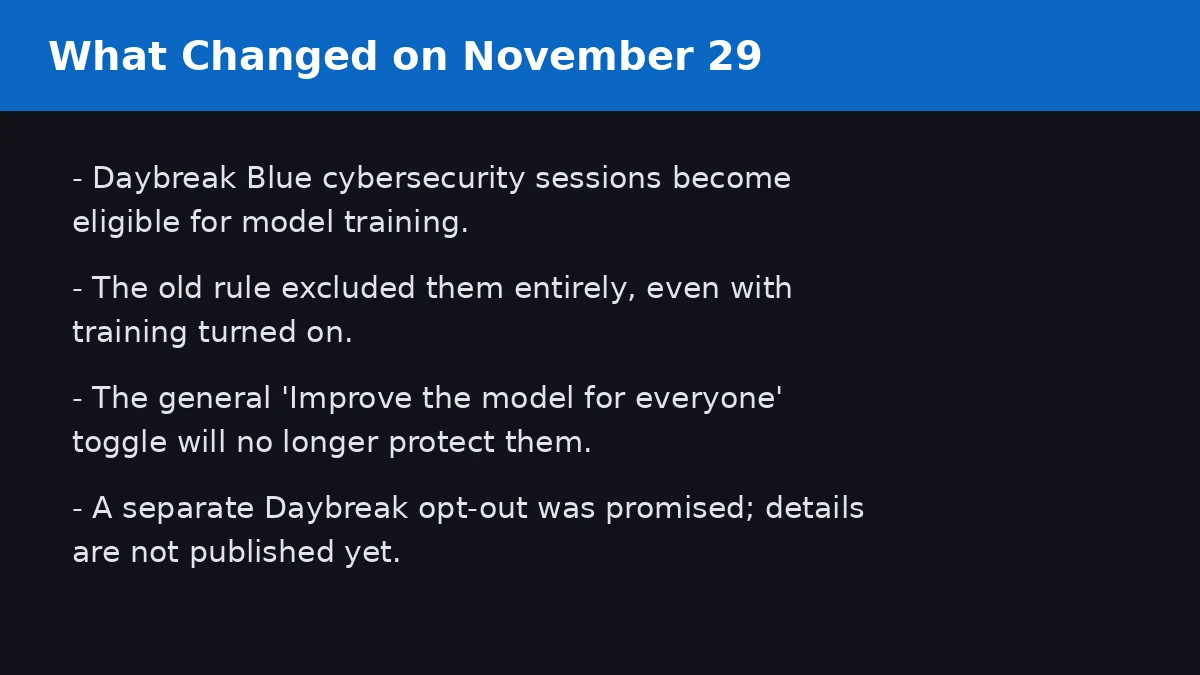
The core facts are consistent across multiple reports. “Starting November 29, OpenAI will use Daybreak Blue session data to train its models,” The Decoder wrote, citing an email shared publicly by Yoav Alon. His LinkedIn post states: “It turns out your Daybreak Blue research may soon become OpenAI’s training data. Even if you explicitly turned training off.”
OpenAI’s own updated data controls page now makes the exception explicit. According to a review of the page, OpenAI “may use content from Daybreak Blue cybersecurity sessions on personal accounts to improve its models, even when the account’s ‘Improve the model for everyone’ setting is turned off.” Activity outside those sessions continues to follow the user’s own setting, and inputs and outputs from Business, Enterprise, Edu and API Platform accounts are not used for training by default.
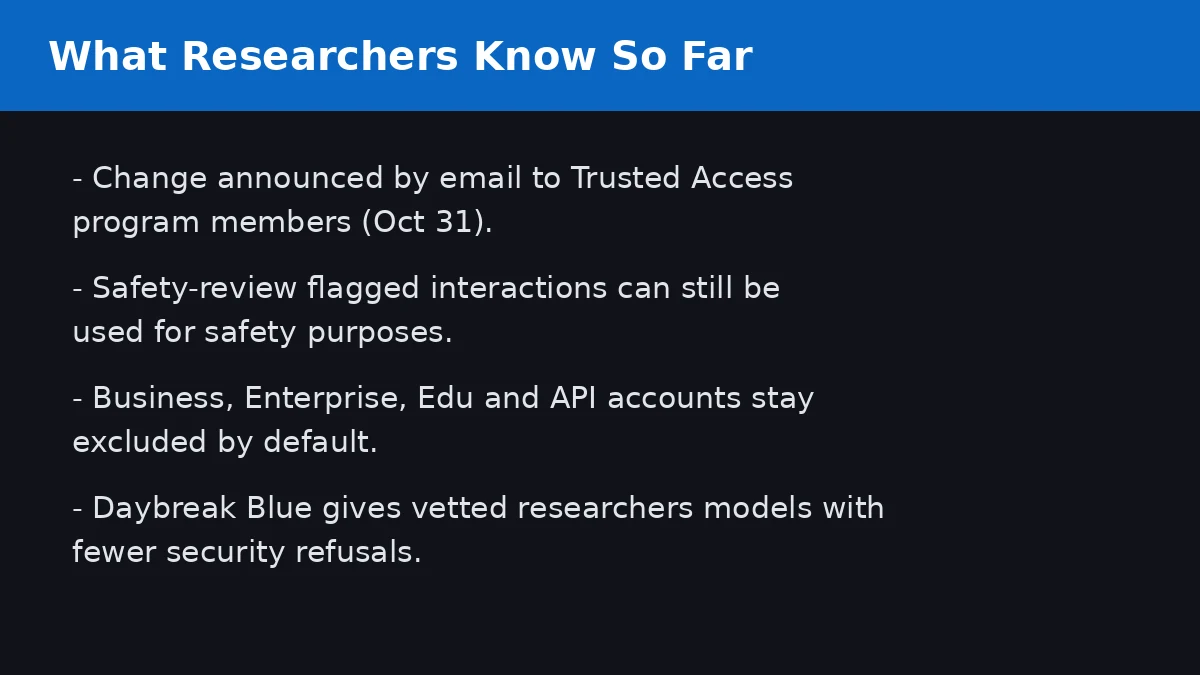
One important carve out remains: “Interactions flagged during safety reviews can still be used for safety purposes,” meaning that opting out of model training would not necessarily prevent all use of session data.
Backlash and the Promised Opt-Out
The reaction from the security research community was immediate. Security researcher Sean Heelan published a critical post on X that drew more than 600 likes and around 100 reposts, characterizing the move as taking researchers’ private work and predicting it would reduce Daybreak usage. Within days, OpenAI followed up with a second email promising a dedicated opt-out mechanism for Daybreak sessions.
What the opt-out will look like is still unknown. As TechProlonged noted, nothing published so far says when the control will appear, what its default will be, or whether it must be switched on by each user. The announced date is November 29; the announcement itself does not name the year.
Why Researchers Are Worried
Daybreak Blue is the security focused tier of OpenAI’s Trusted Access for Cyber program. It gives vetted security researchers access to models with fewer refusals on defensive security work such as vulnerability triage, secure code review and incident response. The sessions routinely contain exactly the material researchers cannot afford to expose: unpublished vulnerability details, exploit chains, server logs and client system layouts.
Researchers are also recalling an earlier dispute. Mathematicians Tristan Buckmaster and Levent Alpoge uploaded drafts about the Navier-Stokes equations to OpenAI’s Codex; OpenAI later presented its own proof and denied using their inputs for training. The denial did not dispel the researchers’ suspicion, and as The Decoder put it, the suspicion alone was enough to show researchers what could go wrong.
What Remains Unknown
Several questions are still open: the exact design and default of the promised Daybreak opt-out, whether it covers sessions that occurred before November 29, and how safety review use will interact with the new training pipeline. The change applies to personal accounts in the Trusted Access program; managed workspaces keep their existing protections. Researchers who paste sensitive material into Daybreak sessions should assume the training boundary moves on November 29 unless the promised opt-out arrives first.
Sources
- The Decoder: OpenAI plans to train models on Daybreak Blue cybersecurity session data that was previously off-limits (October 31, 2026)
- Abijita: OpenAI Daybreak Blue Sessions May Be Used for Training (November 1, 2026)
- AI Daily Post: OpenAI Starts Training on Daybreak Blue Data (October 31, 2026)
- Oossa: OpenAI plans to train on Daybreak Blue session data (October 31, 2026)
- TechProlonged: OpenAI to use Daybreak Blue sessions for training from 29 November (October 31, 2026)
- Archynewsy: Researchers React to OpenAI Using Daybreak Blue Data for Training (October 31, 2026)