Factory has released Droid 1.0, the largest update yet to the agent harness behind its enterprise coding platform. Announced in a research post on October 29, the release makes programmatic tool calling the default mode of operation: instead of firing off tool calls one by one and waiting for each result, the model writes a JavaScript program that runs hundreds of tool calls in a single model request. Factory says the release is available now.
“Today, we introduce Droid 1.0: more accurate, efficient, and faster than ever before, powered by new design principles and a programmatic tool-calling engine.”
What Is Programmatic Tool Calling?
Factory defines an agent harness as everything around the model: the prompts, the tools, how tool results come back, and the loop that runs it all. As Factory puts it: “Droid is our agent harness. An agent harness is everything around the model: the prompts, the tools, how tool results come back, and the loop that runs it all.”
In a standard agent loop, every tool output lands in the model’s context. Programmatic tool calling (PTC) takes a different approach to long-horizon work: the agent writes a program that invokes the tools. Droid 1.0 implements PTC as a Script tool, and Factory describes the mechanism plainly: “The model writes JavaScript that runs in a sandbox with no file, network, or system access of its own.”
Raw files, search results, and logs stay inside the program as variables, and only the printed output returns to the model. Calls that do not depend on each other run concurrently, so a batch takes as long as its slowest call. Factory gives three reasons for making PTC the default: it keeps the model’s context window clean, it cuts the number of model requests, and it makes the agent more reliable because checks and loops run deterministically in code.
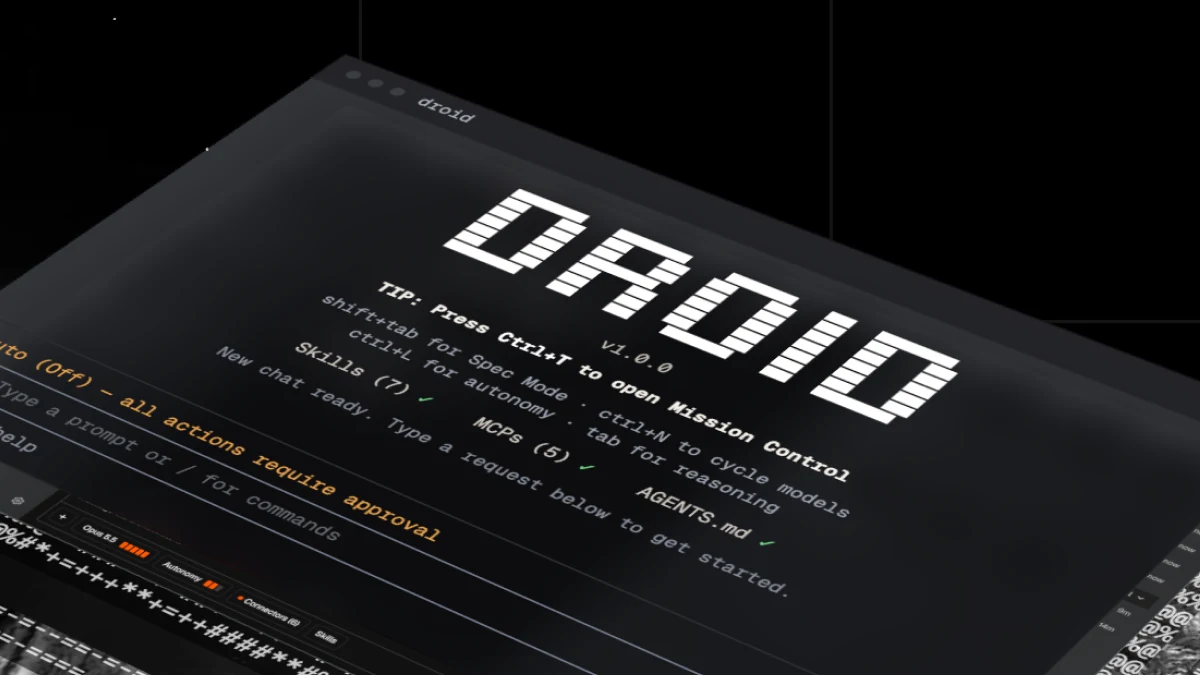
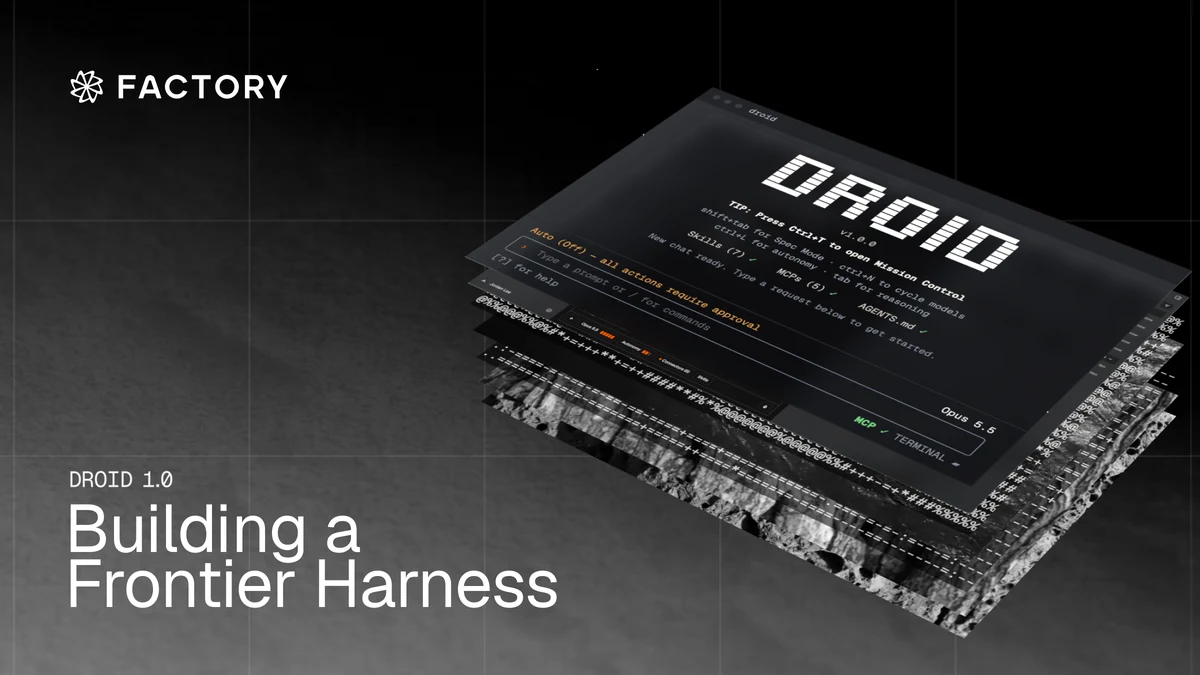
The Droid 1.0 terminal interface. Image: Factory
Benchmark Claims, With a Caveat
Every performance figure below comes from Factory’s own tests, run on Terminal-Bench 4 between October 23 and 28, with three trials per task and each harness tested on the same model. No independent verification is available yet, but Factory published its full methodology alongside the results.
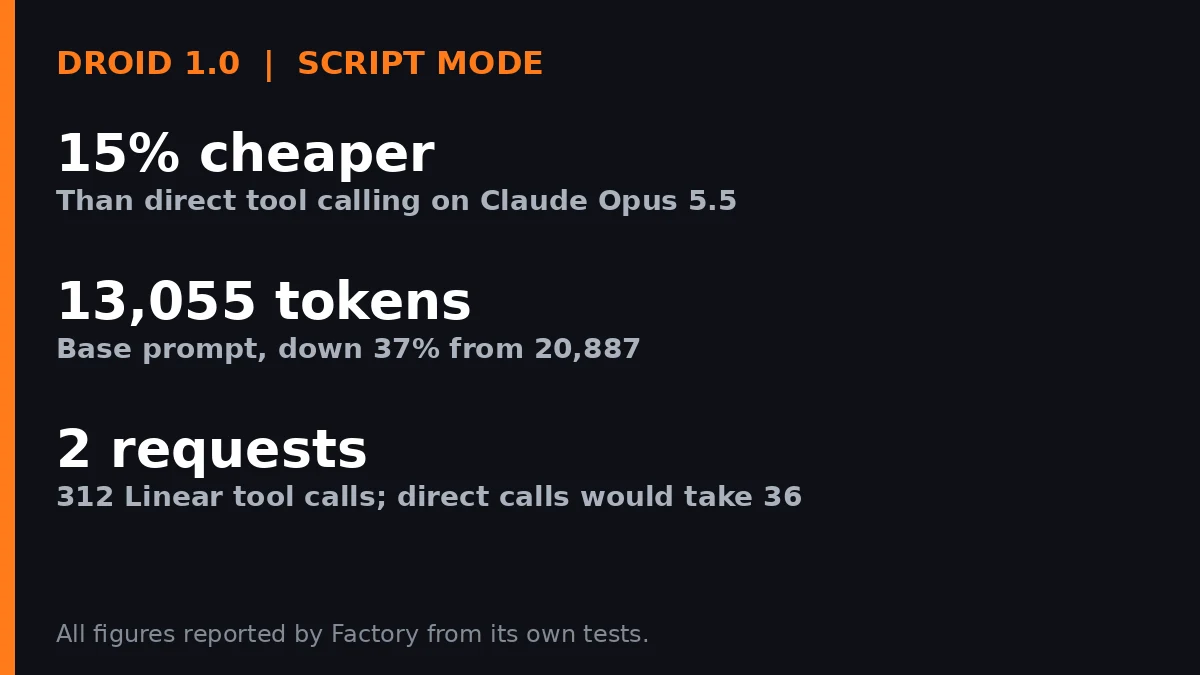
With GPT-6.1 Sol, Factory reports Droid scoring 3.5 points higher than Codex at 12% lower cost, and 6.6 to 12.6 points higher than OpenCode and Devin. With Claude Opus 5.5, it claims 3.0 to 7.6 points higher than Cursor, OpenCode, Devin, and Claude Code, at up to 24% lower cost. Script mode alone cut costs by 15% compared with direct tool calling on Claude Opus 5.5.
Graphic: GPTOnline, based on figures reported by Factory.
On speed, Factory says Droid takes 26% less time per passed task than Claude Code on Opus 5.5 while using 17% fewer tokens. On GPT-6.1 Sol it uses 12% fewer tokens than Codex, while taking 10% longer. A concrete production example: a Linear cleanup that moved 151 issues between queues and verified each move, 312 tool calls in all, took 2 requests and about 61,000 tokens with a Script, versus an estimated 36 requests and 3.1 million input tokens with direct calls.
A Leaner Harness
Beyond programmatic tool calling, Factory cut the base prompt from 20,887 to 13,055 input tokens, a 37% reduction, and now sends only 2 tool definitions up front instead of 11. Newly discovered tools are appended to the end of each request so the cached prefix stays intact; in production, the typical request reads 98% of its input from the cache.
Launch latency fell sharply as well. Between the August 25 and October 20 releases, median time to first paint dropped from 1,839 to 488 milliseconds, time until Droid accepted a prompt fell from 1,876 to 618 milliseconds, and median quit time in production fell from 648 to 30 milliseconds.
Droid also gained bounded-autonomy rules: three turns in a row with no visible output stops the loop, three identical tool calls trigger a nudge, and six stop it. Long-running work can move to the background while the model keeps working, and Droid wakes it when the work finishes.
Availability
Factory Droid 1.0 is available now as a desktop app for macOS and Windows and as a terminal UI, plus the @factory/droid-sdk Node SDK for building on the same harness. Factory is model-independent by design: Script mode is on by default for GPT-6.1 Sol, GPT-6.1 Terra, GPT-6 Astra, GPT-6 Sol, GPT-5.6 Sol, Claude Fable 5.1, Claude Fable 5, Claude Opus 5.5, Claude Opus 5, and Kimi K3, and users can plug in their own API keys.
Why It Matters
The core idea has research lineage. CodeAct (Wang et al., 2024) showed that acting through code beats JSON and text tool calls across 17 models, and Factory notes that Cloudflare and Anthropic brought the idea to production in late 2025, with Codex bringing it to coding agents this year. Factory’s contribution is making it the default in a model-independent harness, and the company says much of the tuning was done by its internal “Agent Factory” loop, in which agents study benchmark failures and real user friction, propose changes, and test them across every model family, with engineers deciding what ships.
The deeper point is architectural: as agents run for hours or days across hundreds of turns, the harness around the model, not just the model itself, is becoming the place where cost and quality are won. Factory’s numbers are self-reported, so treat them as a vendor claim, but the direction is one the whole industry is moving toward.
Sources
- Factory, “Droid 1.0: Building a Frontier Harness” (primary source, published October 29, 2026)
- MarkTechPost: Meet Factory Droid 1.0
- AI Daily Post: Factory Droid 1.0 Uses Script Mode
- Daily AI Brief: Factory AI Releases Droid 1.0
- AlphaSignal: Factory’s Droid 1.0