The GitHub Octoverse 2026 report, published on October 28, puts a hard number on the biggest shift in software development this year: by September 2026, more than 40% of pull requests on the platform began with an AI agent’s first draft, up from just 17% in March. Agents started about 110 million pull requests in September alone, roughly six times the volume of March, as coding moved from human-written drafts to human-directed agents at planetary scale.
What Was Announced?
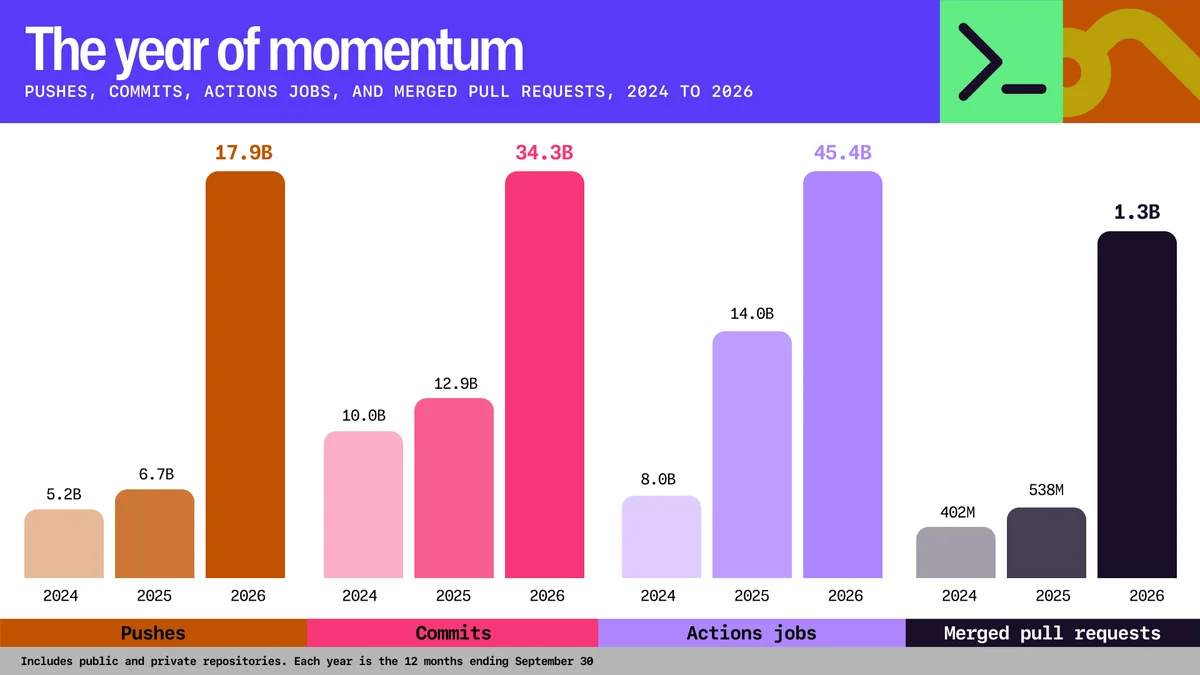
Octoverse 2026, GitHub’s annual state-of-the-platform report covering the year from October 1, 2025 to September 30, 2026, describes a developer ecosystem that grew faster than any previous year on record. Developers pushed code to GitHub 17.9 billion times in the 12 months, more than in 2024 and 2025 combined. Commits climbed to 34.3 billion, more than three times the total two years earlier, while merged pull requests tripled to 1.3 billion, an average of 3.5 million a day. GitHub Actions ran a job 1,440 times every second, or 124 million times a day, more than three times last year’s total.
The report was announced at GitHub’s Universe conference and counts activity across public and private repositories, serving a community GitHub says now exceeds 225 million developers. The United States (38.3 million) and India (32 million) remain the two largest communities, each adding more than 10 million developers this year, while Brazil added 3.28 million, the third most of any country.
Agents Go From Assistant to Author
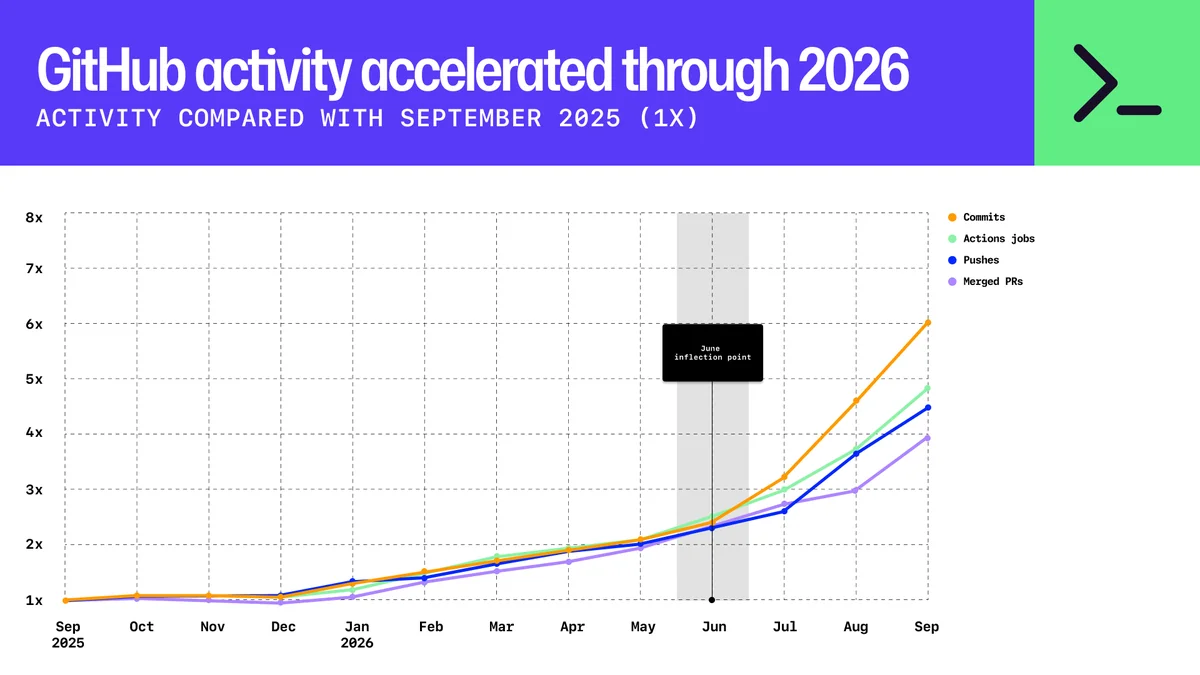
The centerpiece of the report is how quickly agents moved from experimentation to ownership of the first draft. “By September 2026, more than 40% of pull requests on GitHub started with an agent’s first draft, up from 17% in March. That is 110 million in September alone, about 6x March’s volume,” GitHub wrote in the official announcement.
Agent-authored work is not just more common, it looks different. About 87% of agent-started pull requests changed multiple files, compared with 79% of pull requests without detected agent involvement, suggesting agents take on broader refactors rather than single-file tweaks. They also land faster: in February, 83% of agent-involved pull requests merged within two weeks, slightly behind the roughly 86% for others; by September, agent pull requests had reached 90%, while the comparison group held at about 86%.
Adoption of agentic features is accelerating across the platform. Among GitHub Copilot’s monthly active users, 55% now use agentic features, up from 35% a year ago. Copilot cloud agent, where a developer assigns a task and an agent works on it independently, grew 230% year over year. Among repositories created this year, the average repo with an agent configuration file logged eight times as many commits as the average new repo without one.
GitHub’s own framing of the shift is blunt: “For a growing share of work, the first move is now directing an agent, and review is how developers shape what comes back.”
Model Choice Splinters, Review Becomes the Job
The report also shows developers becoming promiscuous with models rather than loyal. In September 2026, 61% of GitHub Copilot users who selected a model themselves used more than one model across their sessions, up from 50% four months earlier. Paid Copilot users touched 47 distinct models in September, up from 29 in May, and no single model carried more than 25% of requests. About 63% of paying users let Copilot pick the model at least once via auto model selection.
As agents write more of the code, review is becoming the core developer skill. Usage of stacked pull requests, which split related work into smaller changes for sequential review, reached more than 264,000 developers by September after a July 30 preview launch, while AI-assisted code review and GitHub Advanced Security both grew more than 90% year over year. Push protection, which screens for exposed secrets such as API keys and passwords, ran 5.8 billion scans this year, nearly four times 2025’s pace.
Public contributions soared to 2.5 billion in 2026, more than double last year’s 1.12 billion, and from June onward about 55% of all commits came from brand-new repositories, a sign the surge is driven by new projects rather than legacy codebases.
Why It Matters
Octoverse 2026 is the first annual report to measure the agent era at full scale, and the data undercuts two common assumptions. First, that agents are still a novelty: with 110 million agent-started pull requests in a single month and a 90% two-week merge rate, they are now the default starting point for a large share of professional software work. Second, that more generated code means more slop in review queues: agent-started pull requests merge faster and touch more files, though GitHub notes its agent signal only captures detectable use, so the real share is likely higher.
The language data adds nuance. TypeScript remains the most used language on GitHub, followed by Python and JavaScript, while Rust grew fastest by percentage, doubling in a year. TypeScript, Python, and Rust also show the highest AI involvement in merged pull requests, roughly 40% to 44%. Developers working with agents appear to gravitate toward languages where agent output is easier to check, and GitHub suggests that when the developer leaves the language choice open, agents favor a narrower set, TypeScript chief among them.
For all the automation, the report closes by stressing what has not changed: “None of that activity changes who decides what the code should do. Someone still has to come up with the idea.” What did change, GitHub writes, “is how much easier it is to take an idea from a weekend thought to something real.”
Sources
GitHub, Octoverse: Commits, pushes, reach new highs in 2026 as developers build with agents (October 28, 2026)
Developer Tech, GitHub says AI agents now start over 40% of pull requests
Automater, GitHub Octoverse 2026: 40%+ of Pull Requests Now Start With a Coding Agent