Mistral AI has released the open weights of Mistral Large 4, the 1-trillion-parameter flagship model it codenamed “Le Chonk”, positioning it as the best open-weight model for agentic coding and defensive cybersecurity. The release, announced October 29, 2026 on Mistral’s official blog, follows the model’s public preview earlier this month and lands squarely in the week’s battle over frontier coding and cyber models, one day after Google unveiled its closed Gemini 4 Carbon.
“We release the weights of Le Chonk, advancing the frontier of open models in agentic coding and cybersecurity,” Mistral wrote in the announcement. The company says three additional weeks of reinforcement learning after the preview drove major gains in coding and defensive security, with improvements still accelerating and “no signs of saturation.”
What Was Announced?
Mistral Large 4 is a natively multimodal, 1-trillion-parameter model trained from scratch on European infrastructure, a lineage Mistral highlights as a foundation for what it calls Sovereign AI: organizations can inspect, customize and deploy the model on their own infrastructure without depending on Mistral’s API.
The model ships with three reasoning modes so developers can trade performance against cost: Low for simple tasks (replacing the old “None” mode), Medium for everyday work, and High (the default) for the hardest cases requiring precision and thorough reasoning.
Availability is broad from day one: Mistral Studio, the Mistral API, OpenRouter, and the open weights on Hugging Face for self-hosting with vLLM or SGLang. It is also served through NVIDIA-hosted endpoints and as an NVIDIA NIM container, and Mistral’s own Vibe Code chatbot at chat.mistral.ai now runs the new model for building features and fixing bugs in users’ own repositories.
Benchmarks and Efficiency
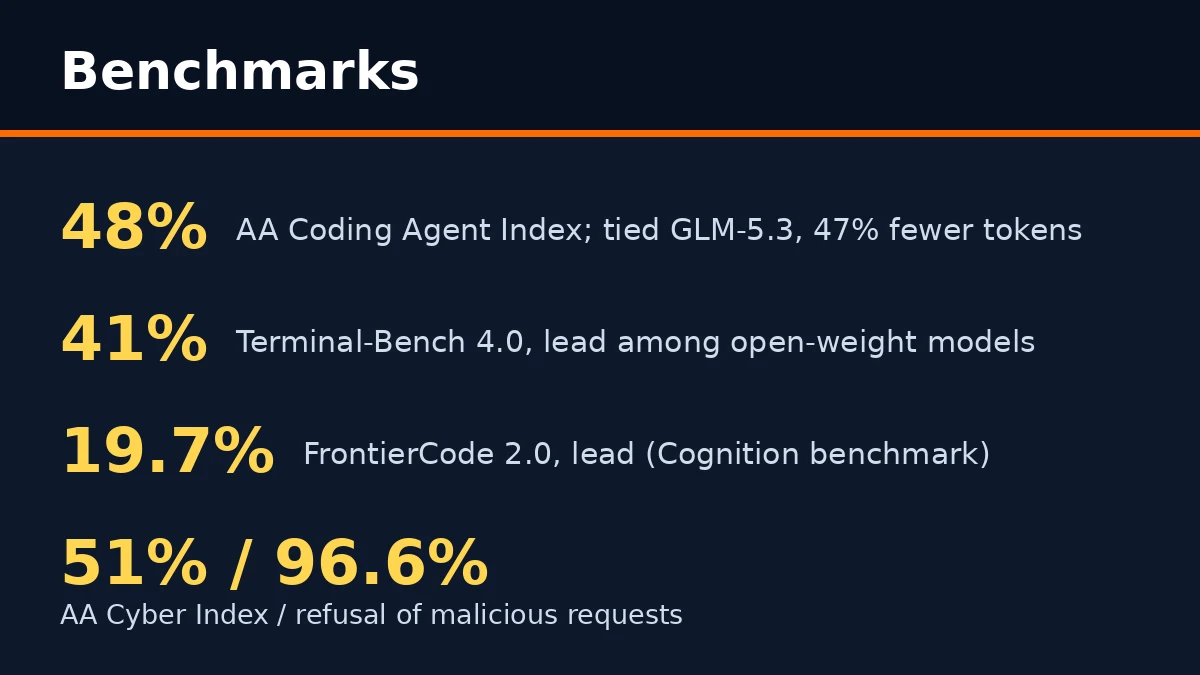
On coding, Mistral claims the open-weight lead. The model scores 48% on the Artificial Analysis Coding Agent Index, effectively tied with the leading open-weight model GLM-5.3 while using 47% fewer tokens per task on average. On Terminal-Bench 4.0 it improved 13 percentage points over its own preview to 41%, leading open-weight models with 30% fewer output tokens. On Cognition’s private FrontierCode 2.0 benchmark, which judges whether a maintainer would merge an agent’s change, Mistral Large 4 leads with 19.7%.
Human preference data backs the claim: in Surge Code’s blind pairwise evaluations, Mistral Large 4 was preferred over leading open-weight models including GLM-5.3, Kimi K3 and DeepSeek V4.1 Flash, ranking behind only Claude Opus 5.5 among all models evaluated.
On defensive cybersecurity, the model scores 51% on the Artificial Analysis Cyber Index, which measures vulnerability discovery, reproduction and patching without breaking existing functionality. Mistral says its guardrails distinguish defensive from malicious tasks: the model averages a 96.6% refusal rate on malicious cyber requests across JailbreakBench, StrongREJECT and AgentHarm, the highest it has measured among open models. Enterprise design partners such as Orange Cyberdefense get preview access to a specialized variant for penetration testing and red-teaming under vetting and contractual safeguards.
Beyond coding and cyber, Mistral reports 73.3% on the Finch finance benchmark (second only to Kimi K3 among open models), 84.5% on BrowseComp for web browsing, and 97.1% attack resistance on the B3 Agent Security Benchmark, up from 93.3% in the preview.
Pricing, Availability and License
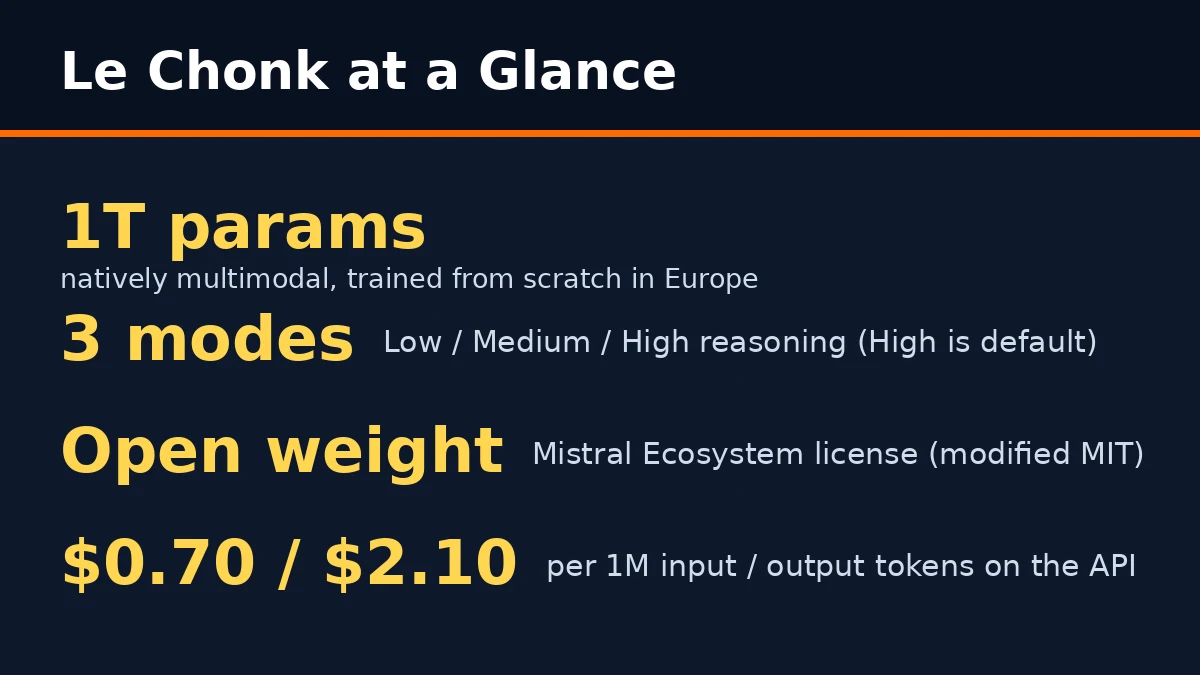
API pricing starts today at $0.70 per million input tokens, $0.07 per million cached input tokens, and $2.10 per million output tokens. The model is released under the Mistral Ecosystem Open-Weight license, a modified MIT license: it is free to use, modify, fine-tune and commercialize, with one condition, businesses running a Model-as-a-Service offering must obtain a separate commercial license from Mistral.
Microsoft is the first cloud provider to carry the model through Microsoft Foundry. “Microsoft and Mistral AI share a commitment to expanding customer choice in next-generation AI,” said Tina Schuchman, Corporate Vice President for Foundry at Microsoft. French public bank La Banque Postale, an existing Mistral partner, said technological sovereignty “is not optional” for it and that the open release “unlocks new opportunities and use cases.”
Why It Matters
The release sharpens a split that opened this week: Google’s Gemini 4 Carbon, announced a day earlier, targets the same coding and cybersecurity frontier but stays closed, rolling out first to vetted defenders through the Fairwind Program. Mistral is betting the other direction, that the organizations most concerned about security and sovereignty want the weights themselves, on their own infrastructure, under their own control.
That argument gets a serious test now. A 1-trillion-parameter open model that leads open-weight coding benchmarks at nearly half the token cost of its closest rival is, at minimum, a pricing shock for every managed coding agent in the market. Whether it becomes the sovereign-AI standard Mistral describes will depend on what the community does with the weights, and Mistral is asking for exactly that: “Run your own evaluations, push its limits, and share your findings with us.”
Sources
- Mistral AI blog: Mistral Large 4 (Le Chonk) is now open weight (October 29, 2026)
- ZDNet: Mistral releases the weights for Mistral Large 4, or Le Chonk
- Mistral AI on Hugging Face (open weights download)