Rime has launched Prism, a speech-to-speech model that enterprises can fine-tune and run on their own infrastructure. Announced on October 28, 2026, Prism is pitched as the first composable speech-to-speech model, one that lets companies inspect and control what the model is about to say before it speaks. Rime says it “not only sounds like a human, it listens and acts like a human, too.”
The San Francisco voice AI company, founded in 2022 by veterans from Stanford and Amazon Alexa, says its platform already powers more than 100 million monthly interactions for customers including Mayo Clinic, Asurion, Upstart and Dialpad. Prism is its attempt to solve the tradeoff enterprises face with voice agents: the most capable models are black boxes, while the controllable ones lose the intelligence hidden in audio.
The Text Checkpoint
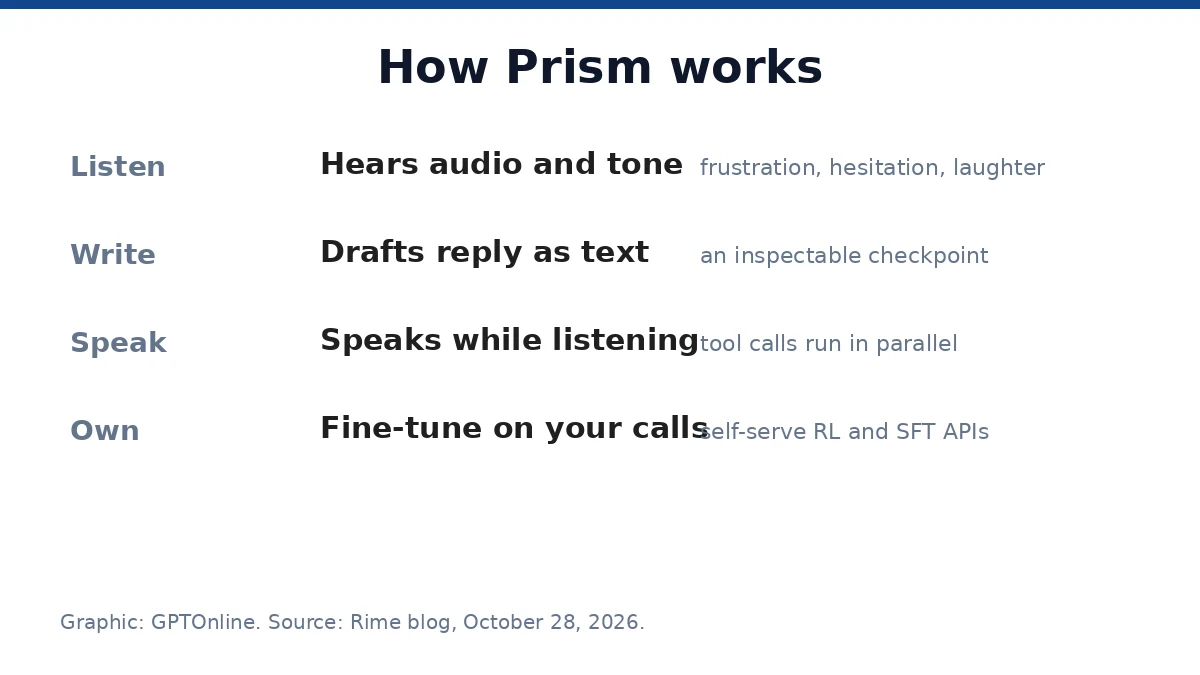
Prism is trained end-to-end as one system that does three jobs: it listens, it writes what it is going to say, and while it speaks, it is still hearing the user. The key design choice is that the text is a checkpoint. Rime explains that “the decision was made over the audio, your rules can read every word before it becomes speech, and the speech still carries the caller’s frustration, laughter, or the dog barking in the background.”
That checkpoint is where companies can apply their own policies and safety guardrails, keep an audit trail, customize vocabulary and pronunciation, and manage tool calls for composable agent flows. Because Prism generates text before speech, guardrails can check a response before it reaches a customer, and the text record makes calls reviewable afterward. Prism also recognizes conversational signals such as frustration, hesitation and confusion, and can use them when responding or routing a call.
Benchmarks Against the Big Labs
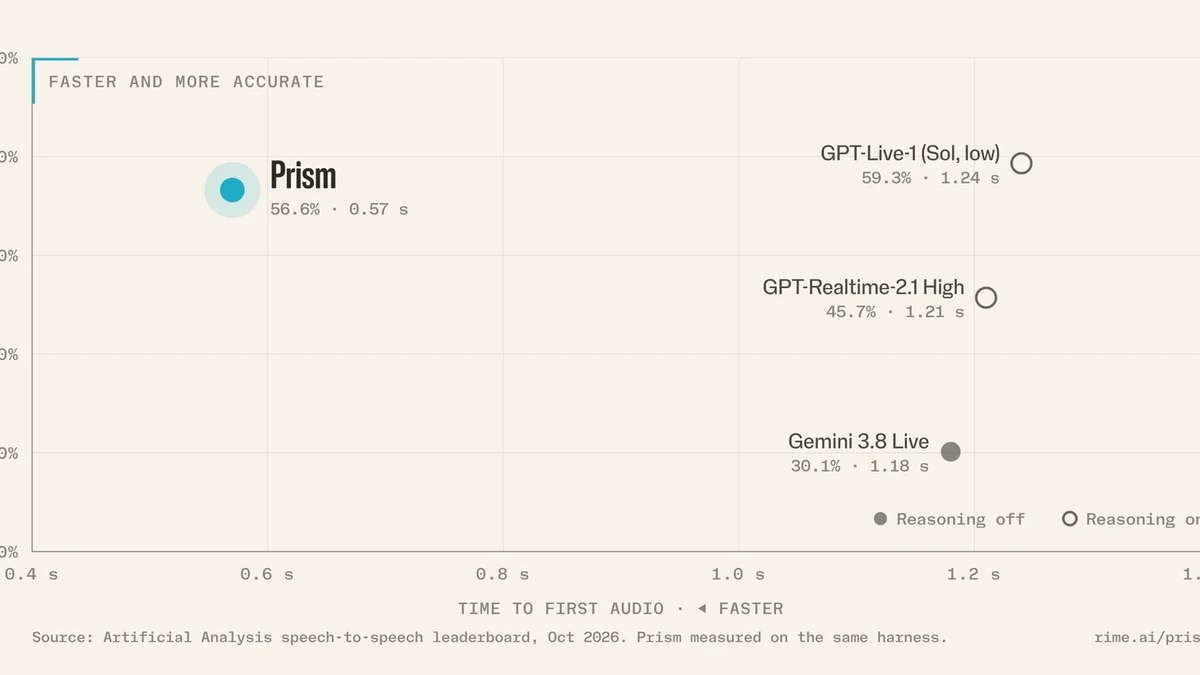
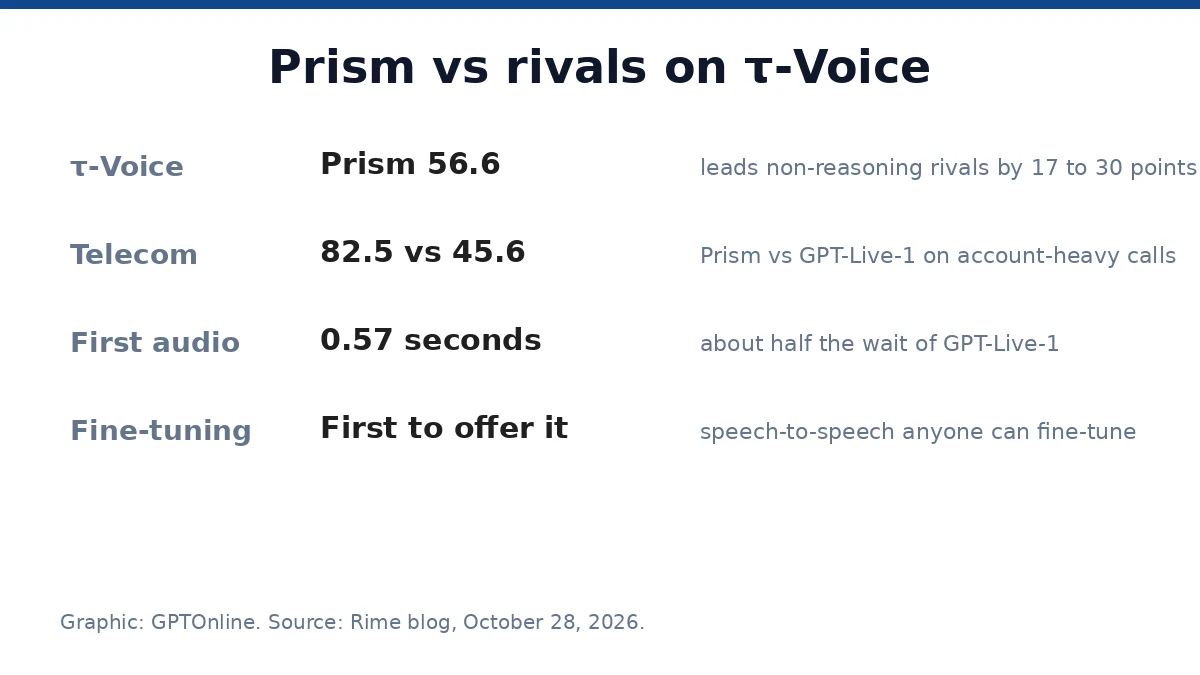
Rime put Prism on the same harness Artificial Analysis uses for its speech-to-speech leaderboard, running it the way it would run on a live call, with no reasoning step before it speaks. On τ-Voice, Artificial Analysis’s benchmark for voice agents, tool calling and instruction following on simulated customer-service calls, Prism scores 56.6, ahead of every realtime model from OpenAI and Google that is not reasoning-first, by 17 to 30 points, and ahead of GPT-Realtime-2.1 even with its reasoning turned up.
In telecom, the domain with the most account and phone numbers to get right, Prism scores 82.5 against 45.6 for GPT-Live-1. It also answers fast: 0.57 seconds to first audio, about half the wait of GPT-Live-1, GPT-Realtime-2.1 and Gemini 3.8 Live. The two models that score above Prism on τ-Voice get there by reasoning before they speak, and take 1.24 to 1.35 seconds to start talking.
Fine-Tuning and Ownership
Rime calls Prism the first speech-to-speech model anyone can fine-tune. With beta customers it is building self-serve reinforcement learning and supervised fine-tuning APIs for training and deploying a company’s own Prism, trained on that company’s conversations and terminology. The model can be deployed on-premises or in a private cloud, giving businesses control over customer data, latency, vocabulary and safety rules. Rime lists SOC 2 and HIPAA compliance, which matters for its healthcare customers.
Dialpad, a design partner from the start, plans to roll Prism out across its agentic products. “Dialpad has been a design partner on Prism from the start,” said Shezan Kazi, VP of AI Products at Dialpad. “We’re looking forward to rolling it out across our agentic products.”
Trial Results, With a Caveat
Rime also cites a trial with Revmo, which runs its ordering agent on OpenAI today. After training Prism on 10 hours of Revmo’s production calls, tool traces and transcripts, Rime says Prism asked before acting in 94% of orders, against 57% for the OpenAI model, and reports order confirmations of 100% against 68%, calls without hallucinations of 85% against 35%, and calls without dead air of 88% against 66%.
Those numbers come from Rime itself, and the company has not disclosed the trial size or methodology, so they should be read as vendor-reported results rather than independent verification. The τ-Voice scores, by contrast, come from a public third-party harness, which makes them the stronger evidence for Prism’s quality.
Availability and Why It Matters
Prism is available to try now at rime.ai/prism. For enterprise voice teams, the pitch is control without giving up quality: a model that hears tone and hesitation like the big labs’ models, but that can be inspected, tuned and run inside a company’s own walls. If the benchmarks hold up in production, Prism could become a serious alternative for customer service voice agents, a market where a wrong answer spoken aloud is harder to take back than a wrong answer in text. The open question is whether a startup founded in 2022 can support enterprise deployments at the scale its customers demand, and whether the fine-tuning tools arrive as promised.
“Eighteen months from now, voice agents built on the cascade will look like pale, ghastly imitations of agents built on Prism,” Rime’s Lily Clifford wrote in the launch post. It is a bold prediction. The benchmarks give it some weight, but production deployments will decide it.