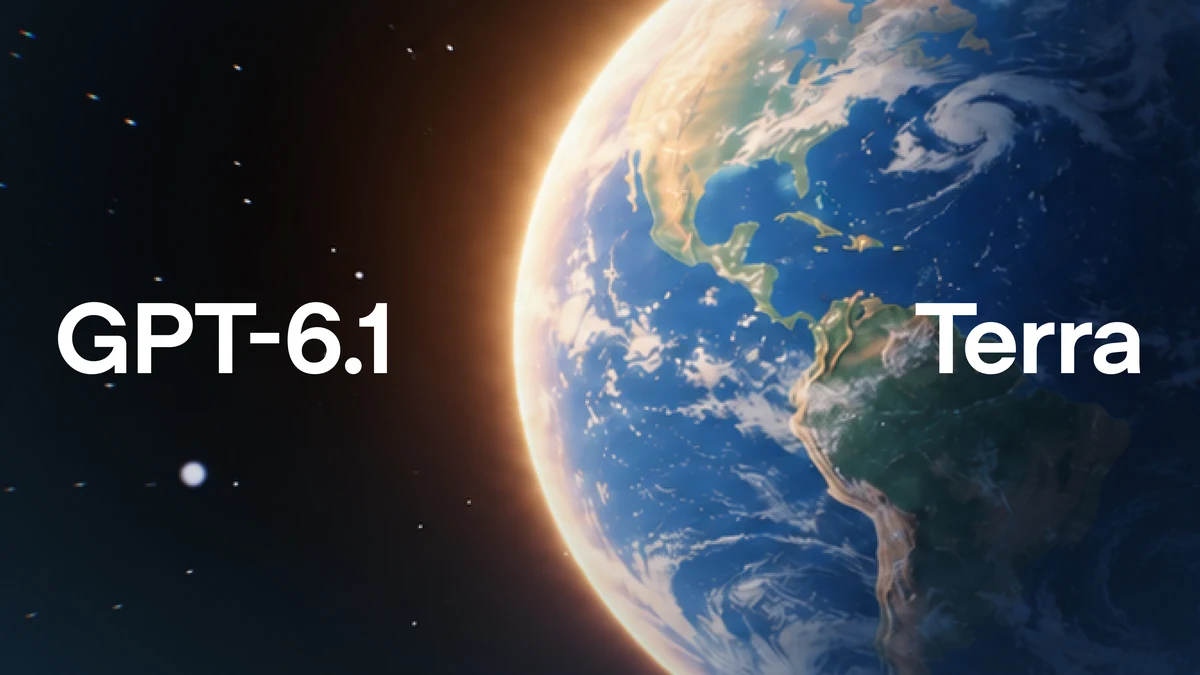
OpenAI released GPT-6.1 Terra on Monday, a new mid-tier model built for the everyday computer work that fills most office days, at half the price of the model it replaces. The launch, announced on October 26, positions Terra as the fast, affordable workhorse of OpenAI’s GPT-6 family, sitting between the lightweight Luna tier and the flagship Sol and Astra models.
“We’re introducing GPT-6.1 Terra, a fast, efficient model that combines detailed visual reasoning and precise computer use alongside clearer, more natural writing,” OpenAI said in its launch post. “A significant step up from GPT-5.6 Terra, it excels at the communication and computer-based tasks that fill the workday, from drafting proposals and interpreting technical drawings to filling out forms and editing videos.”
What Terra Is Built For
Terra is designed around computer use: an AI that can look at a screen, interpret what is on it, and click and type the way a person would. OpenAI pitches it for high-volume, repetitive work such as reading incoming invoices and entering their details into accounting software, as well as drafting proposals, reviewing technical drawings, and editing video.
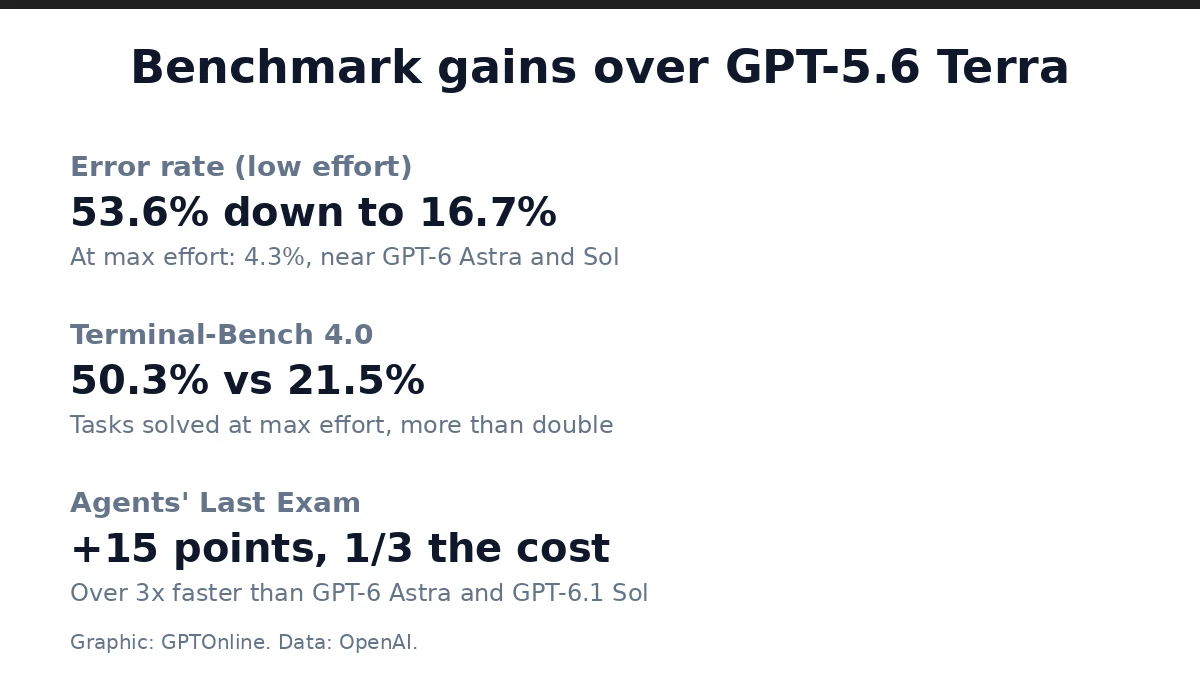
The model was measured on Agents’ Last Exam, a benchmark of professional tasks that includes turning architectural drawings into a 3D model and reviewing an animated film shot by shot. At medium reasoning effort, Terra scored 15 percentage points higher than GPT-5.6 Terra at about one-third the cost. “It even performs on par with GPT-6 Astra at only one-tenth its price per token,” OpenAI noted. Terra is also much quicker, the company said, completing tasks over three times faster than both GPT-6 Astra and GPT-6.1 Sol.
On MMMU-Pro, a visual reasoning benchmark, Terra outperforms GPT-5.6 Terra at every reasoning setting and nearly matches the scores of the company’s most capable models. On OSWorld 2.1, which tests how well agents use desktop apps to complete multistep tasks, Terra surpassed GPT-5.6 Terra’s best score at medium reasoning effort, at a fraction of the cost per task.
Fewer Errors, Stronger Coding
OpenAI says it invested heavily this year in reducing hallucinations and factual errors. On its internal benchmark of error-inducing prompts, the error rate at low reasoning effort fell from 53.6% with GPT-5.6 Terra to 16.7% with GPT-6.1 Terra. “At maximum effort, the error rate fell by 18 percentage points to 4.3%, nearly matching the rates for GPT-6 Astra and GPT-6.1 Sol,” the company said.
Coding improved sharply as well. On Terminal-Bench 4.0, which tests coding agents on command-line tasks, Terra solved 50.3% of tasks at maximum reasoning effort, more than double GPT-5.6 Terra’s published score of 21.5%. On Terminal-Bench-Science 0.1, a benchmark for using code in scientific research, Terra surpassed GPT-6.1 Sol at lower cost, coming within five points of Claude Opus 5.5 at less than one-fifth the estimated cost. OpenAI still recommends GPT-6.1 Sol or GPT-6 Astra for the most complex coding work.
Independent testing backed up the efficiency claims. Artificial Analysis found Terra gained 6 points on its Intelligence Index over GPT-5.6 Terra at maximum effort, at less than a third of the cost per task, and called it the first Terra-class model since GPT-5.6.
Pricing and Availability
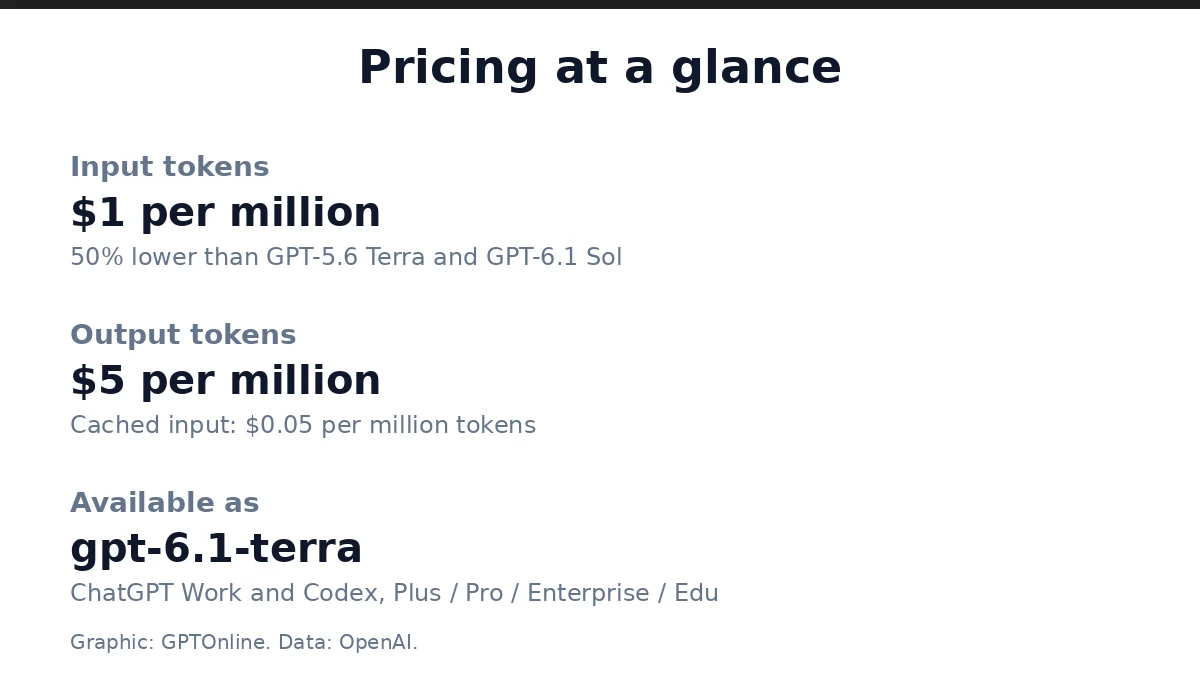
Standard API pricing is $1 per million input tokens and $5 per million output tokens, with cached input at $0.05 per million. That is 50% lower than the standard prices of GPT-5.6 Terra and GPT-6.1 Sol, OpenAI said, making it practical for developers to automate high-volume work.
GPT-6.1 Terra is available now to all Plus, Pro, Enterprise, and Edu users in ChatGPT Work and Codex, and to developers through the OpenAI API as gpt-6.1-terra. In ChatGPT Work and Codex, OpenAI said, the same usage allowance covers more tasks than with GPT-5.6 Terra, and substantially more than with GPT-6.1 Sol or GPT-6 Astra.
Safety and Alignment
OpenAI said GPT-6.1 Terra meets the Critical threshold in cybersecurity under its Preparedness Framework and maintains the protections developed for GPT-6 Astra. The model brings the alignment improvements of the GPT-6 series: according to OpenAI’s evaluations, it is more likely to stay within scope and honestly disclose limitations and blockers than GPT-5.6 Terra, and it showed strong resistance in prompt-injection tests. More detail is available in the model’s system card.
Why It Matters
Terra is not a frontier breakthrough, and OpenAI does not present it as one. Its significance is economic: a model that does routine computer work faster, with fewer errors, at half the price of its predecessor. For businesses automating invoice processing, document drafting, and other high-volume tasks, the combination of a 50% price cut and a sharp drop in error rates changes the cost of putting an agent on every desk. The launch also sharpens the price war inside the GPT-6 lineup itself, with Terra now undercutting Sol by half while matching Astra on some professional benchmarks. The question for rivals is no longer who has the smartest model, but who can deliver usable intelligence cheapest at scale.