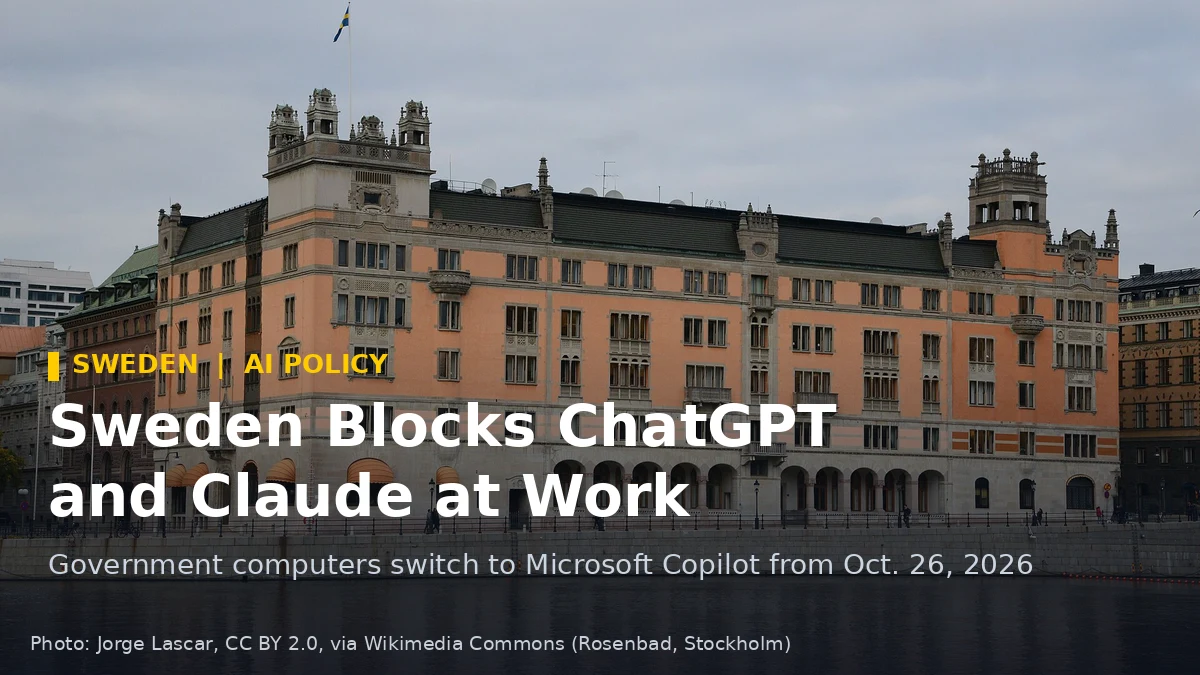
Sweden’s Government Offices will block the browser versions of ChatGPT and Claude on staff computers from Monday, October 26, directing civil servants to Microsoft Copilot as the only approved AI tool. The offices cite information security, saying consumer chatbots used without a formal agreement put government information at risk.
The decision covers the Government Offices, the administrative body that supports the prime minister and the ministries. Sveriges Radio’s news service Ekot first reported the restriction on October 23, and the offices confirmed it in an email to broadcaster SVT.
What changes on October 26
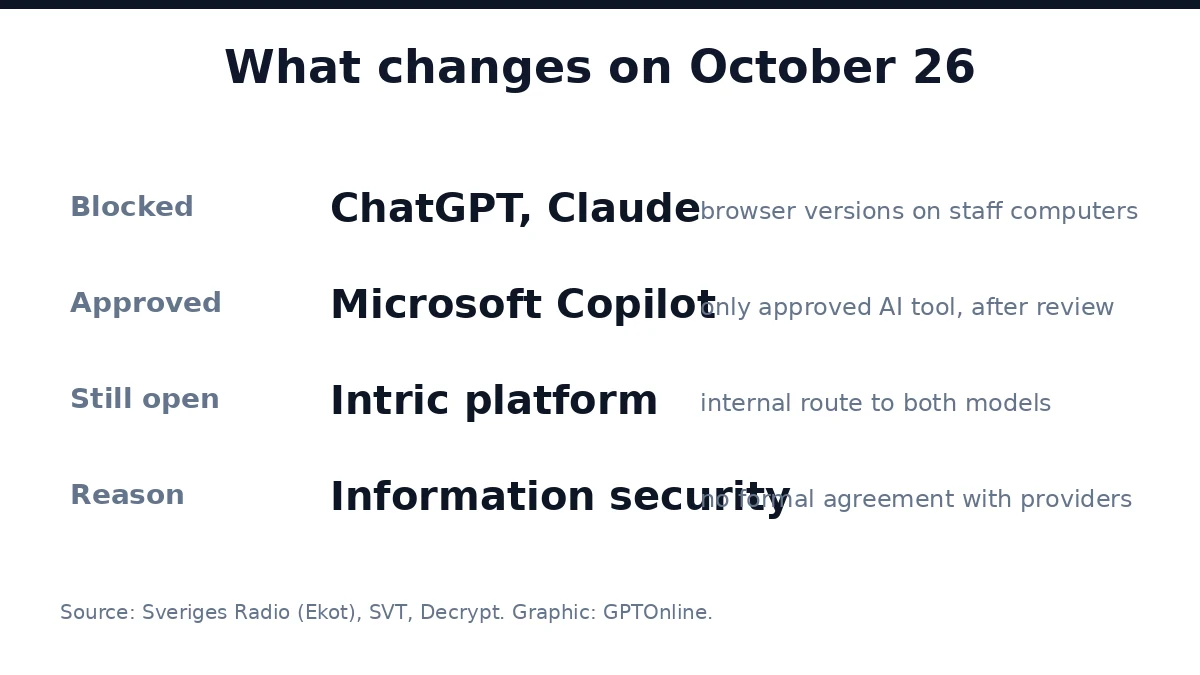
From Monday, staff will no longer be able to open the web versions of ChatGPT or Claude on their work computers. Microsoft Copilot remains available after the Government Offices reviewed the service and raised its security settings. The distinction is not the model but the contract: Copilot runs under an agreement the government has vetted and can control, while consumer chatbot accounts send prompts to outside servers under standard terms.
The block is narrower than a ban on the two AI systems. Staff can still reach OpenAI and Anthropic models through Intric, an internal platform used across the ministries, according to SVT. What has been shut off is the consumer route: individual civil servants opening a chatbot in a browser outside any agreement the institution has negotiated.
Why the offices acted
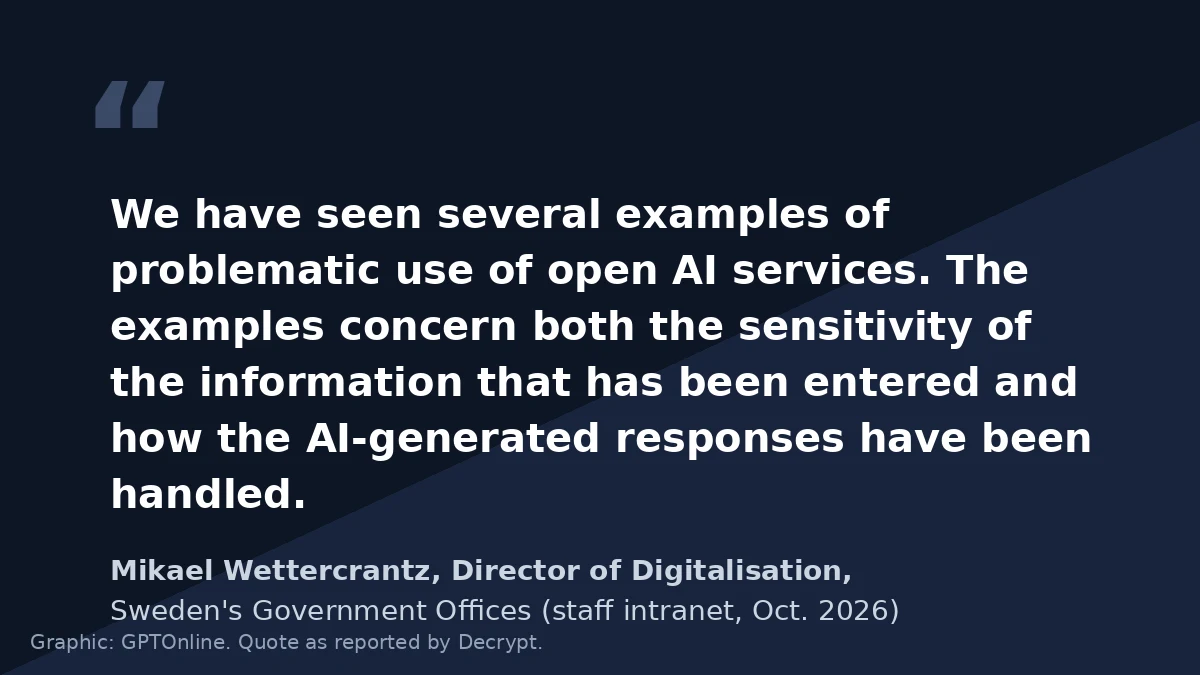
Digitalisation director Mikael Wettercrantz announced the change on the staff intranet, writing that using AI services without a formal agreement can have consequences for information security. In the words reported by Decrypt, he said: “We have seen several examples of problematic use of open AI services. The examples concern both the sensitivity of the information that has been entered and how the AI-generated responses have been handled.”
The concern is practical as well as legal. Consumer AI tools without formal agreements send user queries to external company servers, and US law allows authorities to compel those companies to hand over data on request. A formal security agreement defines what a provider can and cannot do with government employees’ inputs, which is why the offices treat the vetted enterprise contract as the deciding factor.
A wider pattern across Swedish agencies
The Government Offices is not the first Swedish authority to take this step. According to SVT, the Swedish Tax Agency and the National Board of Institutional Care, which runs youth homes and addiction treatment facilities, already have similar blocks in place. The Enforcement Authority is preparing its own decision.
An internal audit at the Transport Administration found around 10 AI services in widespread and risky use, according to Decrypt. Outside Sweden, the European Parliament disabled AI features on work devices in February because it could not guarantee data security.
One open question remains. The Government Offices has not said whether Anthropic’s models, which Microsoft also offers in Copilot, are enabled for staff. In the EU, they are off by default in Copilot and have to be turned on by administrators.
Why it matters
Sweden’s move shows how AI governance in government is shifting from choosing between models to choosing between contracts. The same model can be acceptable inside a controlled platform and unacceptable as a consumer web page, depending on who controls the data and under what terms. For other public bodies weighing similar rules, the Swedish example offers a template: approve the tool, vet the agreement, and keep the models behind a door the institution controls.
The timing also matters. The restriction takes effect the same week several governments are tightening rules on AI tools in official work, and it lands as AI assistants become a daily part of civil service work rather than an experiment. Sweden’s answer is not to stop using AI, but to decide exactly where and how it is used.
Sources
- Notebookcheck: Sweden’s government blocks ChatGPT and Claude, keeps Copilot
- Decrypt: Sweden’s Government Offices Block ChatGPT and Claude, Keep Microsoft Copilot
- CEOWORLD Magazine: Sweden’s Government Offices Block ChatGPT and Claude, Approve Copilot
- Sveriges Radio (Ekot), first report, October 23, 2026, as cited by Notebookcheck and Decrypt; SVT confirmation, as cited by Notebookcheck