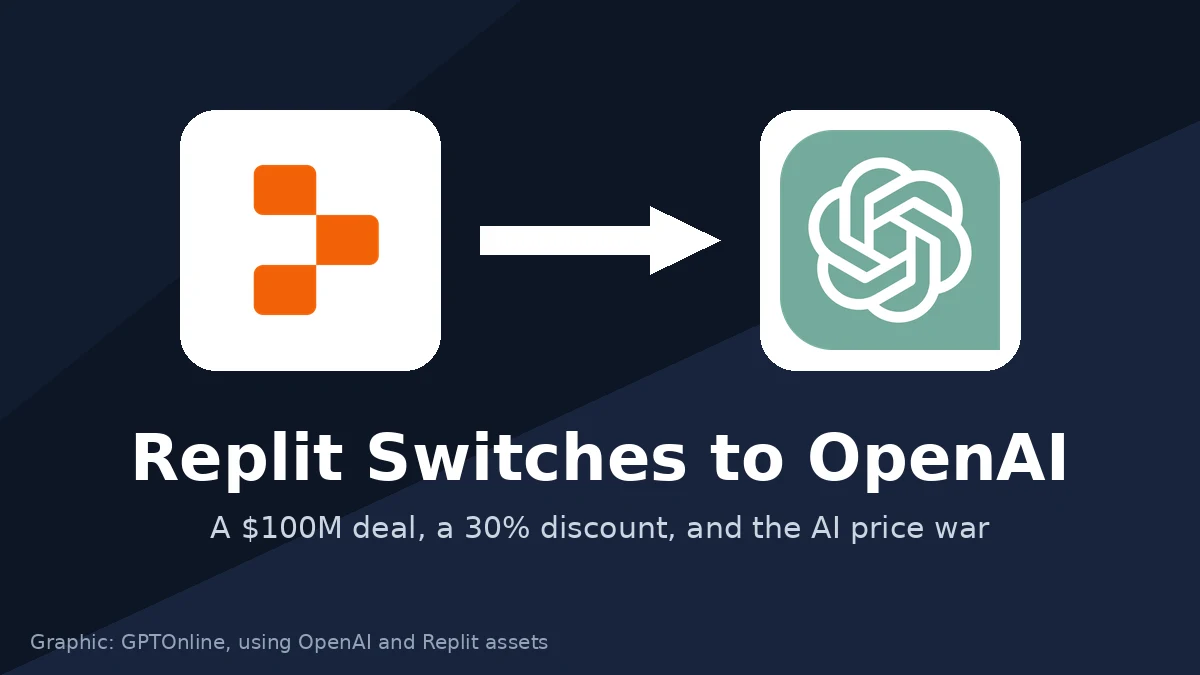
Replit has moved most of its AI spending from Anthropic to OpenAI, after OpenAI offered a discount of more than 30% on a contract worth over $100 million a year. The Information reported the terms on October 24, in a story that reads as the clearest evidence yet that the AI price war is now deciding where big customers run their workloads.
The switch matters because of who Replit was to Anthropic. Until recently, the coding platform was one of Anthropic’s top five customers, and its Agent product ran largely on Claude models. OpenAI is now the default model provider for Replit Agent, which means most of Replit’s users will run on ChatGPT models unless they actively choose something else.
What Was Announced?
There was no joint press release and no new product. The news is the Replit OpenAI deal itself, reported by The Information under the headline “Anthropic’s Margin is OpenAI’s Opportunity.” According to the report, Anthropic declined to extend Replit’s previous discount without a bigger spending commitment, and OpenAI stepped in with more than 30% off a contract worth over $100 million a year.
Replit had already signaled the direction of travel. The company announced a partnership with OpenAI in August. What was not public until this month was that the Anthropic relationship was ending as the default.
The switch is not a clean break, and that distinction matters. TechCrunch reported that a person familiar with the deal said the Anthropic partnership is still in place, and Replit’s own documentation still lists Claude models. Customers can still pick Claude. But defaults decide spending in products like this, and the default now belongs to OpenAI.
What Masad Said on Stage
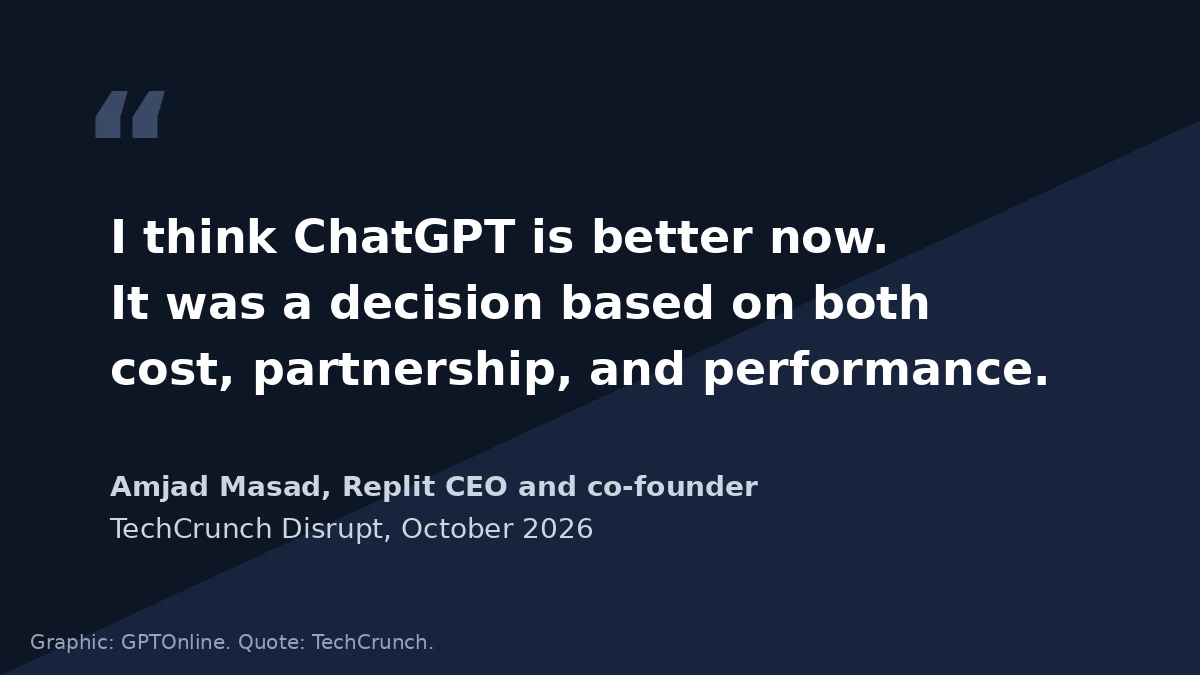
Replit CEO and co-founder Amjad Masad announced the change onstage at TechCrunch Disrupt, telling the audience the company was “no longer working with Anthropic.” He was blunt about the reason. “I think ChatGPT is better now,” he said, pointing to Replit’s internal benchmark and a public benchmark the company publishes, where he said OpenAI’s Sol and Astra models “perform better on building vibe-coded applications from scratch.”
“It was a decision based on both cost, partnership, and performance. And for all these reasons, we just felt like they were a better partner for now,” Masad said.
He softened the message over the weekend. “Replit remains model agnostic,” Masad told TechCrunch afterward. “Our users can choose Anthropic’s Claude or other supported models. OpenAI is now our preferred partner for powering Replit Agent, based on performance, economics, and the strength of our partnership.” He repeated the point on X, writing that OpenAI models are “generally more affordable.”
TechCrunch reported that insiders familiar with the partnership rejected Masad’s claim, pointing to Replit blog posts from late September that still cited Anthropic’s Claude Fable 5 and Fable 5.1 models in Replit Agent’s production environment.
Rippling Shows the Same Pattern
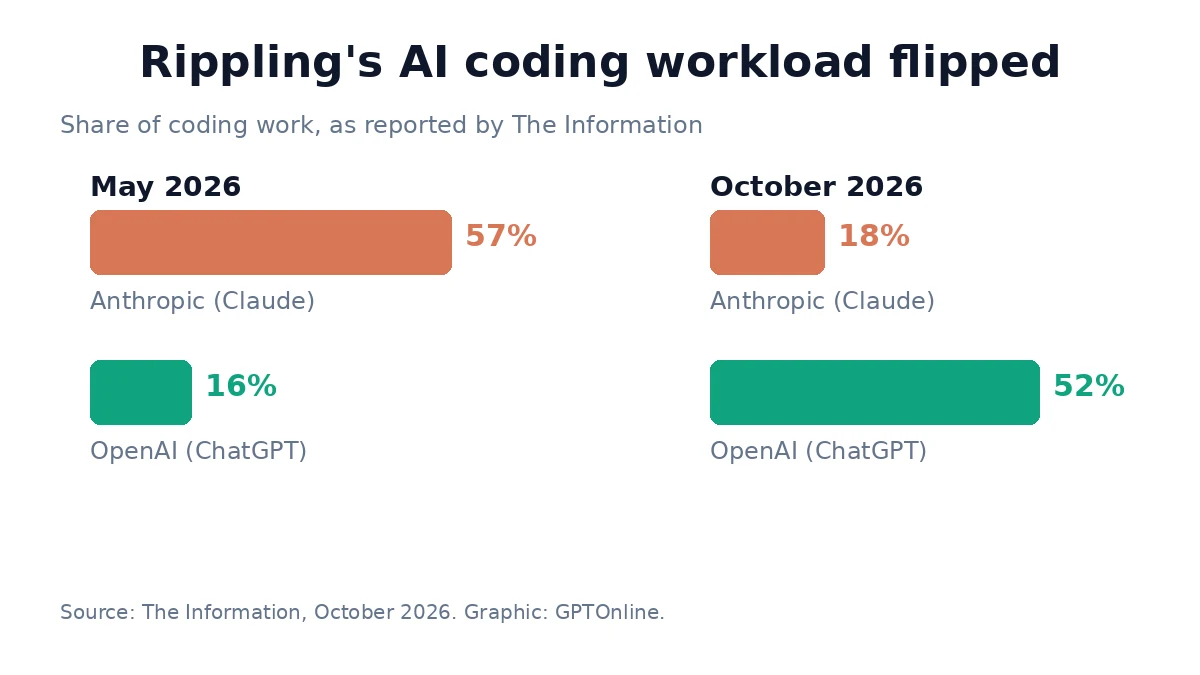
Replit is not the only customer moving. The Information paired the Replit deal with figures from Rippling, the HR software company, where the split of AI coding work has flipped in five months. In May, Anthropic models handled 57% of Rippling’s coding work and OpenAI handled 16%. Those shares have now reversed: OpenAI handles 52% and Anthropic 18%. Rippling chief executive Parker Conrad said the company switched because OpenAI’s pricing was more competitive.
The Information also reported that DataCamp was offered a 40% discount by OpenAI on models for internal product development, provided it also used Codex, with its chief executive estimating costs could fall by 80% to 90% if the offer extended to the products it sells.
Why Anthropic Is Losing on Price
The uncomfortable part for Anthropic is that the discounting is structural, not a one-off. The Information reported in September that Anthropic ends enterprise discounts once customers hit their contractual usage caps, forcing a renegotiation at list prices, while OpenAI gives customers the rest of the calendar month plus an extra month to renegotiate. That policy is part of why Replit walked: Anthropic would not extend its discount without a bigger commitment, and OpenAI would.
Anthropic’s position is not weak on growth. The Information reported its growth held at 45% despite slowing from the second to the third quarter, and its computing costs in the second quarter were $5.6 billion against $11.5 billion in revenue. But the company is preparing for a large IPO, with a public filing reportedly planned for October 26, and defending margins matters more to a company about to be priced by public markets.
OpenAI, for its part, has forecast that its computing spending this year will significantly exceed its revenue. It can afford to buy share. Anthropic is choosing not to match every discount, and Replit and Rippling show what it costs in volume.
Why It Matters
For builders, the lesson is that the model behind the tool you use may now change because of a procurement decision, not a benchmark. Most Replit users never open the model menu, so the default switch quietly moves their work from Claude to ChatGPT, with different code output and a different credit bill. Enterprise buyers should check which models their workspaces can reach and re-test what their builders shipped on Claude before trusting the new default.
For the industry, the Replit deal marks the moment price became the deciding factor in the frontier model race. Capability still matters, and Masad made a performance claim too. But no benchmark appears anywhere in the reporting of this deal. The reported trigger was a withdrawn discount. When two model families are close enough that a 30% price gap decides a $100 million contract, the competition has moved from the lab to the sales desk.
Sources
- The Information, “Anthropic’s Margin is OpenAI’s Opportunity,” October 24, 2026 (paywalled)
- TechCrunch, “Replit makes OpenAI its default over Anthropic, CEO says,” October 16, 2026 (updated October 22)
- AI Weekly, “Replit Shifts $100M+ AI Spend to OpenAI After 30% Price Cut,” October 25, 2026
- Paktechstan, “OpenAI’s Discounts Are Flipping the AI Coding War as Rippling Swaps Claude for ChatGPT,” October 25, 2026