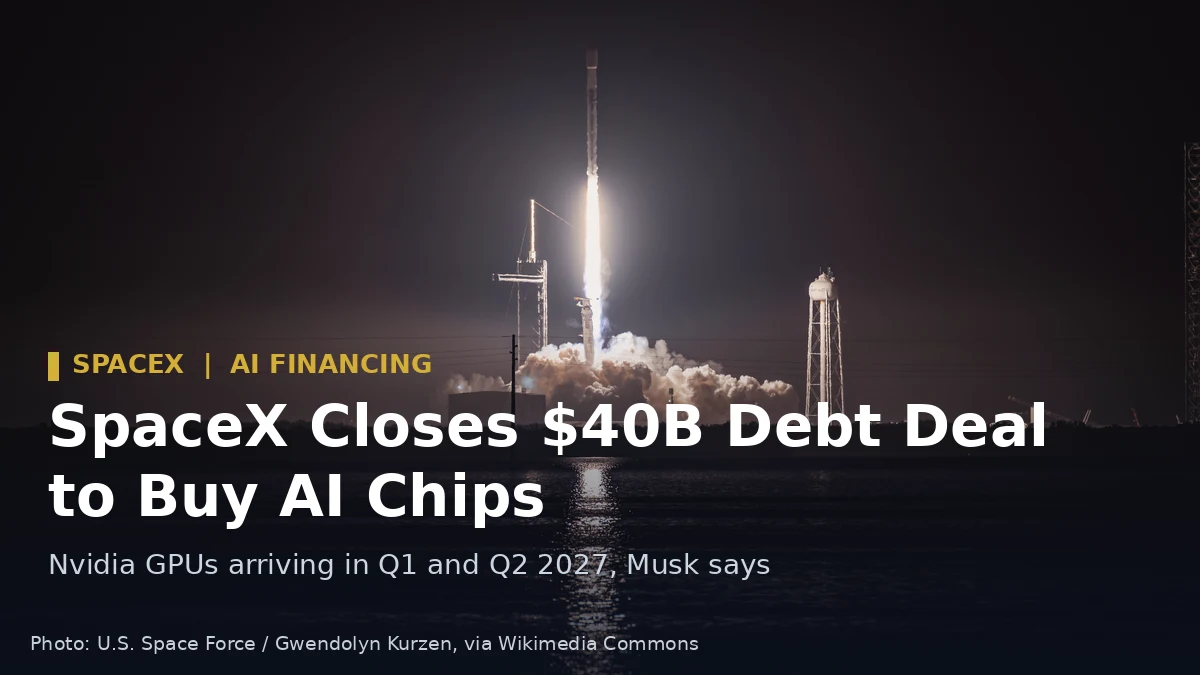
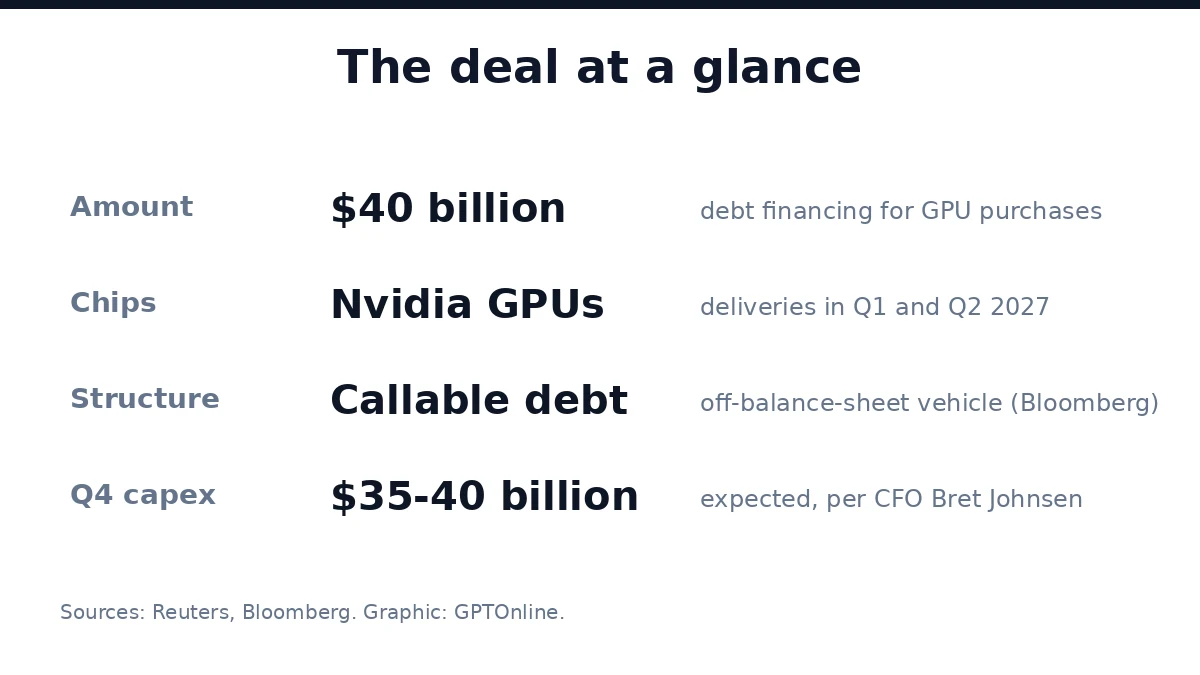
Elon Musk said on Sunday that SpaceX has closed $40 billion in debt financing to buy graphics processing units for its artificial intelligence ambitions, in one of the largest single financings tied to the AI buildout this year. The SpaceX $40 billion debt deal will fund purchases of Nvidia GPUs, with deliveries expected in the first half of 2027, according to Reuters.
Musk disclosed the deal in a post on X, saying the company’s investment-grade credit rating and revenue from its Starlink satellite internet and rocket launch businesses helped it keep access to credit while other AI firms are being shut out. “This is primarily callable debt for GPU purchases that will arrive in Q1 and Q2. Not a major factor this quarter,” Musk wrote.
What Was Announced?
Reuters reported earlier this month that SpaceX was in talks with banks and asset managers to raise $40 billion for Nvidia AI chips. Bloomberg reported that Goldman Sachs was leading talks with investors, including Apollo Global Management, over a structure that would use a special purpose vehicle to keep the debt off SpaceX’s balance sheet and protect its investment-grade ratings.
There is one important caveat. Reuters noted it was not immediately clear from Musk’s post what he meant by the deal being “closed,” or whether investors had agreed to pricing for the debt. The announcement, for now, rests on Musk’s word rather than a completed filing with confirmed terms.
Why SpaceX Could Borrow When Others Cannot
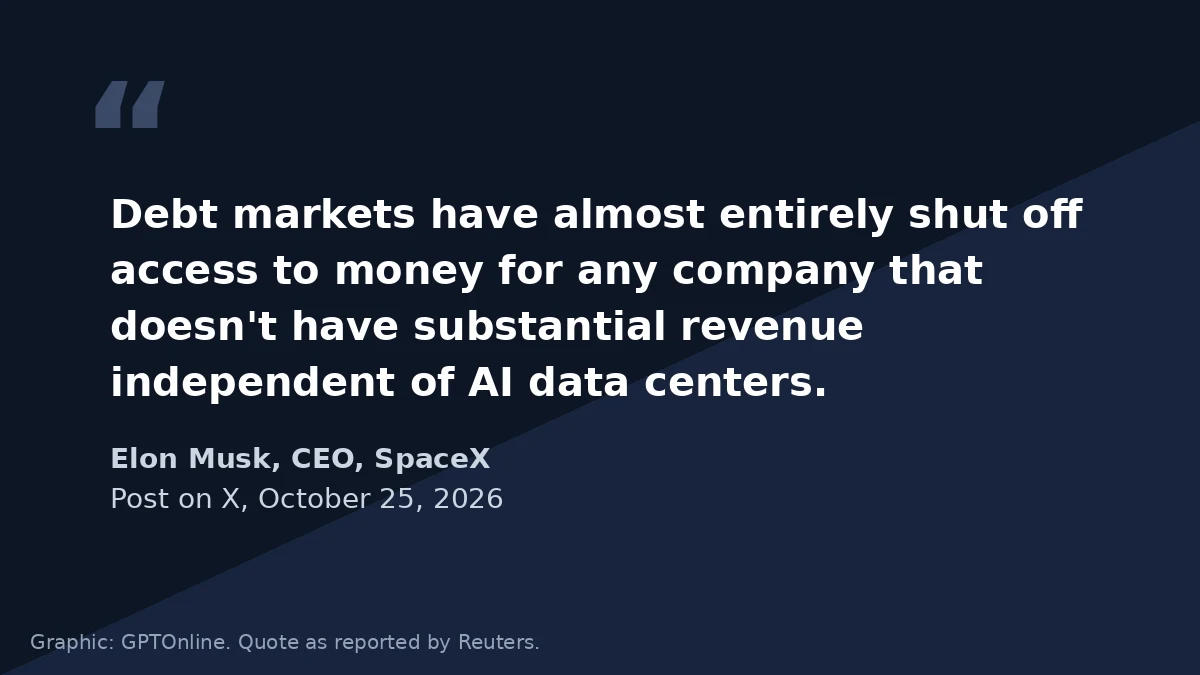
Musk used the announcement to draw a sharp line between SpaceX and the smaller AI cloud companies known as neoclouds. He said debt markets “have almost entirely shut off access to money for any company that doesn’t have substantial revenue independent of AI data centers.” He predicted that “the 200+ neoclouds are going to see guppy-level death and consolidation. Some will make it through, but not many,” and later said SpaceX will not buy any neoclouds, calling it “pointless.”
Neoclouds such as Nebius and CoreWeave rent computing power to AI developers and mostly serve tech customers, offering capacity tailored for AI workloads. Investors have started betting against US neocloud and data center companies after fears that their debt-fueled AI buildout was becoming unsustainable sparked a selloff, according to Reuters.
The Numbers Behind the Deal
SpaceX’s third-quarter revenue climbed 161% from a year earlier to $14.58 billion, and its AI revenue surged by almost ten times to $7.56 billion, the clearest sign yet that its heavy investment in AI is paying off. For the fourth quarter, the company expects $35 billion to $40 billion in capital expenditure, according to Chief Financial Officer Bret Johnsen.
The spending does not stop at buying chips. Terafab, the chip manufacturing joint venture between SpaceX and Tesla in Austin, should produce its first test chip around May or June of next year and aims to reach volume production by the third quarter of 2028. Before its blockbuster IPO, SpaceX listed “manufacturing our own GPUs” among the substantial capital expenditures in its S-1 statement. Musk also told investors last week that a merger of SpaceX and Tesla would be “a good idea,” citing growing overlap between the companies.
Why It Matters
The deal shows how the AI race is splitting into two tiers. Companies with diversified revenue and investment-grade ratings can still raise enormous sums to buy computing power, while smaller firms that exist only to rent out GPUs are finding credit markets closed to them. If Musk’s prediction is right, the next phase of the AI buildout will be shaped as much by who can borrow as by who can build.
For readers, the signal is in the scale: a single company’s GPU shopping list now runs into the tens of billions of dollars, and its own chipmaking ambitions stretch years into the future. What to watch next is whether the pricing and terms of the debt are confirmed, and whether the neocloud shakeout Musk predicts actually arrives.
Sources
- Reuters: Musk says SpaceX raised $40 billion in debt deal, predicts neocloud shakeout (via Channel News Asia)
- Reuters: Musk says SpaceX raised $40 billion in debt for GPUs (via WNCY)
- Bloomberg: SpaceX closes $40 billion debt deal to fund AI chip purchases (via Traders Union)
- Firstpost: SpaceX raises $40 billion in debt for AI chips. What does Musk plan next?