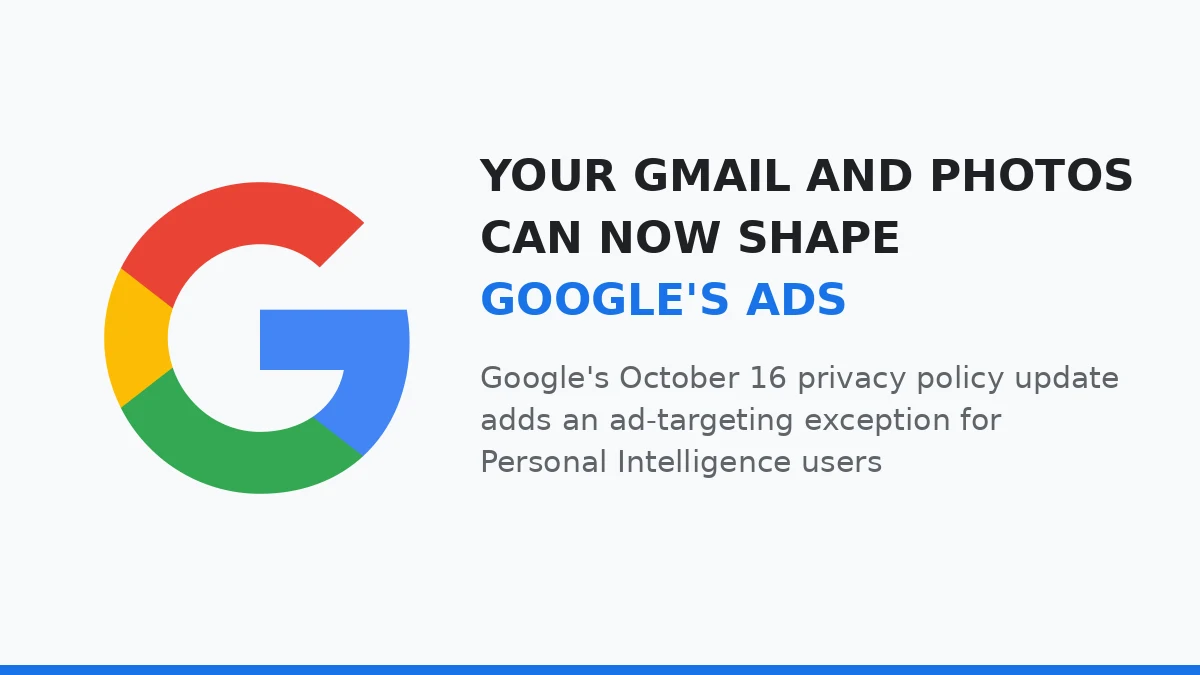
Google has quietly rewritten one of its longest standing privacy promises. A privacy policy update that took effect on October 16, 2026 adds an exception to the company’s pledge never to base personalized ads on content from Drive, Gmail or Google Photos. The change, first spotted by Android Authority and reported by The Verge on October 23, ties the exception directly to Google’s Personal Intelligence features, the opt-in tools that let Search and Gemini Apps draw on a user’s own emails, files and photos.
The revision does not announce a new ad product. It changes the ceiling on what Google may do with personal content once a user connects it to the company’s AI tools, and that distinction is exactly why the wording matters.
What Changed
For more than five years, Google’s privacy policy carried a flat assurance: personalized ads were not based on content from Drive, Gmail or Google Photos. A line-by-line comparison of the October 16 text against 54 earlier archived versions of the policy, published by PPC Land, shows the company kept that wording identical since July 1, 2021. The October 16 update, which arrived fifteen days after the previous version, rewrites three sentences in the advertising section and adds a new explanatory note. None of the earlier versions contained an equivalent carve-out.
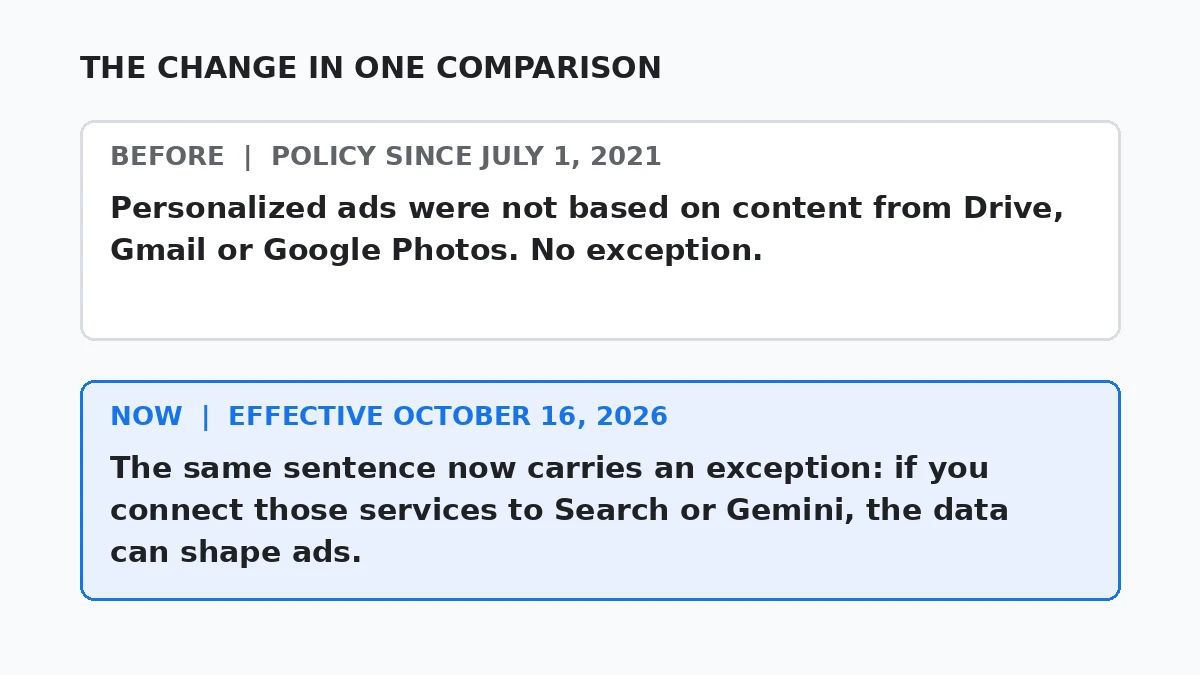
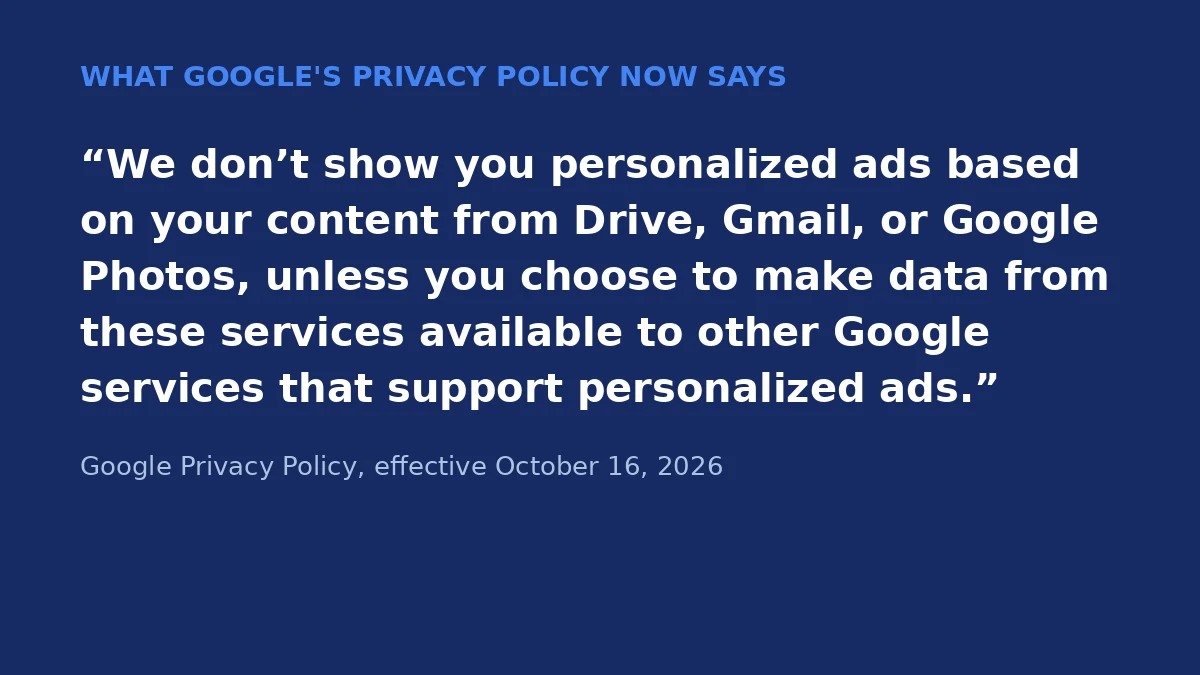
The new sentence, which GPTOnline verified directly in Google’s published privacy policy, reads:
“We don’t show you personalized ads based on your content from Drive, Gmail, or Google Photos, unless you choose to make data from these services available to other Google services that support personalized ads.”
Anyone who has never linked those services to another Google product is in the same position as before. The promise only narrows at the point of connection.
How Personal Intelligence Connects Your Data to Ads
Personal Intelligence first began rolling out in beta at the start of 2026. It allows Gemini to share data between apps, including Gmail, Photos, Search and Drive, so the company’s AI tools can give answers with more personal context. The policy now states that the same access can also inform advertising.
Google’s own policy text describes the mechanism in plain terms:
“You may choose to allow certain Google services, including services like Search or Gemini Apps, to access data from other Google services you use, such as Google Photos and Workspace apps like Gmail and Drive, in order to provide you with a more personalized experience, subject to the policies and settings of the accessing service. For example, Search may process some of the data that you allow Search to access to personalize content, including ads.”
The policy gives two concrete examples of how that works in practice. If a user asks Search about a recent hotel booking, Search may use booking details from an email to suggest things to do near the hotel. And if a user searches for “mountain bikes” in Search, they may see ads for sports equipment on YouTube. In both cases, the data moves from a private service into an advertising surface through the connection the user enabled.
What Google Says Stays Off Limits
The update keeps several guardrails in place. Advertisers never receive direct access to content in Drive, Gmail or Photos, and Google says it does not share information that personally identifies users with advertisers, such as a name or email address, unless the user asks it to. The policy also states that Google does not show personalized ads based on sensitive categories, such as race, religion, sexual orientation or health.
What changes is the middle layer. Google itself now sits between a user’s private files and its advertising system, and the policy language permits that bridge. The wording is permissive rather than descriptive: it sets out what Google may do, not a start date for any ad change, the ad formats involved, or how many users the exception could affect.
How to Check Your Settings
Personal Intelligence remains opt-in, and users who are uncomfortable with the new wording can review what they have connected. In a Google account, the path runs through Data and privacy, then Personalization settings, then Manage Personalized Recommendations in Search services. Personalized Recommendations can also be turned off entirely from that page.
Why It Matters
The change sits at the exact point where helpful AI and targeted advertising meet. Personalized AI is only useful if it can read a user’s context, and that context lives in inboxes, documents and photo libraries. For five years, Google drew a clear line: it would use that context to answer questions, but not to sell ads against it. The October 16 update moves that line. Connecting personal services for better AI answers now also means opening the same content to more personalized ads, and the choice rests with the user at the moment of connection.
For users, the practical question is no longer whether Google can read their email for ads. It is whether the personalized answers are worth the trade, and whether they remember which connections they have already switched on.