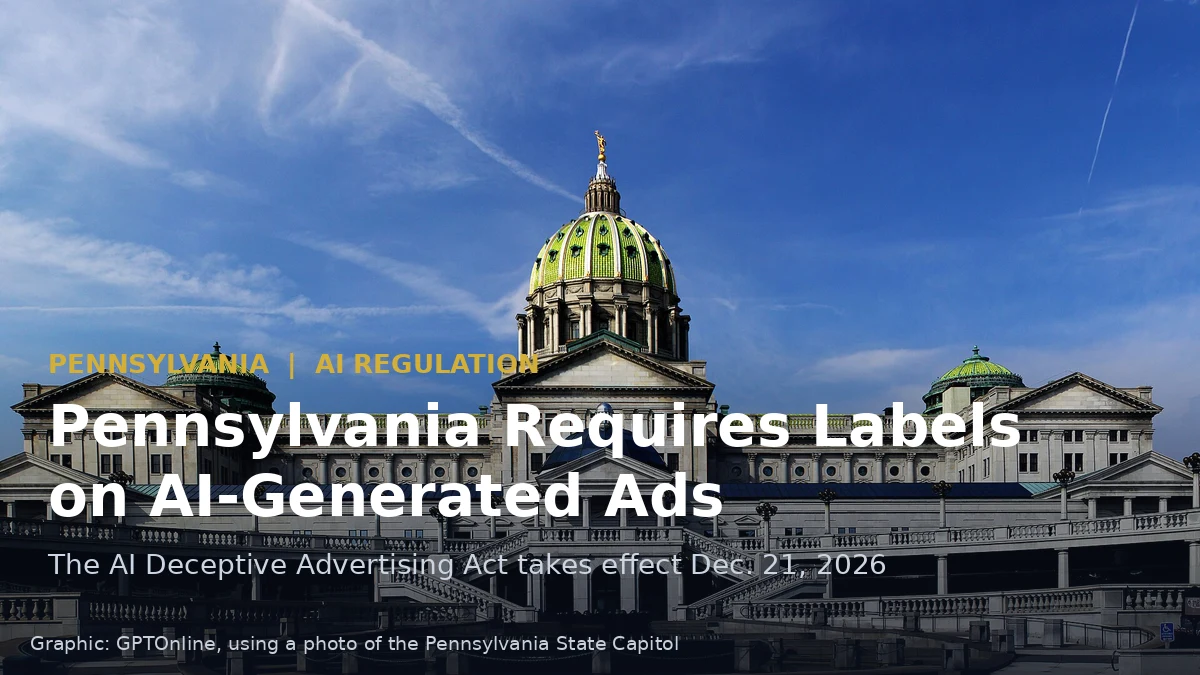
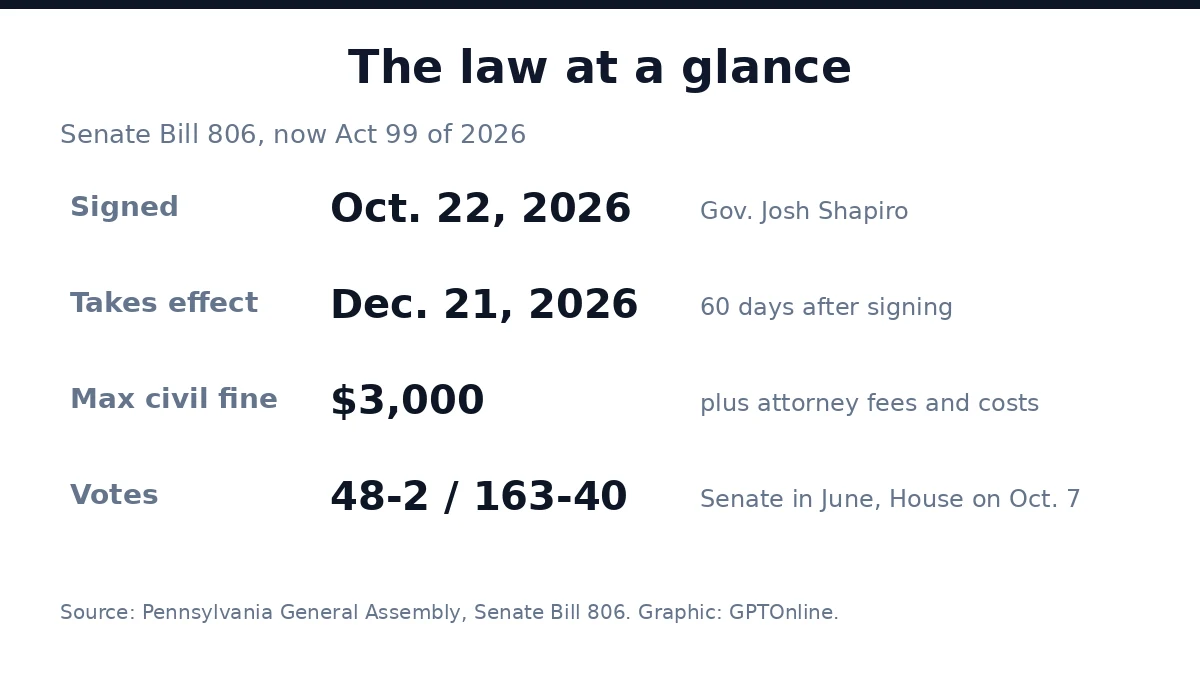
Pennsylvania has become one of the first states in the United States to require labels on AI-generated advertising. Gov. Josh Shapiro signed the Artificial Intelligence Deceptive Advertising Act into law on Thursday, October 22, 2026, and the measure takes effect 60 days later, on December 21. The Verge reported the signing on October 25.
The law began as Senate Bill 806, sponsored by State Sen. Nick Pisciottano. It passed the state Senate 48-2 in June and the House 163-40 on October 7, and it is now recorded as Act 99 of 2026. The full text is published by the Pennsylvania General Assembly.
What the law requires
The rule is narrower than a blanket label on every ad made with AI. It applies when an advertisement uses synthetic content, defined in the act as material that has been “significantly modified or generated by artificial intelligence,” in a way that creates a false consumer perception about the nature, origin or authenticity of the goods or services being advertised. The format does not matter: the rule covers still images, video, audio and text.
When that trigger is met, the ad must carry a clear and conspicuous disclosure stating that it contains content modified or generated using AI. The disclosure has to appear the first time the synthetic content is shown to a consumer, in the same medium as the ad itself, and, where technically feasible, it must be permanent or extraordinarily difficult to remove. Under the act, a disclosure is clear and conspicuous only if it is readily noticeable, readable, understandable and, for audio, capable of being heard.
The law also sets out what it does not cover. Content that is evidently fictional from its content or context is exempt, as are parody, satire, commentary and criticism. So is content limited to text, which means a text-only ad written with a chatbot falls outside the rule. And adding a label is not a free pass: the act says disclosure cannot be read to limit any other recourse under the law, so a misleading ad can still be unlawful even with a disclosure attached.
Penalties and enforcement
There is no private right of action, so consumers cannot sue under the act themselves. Enforcement belongs to the Pennsylvania attorney general and the state’s 67 district attorneys, who can seek an injunction or bring a civil action. A court can impose a civil fine of up to $3,000 per violation, plus actual attorney fees and court costs.
The attorney general’s office expects enforcement to need new staff. An official fiscal note cited in reporting on the law anticipates hiring a deputy attorney general, a technologist and an administrative assistant, at an estimated cost of about $437,000 in fiscal 2026-27 and $498,000 in later years.
The loopholes and open questions
The law leaves several key terms undefined, and that is where the arguments will start. What counts as “significantly modified” is subjective, and so is what counts as “evidently fictional” or a “false consumer perception.” The act does not say who decides those questions in the first instance, and regulators and courts will have to draw the lines case by case.
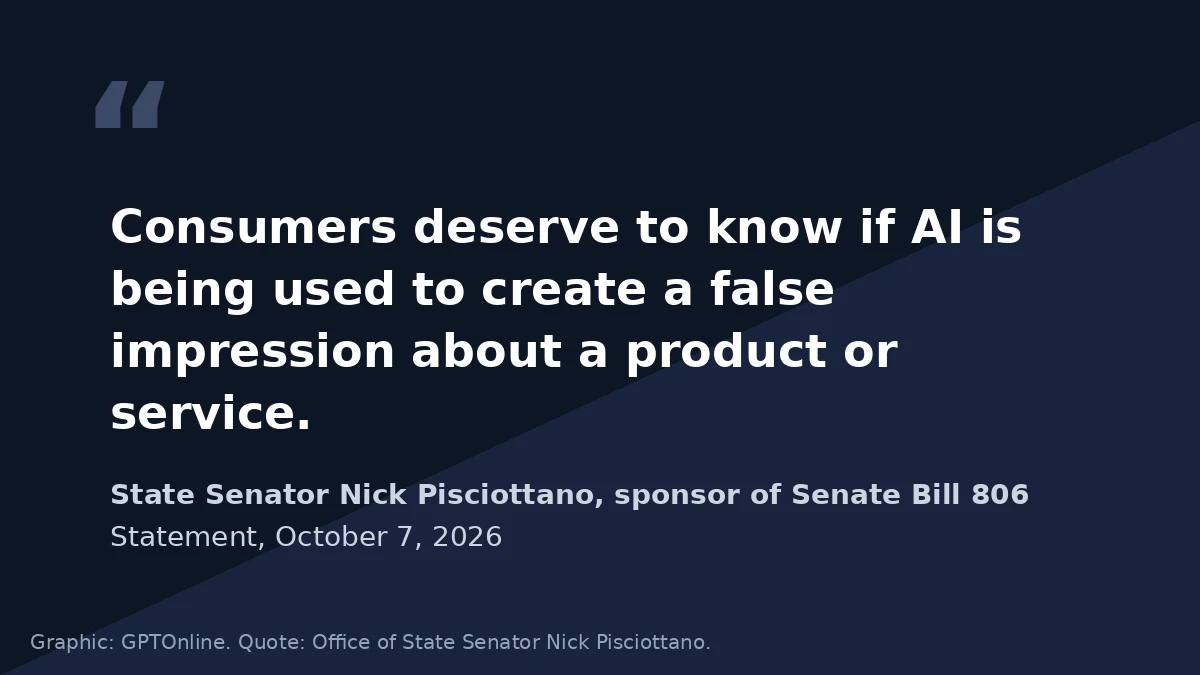
Pisciottano framed the measure as basic consumer protection. “Consumers deserve to know if AI is being used to create a false impression about a product or service,” he said in a statement on October 7, when the House passed the bill. His office gave the example of an AI-generated image that could lead buyers to believe they are looking at the actual product.
The law firm Loeb & Loeb, in a client note summarized by AI Brief, said an AI spokesperson giving accurate information may not need a Pennsylvania label, while an AI-altered real person delivering a fake endorsement may. The firm expects many advertisers to label all AI imagery, video and audio in Pennsylvania ads rather than apply the test case by case.
The tech industry group NetChoice opposed the bill, arguing in testimony to a House committee that existing federal and state laws already prohibit deceptive advertising, and that the format rules risk overwhelming short videos, small display ads and audio spots. MediaPost reported the group’s objections when the bill passed the House on October 8.
Why it matters beyond Pennsylvania
The Pennsylvania AI ads law applies regardless of where an advertisement was created. That means a commercial produced in another state can still need a Pennsylvania disclosure if it is expected to air there, and labels may start appearing in commercials in other states for the same reason. National advertisers are likely to standardize on labeling rather than cut a separate version for one state.
Pennsylvania is not acting alone. California signed a law last month requiring ads using synthetic performers to disclose that the digital figures were generated by AI, and New York’s synthetic performer law has been in effect since June, covering ads featuring AI-generated people, with penalties of $1,000 for a first violation and $5,000 after that. Pennsylvania’s law goes further in one respect: unlike New York’s, it reaches audio ads as well.
For advertisers, the practical deadline is now December 21. Any campaign that uses AI-generated or heavily AI-edited images, video or audio in Pennsylvania, and that could leave a shopper with a false impression of what is being sold, will need a label in the same format as the ad, shown the first time the content appears.
Sources
- The Verge: Pennsylvania will require labels on AI-generated ads
- Pennsylvania General Assembly: Senate Bill 806, Printer’s No. 1808 (bill text)
- WebProNews: Pennsylvania Gives Advertisers Until Dec. 21 to Label AI Content That Could Mislead Buyers
- AI Brief: Pennsylvania Enacts AI Disclosure Law for Deceptive Ads (Loeb & Loeb analysis)
- MediaPost: Pennsylvania Passes Bill Requiring Disclosure Of Misleading AI In Ads