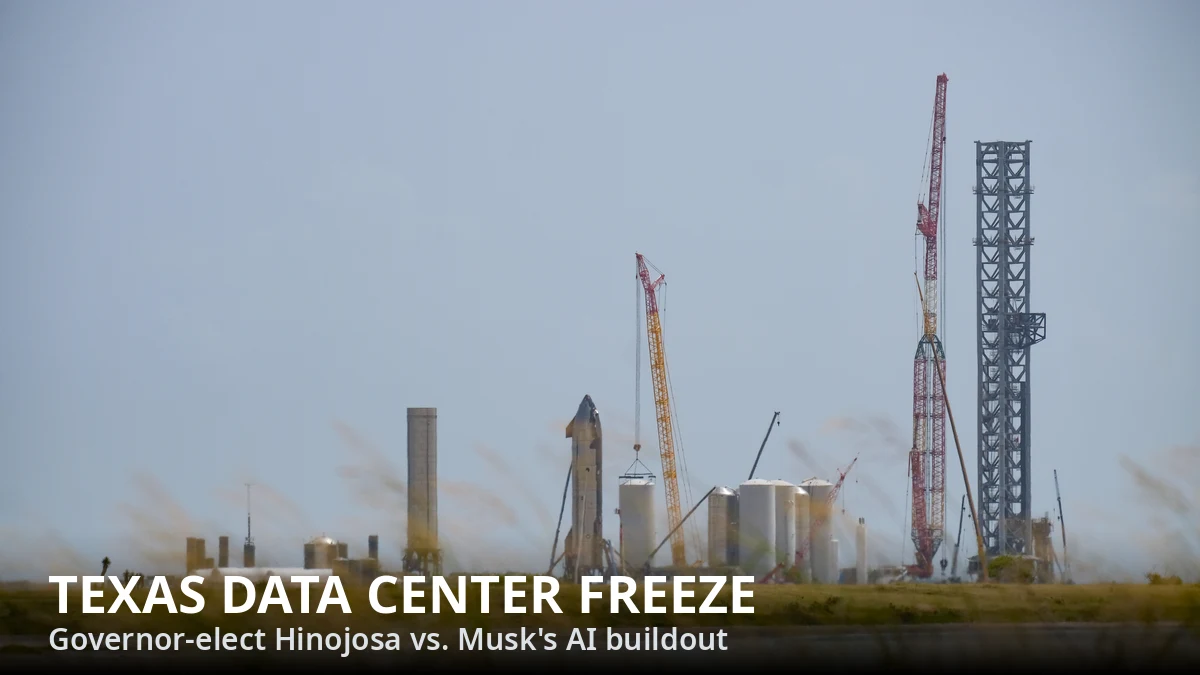
Texas governor-elect Gina Hinojosa has put Elon Musk’s artificial intelligence ambitions in the state on notice. Days after defeating Governor Greg Abbott in the November 3 election, she asked state officials to pause land talks near SpaceX’s Starbase site and pledged a statewide moratorium on new data center construction until Texas passes protections for water, power customers and local communities. The freeze, if it becomes law, would land directly on SpaceX’s accelerating AI plans, including a reported supercomputer at Starbase and a target of 13 gigawatts of computing capacity by the end of 2027.
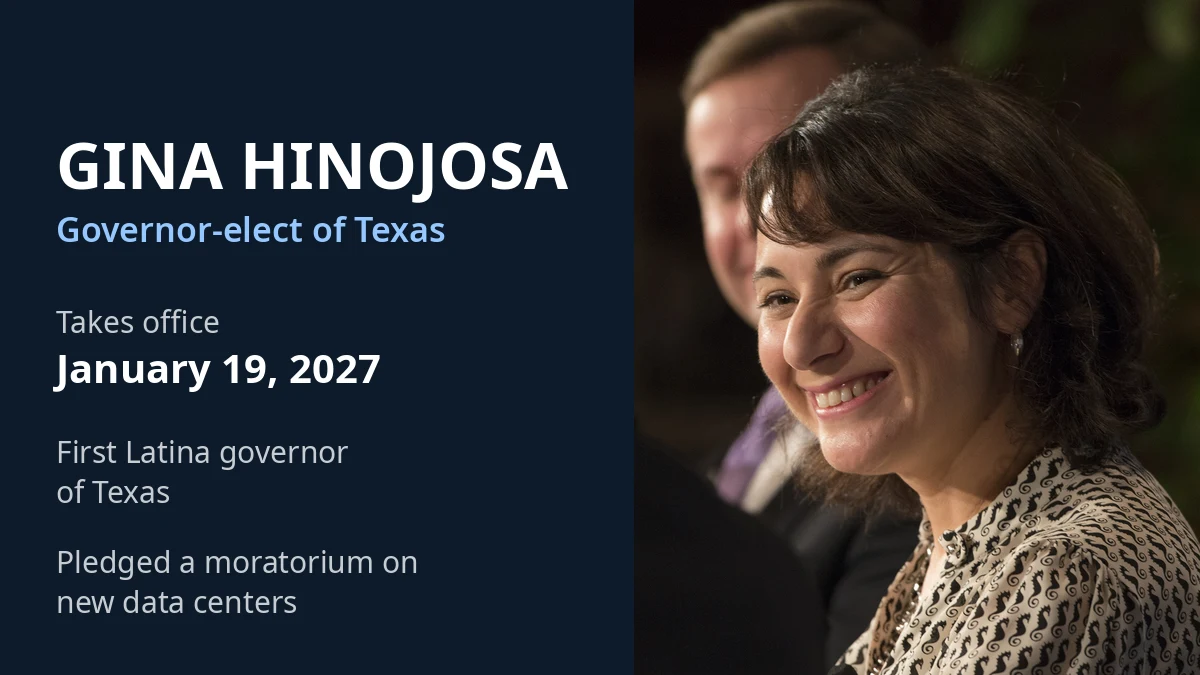
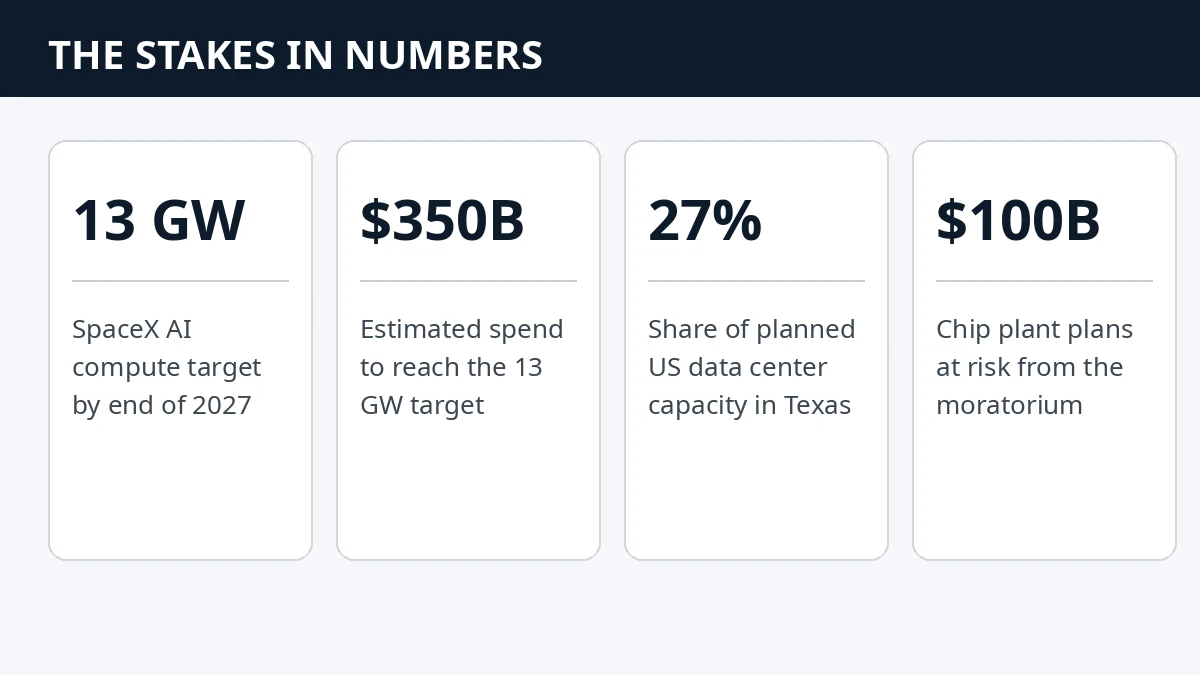
Hinojosa, a Democrat who will become the first Latina governor of Texas and the first woman to lead the state since 1995, takes office on January 19, 2027. Until then her moratorium is a pledge, not a law, and it would need the Texas legislature to act. But the signal alone has rattled the center of the American AI buildout: Texas holds 27 percent of planned data center capacity in the United States, according to Wells Fargo estimates.
What Hinojosa asked for
At her first news conference since the election on November 5, Hinojosa said she had asked the Texas Parks and Wildlife Department to hold off on any action involving public land near Boca Chica Beach during the transition. She repeated the request on Saturday, November 7, asking the department to take no action on a possible transfer of about 1,300 acres near Boca Chica while her team reviews the proposal.
The land sits next to SpaceX’s Starbase launch complex in Cameron County, on the Gulf Coast near the Mexican border. In October, reports emerged that the parks commission planned to discuss selling about 1,300 acres of public land in the county, including Boca Chica State Park, during a closed-door session, with SpaceX reported to be the likely buyer. The department has since said the commission “is not considering the sale of the Boca Chica property at its November meeting,” and any sale would need a final vote in an open session.
Hinojosa used the issue in the final weeks of the campaign. “Texas is not for sale,” she said, accusing Abbott of “handing over our land to the world’s only trillionaire.” She also sued Abbott in October to obtain his private communications with Musk, and a judge on October 27 ordered the governor to stop blocking her from seeing them.
A moratorium aimed at the AI buildout
The land fight is only part of the story. Hinojosa has pledged a statewide moratorium on new data center construction until the state sets rules covering local water supplies, household power bills and the nondisclosure agreements that conceal projects, and she wants to end data center sales-tax subsidies she says cost Texas billions.
“We will have laws to protect Texans, and we need to stop what we are doing with data centers until we have those protections,” Hinojosa said at her November 5 news conference.
Reuters reported the moratorium threatens plans by Tesla and SpaceX for a $100 billion chip plant in the state. Musk gave more than $445 million to Republican causes this cycle, about $225 million of it in Texas races, according to the same report.
What is at stake for SpaceX
SpaceX is scaling its AI infrastructure fast. A UBS report cited by ANI says SpaceX now targets 13 gigawatts of AI computing capacity by the end of 2027, up from the 2.5 to 3 gigawatts it had expected earlier, with as much as 20 gigawatts possible depending on power generation. The Information reported on November 7 that public records appear to show SpaceX building a “Starbase supercomputer” in Texas, though the details of that project have not been confirmed publicly.
According to UBS, Musk has said demand is strong enough for SpaceX to sell its computing capacity several times over, and the infrastructure could support annual recurring revenue of $500 billion to $1 trillion by the end of 2027, against an expected $100 billion at the end of 2026. The expansion will require heavy spending: SpaceX has guided for capital expenditure of $35 billion to $40 billion in the fourth quarter of 2026, up from $19.6 billion in the third quarter, and UBS estimates the company would need around $350 billion to reach its 13 gigawatt target.
SpaceX has spent years expanding around Boca Chica, where it chose to build its Starship test and launch site in 2014. Starbase became a city in 2025 and has annexed more than 7,100 acres, much of it covering the park, though annexation does not change who owns the land. A separate 715-acre federal land exchange to SpaceX remains tied up in litigation.
Musk’s response: data centers in space
Musk responded to the election result early on November 4 with a post on X: “Data centers in space looking pretty appealing right now.” He did not mention Hinojosa or Texas, and he did not announce any change to his companies’ plans.
Space-based computing was already part of Musk’s plans. In February, SpaceX asked the Federal Communications Commission for permission to launch up to 1 million solar-powered satellites for an orbital AI network, and Musk has said the first AI satellites could launch in 2027.
Why it matters
Texas is the front line of the AI infrastructure boom, and Hinojosa’s win shows voter backlash over data centers, centered on power bills, water use and local control, is now shaping who governs the states where the buildout happens. A moratorium in the state holding more than a quarter of planned US capacity would ripple across the industry.
The pressure is not limited to Texas. Democrats in Washington are planning a wave of AI legislation when they take control of Congress in January, including bills on data center electricity costs, as GPTOnline reported. What to watch next: whether Hinojosa’s freeze survives the Texas legislature after her January 19 inauguration, and how much of SpaceX’s 13 gigawatt target gets built while the politics of AI infrastructure are rewritten.
Sources
- Reuters (via Billionaire Africa): Billionaire Musk’s SpaceX Texas land talks face pause call
- American Bazaar: Texas Governor-elect Gina Hinojosa vows to halt data center expansion until residents are protected
- Particle: Hinojosa asks state to hold off on 1,300-acre land transfer near SpaceX Starbase
- ET Now (with inputs from Reuters and ANI): SpaceX targets 13 GW of AI computing capacity by 2027, UBS says
- Thought Catalog: After Gina Hinojosa beat Greg Abbott, Elon Musk said data centers in space look “pretty appealing”
- The Information, via Techmeme, November 7, 2026: public records appear to show SpaceX building a “Starbase supercomputer” in Texas