What Was Announced?
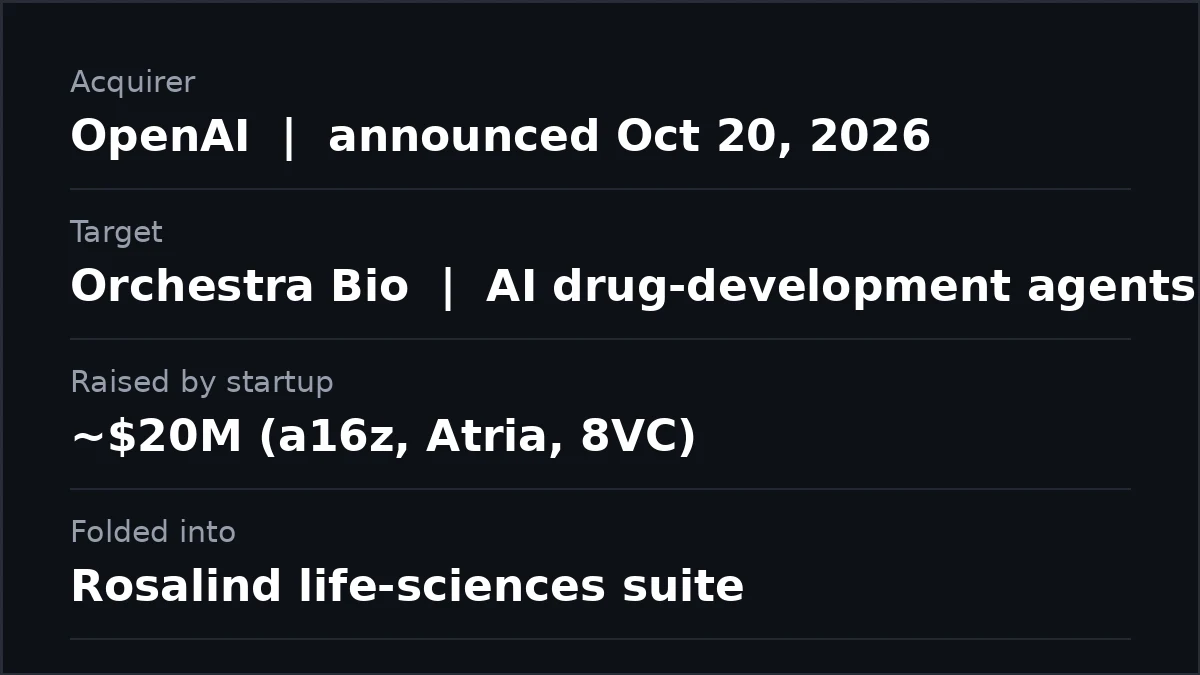
OpenAI said on Tuesday that it has acquired Orchestra Bio, a four-year-old San Francisco startup whose AI agents help pharmaceutical teams coordinate the complex work of drug development. The company shared the news exclusively with Axios, and financial terms were not disclosed, according to TechCrunch.
Orchestra Bio’s team and technology will be folded into Rosalind, OpenAI’s family of AI models and tools for life sciences research. In its announcement, OpenAI said: “We’ve acquired Orchestra Bio, a platform that helps biopharma teams coordinate the complex process of drug development. Together, we’ll build on Rosalind, our AI models and tools for life sciences research, to streamline those operations and help new treatments reach patients.”
The startup had raised around $20 million as of 2025 from backers including Andreessen Horowitz, Atria, and 8VC, according to TechCrunch. It was founded around October 2022 by Ashoka Rajendra, making this roughly a four-year journey from first check to acquisition.
What Orchestra Bio Does
Most AI-for-biology startups pitch molecule discovery: let the model find the drug. Orchestra Bio’s pitch was different. The company describes its platform as an “agentic operating layer” that sits on top of a drug program and coordinates the work around the molecule, with AI agents handling tasks alongside human scientists.
Scientists and program leaders hand off the monitoring and tracking of studies to those agents. OpenAI’s example: a failed manufacturing batch delays the start of a clinical trial. Orchestra’s agents work out which activities and timelines are affected, pull together the relevant information, and compare ways to respond. People still decide what to do next. In the startup’s own words, published on its website: “Agents can handle planning, orchestration, and analysis, while scientists and program leaders focus on the decisions that require their expertise.”
The deal matters because the business of making drugs is brutally slow and expensive. OpenAI notes that bringing a new medicine from target discovery to U.S. regulatory approval takes 10 to 15 years on average, and industry estimates put the cost above $2.6 billion per approved drug, with fewer than 10% of candidates that enter human testing ever reaching pharmacy shelves, Decrypt reports. The science is only part of it. As OpenAI put it: “Our goal is to help scientists make discoveries and manage the work needed to turn them into treatments that reach patients sooner.”
Where It Fits: Rosalind
Rosalind is OpenAI’s life sciences brand. OpenAI introduced GPT-Rosalind, a reasoning model for biology, drug discovery and translational medicine, on April 16, 2026, alongside the Rosalind Workbench, which connects researchers with scientific tools and data to plan experiments and analyze results. OpenAI has already named Moderna and Novo Nordisk among the customers working with Rosalind, and published pricing took effect on October 5, WebProNews reports.
Orchestra adds a team with experience across biotech, software and AI, plus a platform built for the operational side of drug development. OpenAI says the combined effort aims to build agents that connect scientific findings with the studies, decisions, and next steps needed to advance a potential medicine.
Why It Matters
The acquisition is a classic example of how the biggest AI labs are building ever more software for the biggest industries, like pharma. In the startup world, there is an ongoing fear that at any moment, the labs will launch new features and become competitors. In this case, Orchestra is getting absorbed rather than stomped out, as TechCrunch notes.
It also lands six months after rival Anthropic bought Coefficient Bio for roughly $400 million in April and launched Claude Science in June, as both labs race to own the workflow behind new medicines, AI Weekly reports. Anthropic’s deal targeted discovery; OpenAI’s targets the coordination of programs already underway. Either way, the message from the frontier labs is the same: the next growth story in AI may not be chatbots at all, but the software that runs drug programs from first candidate to approval.
Sources
- TechCrunch: OpenAI acquires startup Orchestra Bio to beef up its biotech business
- WebProNews: OpenAI Buys Orchestra Bio to Put AI Agents Inside Drug Development Programs
- AI Weekly: OpenAI Buys Orchestra Bio, Folds Drug-Dev Agents Into Rosalind
- Decrypt: OpenAI Buys Orchestra Bio to Put AI Agents in Charge of Drug Development Grunt Work
- Unite.AI: OpenAI Acquires Orchestra Bio to Expand Rosalind Life Sciences Tools