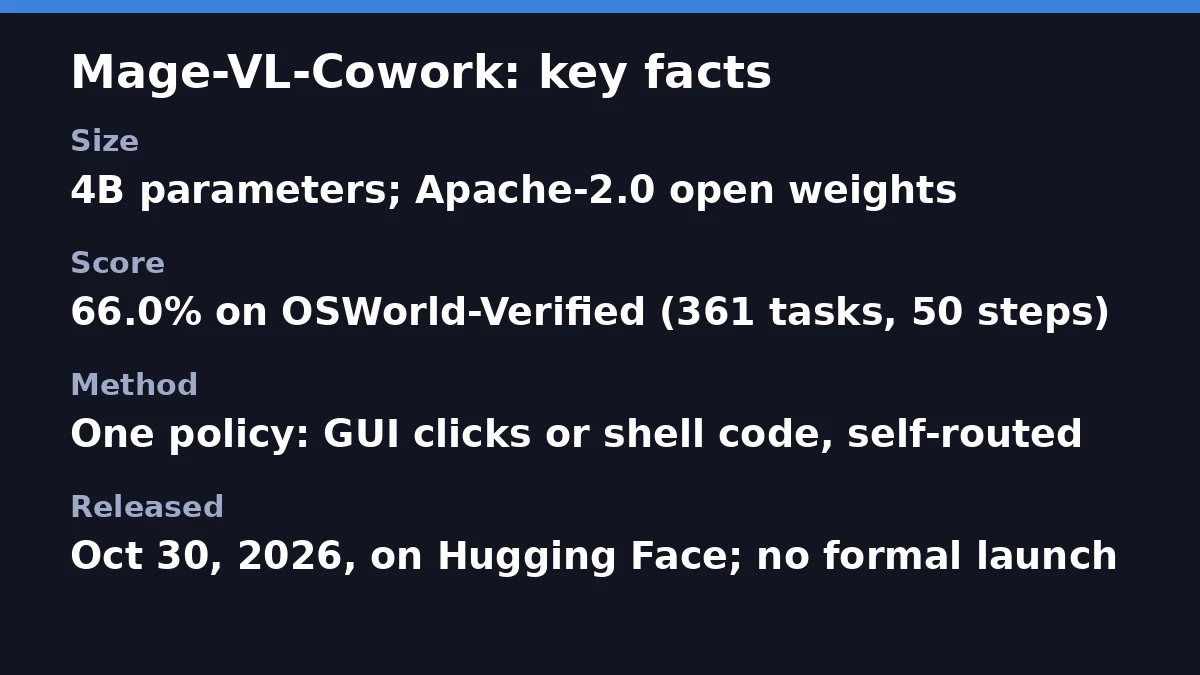
Microsoft’s Mage team has published Mage-VL-Cowork, an open-weight 4-billion-parameter computer-use agent that decides on its own whether to click through a desktop interface or to run code in a terminal, scoring 66.0% on the OSWorld-Verified benchmark.
The weights appeared on Hugging Face on October 30, 2026, under the permissive Apache-2.0 license, alongside a project page, evaluation code, and a technical report. There was no formal launch announcement from Microsoft; the release was detected on the platform by outside trackers.
One policy, two ways to act
Mage-VL-Cowork is a vision-language agent that operates a desktop through a single policy with two tool channels. Each turn, the model emits a short rationale, a one-line action summary, and a tool call that is either a GUI action (mouse clicks and keystrokes in normalized coordinates) or a shell command in a persistent Python environment. No separate router decides which channel to use; the model routes itself.
In one demo from the project page, asked to merge spreadsheet cells, the agent skipped the GUI entirely and edited the file with openpyxl in the terminal, finishing in 6 steps and 39 seconds and touching the interface only once.
The headline number and the recipe
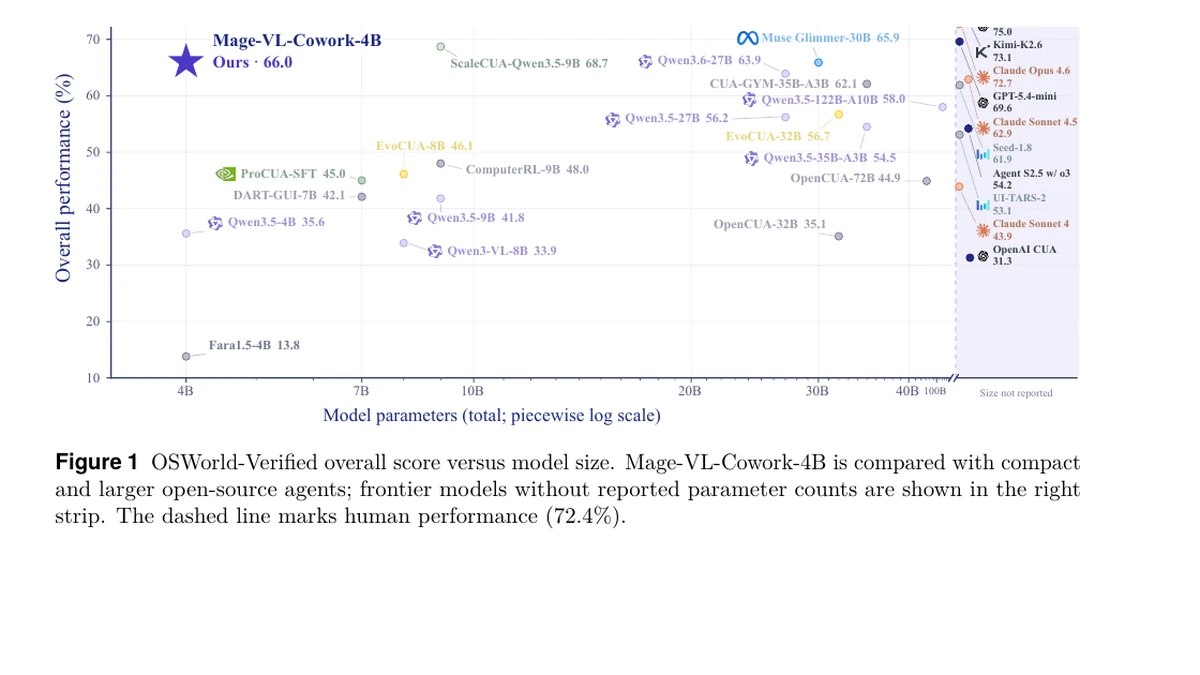
On OSWorld-Verified, a 361-task desktop-operation benchmark, Microsoft reports a 66.0% success rate under a 50-step budget, describing it as the best result at the 4B parameter scale. The team’s comparison table puts it ahead of larger open models including Muse Glimmer-30B at 65.9% and Qwen3.6-27B at 63.9%, though independent labs have not yet reproduced the numbers and the official leaderboard’s top score stands at 86%.
The more reusable contribution may be the training recipe. Mage-VL-Cowork was post-trained from an intermediate Mage-VL 4B checkpoint (Microsoft’s own Mage-ViT vision encoder plus Alibaba’s Qwen3-4B language backbone) through a five-stage “Specialize-then-Unify” curriculum: GUI-oriented midtraining, GUI agent SFT, coding and terminal SFT, hybrid agent SFT, and online hybrid RL. The team also built Mage-CUA-Forge, a workflow that synthesized 293,806 desktop and web tasks across 6,915 skills while cutting per-task data generation cost by 82.6%.
What it is not
Despite the name, Mage-VL-Cowork is a research checkpoint, not a product. Microsoft states the Mage models are “released for research purposes only and are not intended for product or service deployment.” It is also unrelated to Copilot Cowork, the paid agent inside Microsoft 365, and to Claude’s Cowork; Microsoft has a separate model, called Cowork 1, for the Copilot product.
Practical users should note the rough edges: as of October 31, community reports say no stock llama.cpp, Ollama, or LM Studio build can yet load the model’s vision projector, and the MLX port was still an open pull request. The bf16 weights total about 9.48 GB, with a community Q4 quantization near 2.7 GB.
Why it matters
Computer-use agents are among the most compute-hungry workloads in AI, and a 4B model that can run on a single workstation lowers the barrier for researchers and developers to experiment with self-hostable desktop automation. Whether the 66.0% figure holds up outside Microsoft’s harness will determine how much of this release is milestone and how much is marketing.