Updated October 15, 2026. This is a documentation-only review of Lovable’s public product, pricing, and privacy information. GPTOnline did not create an account, build or deploy an application, or run functional, performance, or security tests.
Lovable is an AI-assisted platform for creating web applications through conversational instructions and editable code. Its practical appeal is a shorter path from an idea to something a team can inspect: screens, interactions, and connected services. A convincing preview still needs review against the intended requirements. Generated software should not be described as automatically complete, secure, or ready for customers.
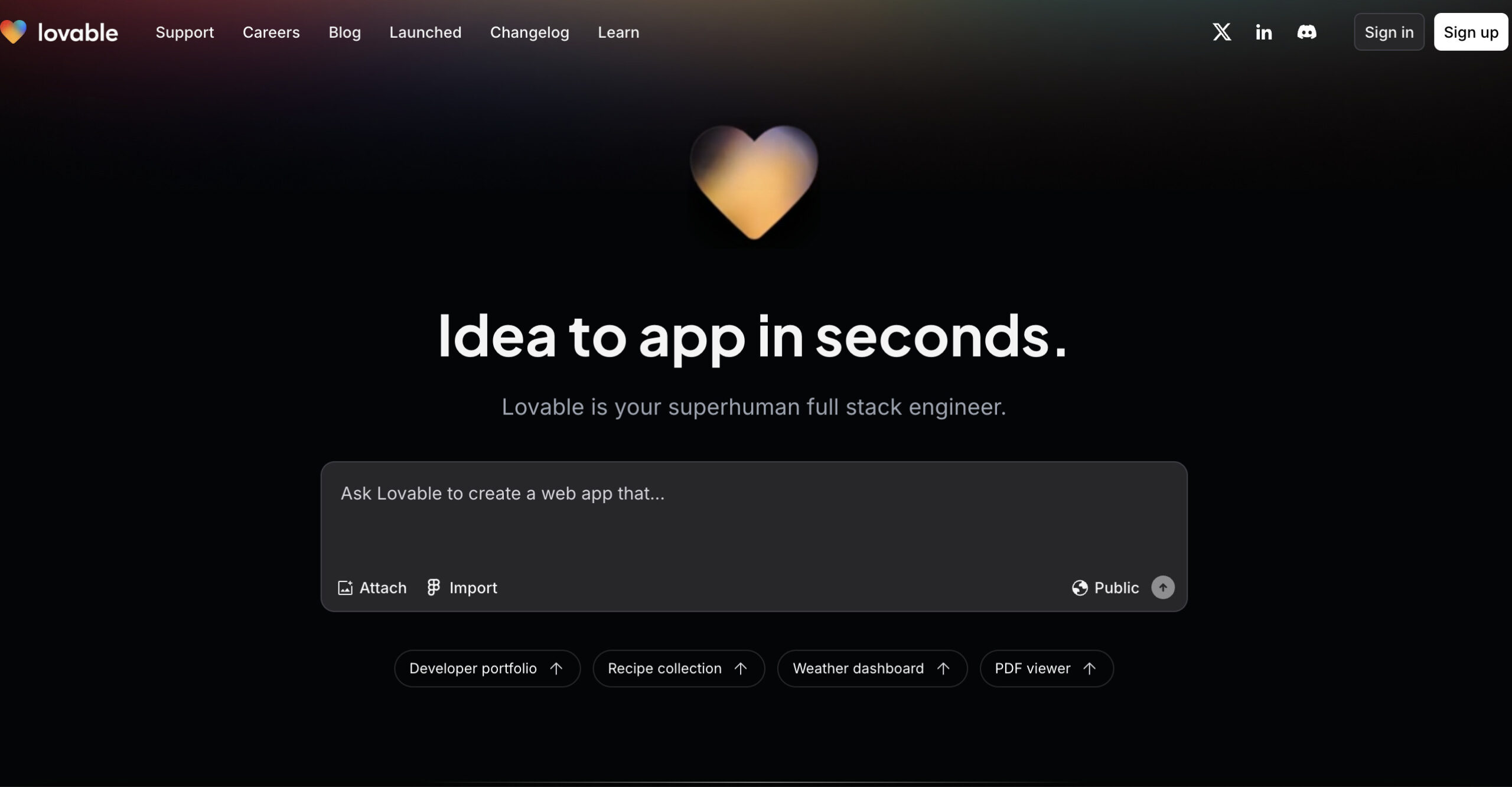
Historical Lovable homepage retained from the original March 2025 listing. The “Idea to app in seconds” and “superhuman” wording is vendor marketing, not a GPTOnline performance test or a guarantee of production readiness.
Who it suits
Consider Lovable for a limited prototype, a small internal workflow, or a web product whose requirements can be described clearly. It is particularly useful to evaluate when a designer or founder needs a concrete interface to discuss with a developer. If the main goal is a content-led website, our Framer guide provides another starting point for comparison. Decide first whether you need application logic, editorial publishing, or both.
Platform and backend
The official FAQ says new projects use TanStack Start, while legacy projects may still use React and Vite. Lovable does not offer a free choice of framework. It builds web applications; it does not generate React Native projects or provide a built-in app-store submission workflow.
Lovable itself has macOS and Windows desktop apps and iOS and Android mobile apps. Those apps let you work on projects; they do not turn the resulting project into a native mobile product. Some mobile workflows, including initial account creation and connecting OAuth integrations, still require the website.
Lovable Cloud supplies a built-in backend based on Supabase’s open-source foundation, including database, authentication, and storage. Connecting a separate Supabase project remains an option. Backend choice deserves attention early: the documentation does not offer one-click Cloud-to-Supabase migration.
Current pricing
The current pricing page lists Free, Pro, Business, and Enterprise. At the entry monthly tiers, Pro costs $25 and Business costs $50, each with 100 monthly plan credits. The plan documentation identifies these prices as USD. Enterprise pricing requires a sales discussion. Higher credit tiers and annual billing are separate choices. Credit values differ between plans, so equal credit counts do not imply equal runtime capacity.
Plans cover a workspace with unlimited collaborators rather than charging for each seat. Pro includes custom domains and badge removal; Business adds controls such as SSO and internal publishing. Check the selected billing period and credit tier before subscribing.
Budget beyond building
Credits and usage now describes one general credit balance spanning building, chat, Cloud resources, and AI features inside deployed apps. Usage-specific grants are applied first. Free includes five daily build credits, capped at 30 monthly; Free, Pro, and Business also currently receive monthly grants of 20 Cloud credits, four AI credits, and one connector credit. These monthly grants are temporary and may change.
Build-mode costs vary with the work. Plan mode costs one credit per message plus any research work it invokes. Runtime usage depends on factors such as database activity, storage, network traffic, and model calls. A fixed subscription therefore does not establish the total cost of an actively used application.
Hosting documentation distinguishes serving published pages from backend and AI activity. A site can remain published while credit exhaustion interrupts its backend or AI features. Track both development and operating usage, and budget separately for any external services you connect.
Code ownership and export
Lovable says users own their code, subject to applicable third-party rights. Git sync supports two-way synchronization with GitHub, GitLab, or Bitbucket, with one repository and one synchronized branch per project. Connecting creates a new repository; importing an existing repository as a Lovable project is unsupported. Paid plans also offer direct code downloads.
Exporting code is only part of an exit plan. Repository contents include database migration files, but not database records. A repository push updates the editor preview without automatically publishing the live site. Before relying on portability, identify how you would preserve data, stored files, credentials, and service configuration.
Privacy and training
Lovable’s September 15, 2026 privacy policy permits using customer content and usage data for its AI training, while excluding Business and Enterprise content and usage, account and billing details, and apps’ end-user data. Free and Pro users should review the training setting before entering confidential material.
The opt-out documentation describes a free account-level control that applies prospectively to your contributions. It does not change teammates’ settings or retract data from earlier training. Project visibility, published-site access, and training choices are different controls; check each deliberately.
Publishing and security
Publishing deploys a snapshot, so subsequent edits need another publish. The publish flow runs a Quick security scan, while a deeper scan is separate. Findings do not block publishing by default unless stricter workspace rules apply. Lovable’s security guidance explicitly warns that automated checks cannot guarantee complete security.
A safe prototype brief
For a fictional example, imagine “Lantern Shelf,” a board-game lending catalogue using invented game names and quantities. Start with a searchable list, a game-detail screen, and an availability filter. Use synthetic records and omit accounts, payments, personal contact details, and external integrations from the first version.
Write acceptance checks before prompting: an unavailable game must stay unavailable after refreshing; an empty search must explain the result; keyboard users must reach every control. Add a reservation concept only after the basic catalogue behaves consistently. This is an illustrative brief, not an application GPTOnline built.
What still needs validation
Before a real launch, test authentication, authorization between users, input validation, failed requests, mobile layouts, accessibility, data recovery, and realistic operating costs. Record expected and actual results rather than accepting a generated success message. Arrange qualified review for sensitive data or critical workflows. Our documentation review establishes advertised capabilities and stated limits; it cannot establish a particular app’s reliability, security, speed, or production suitability.
Visit Lovable’s official website to inspect the current product and plan details.