The Shanghai Artificial Intelligence Laboratory has published Sage-Med-Preview, a medical multimodal model that reads scans, answers clinical questions and drafts radiology reports. The model combines 35 billion total parameters with only 3 billion active per token, and the lab reports it beats much larger models, including GPT-5.4 and Claude-Opus-4.6, on its medical benchmark suite. The weights, a technical paper and a public leaderboard are all available now.
Sage-Med-Preview is built on the lab’s Intern-S2-Preview foundation model. It is designed as a single system for medical knowledge, image understanding, report generation and visual grounding, the task of pointing to the exact region of a scan that matches a description. Training combined continual pretraining, task-oriented mid-training, three-stage supervised fine-tuning and difficulty-adaptive reinforcement learning, using curated pools of about 164 million records and 226 billion tokens.
What the Lab Claims
According to the official model card, “Sage-Med-Preview is a medical multimodal model developed by the Shanghai Artificial Intelligence Laboratory, built on Intern-S2-Preview with 35B total and 3B active parameters.” The lab reports an average score of 58.26 across 31 public medical multimodal benchmarks, ahead of Hulu-Med-235B at 50.99, Intern-S2-Preview at 52.24, GPT-5.4 at 52.78 and Claude-Opus-4.6 at 49.18.
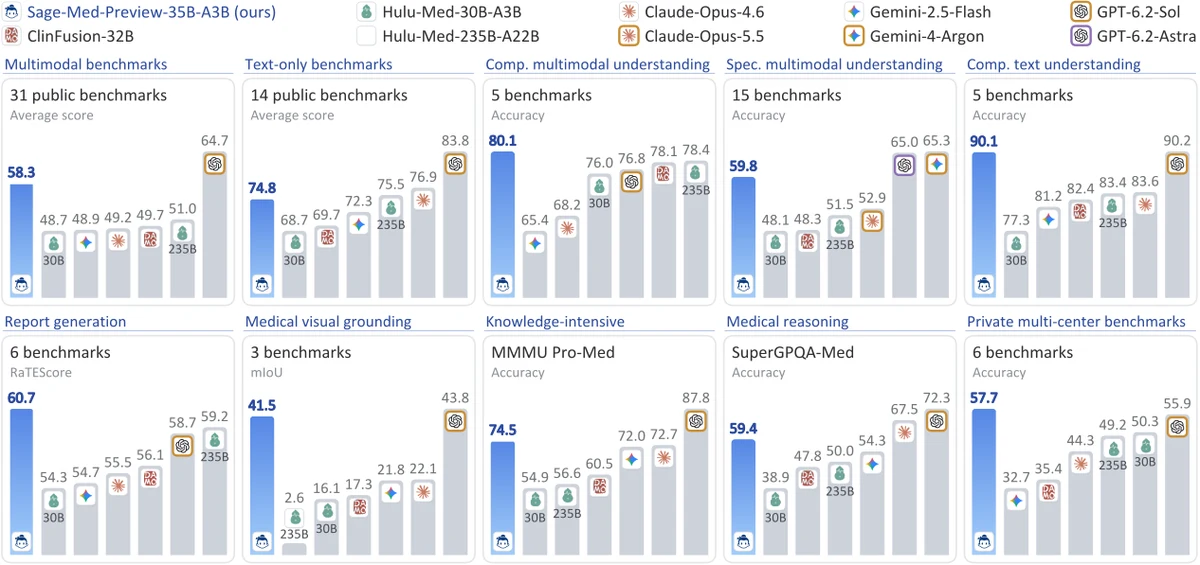
Sage-Med-Preview leads most panels but trails GPT-6.2-Sol on the 31-benchmark multimodal average. Image: Shanghai AI Laboratory.
The same figure, however, shows the model trailing OpenAI’s GPT-6.2-Sol on that 31-benchmark average, 58.3 against 64.7. Sage-Med-Preview leads GPT-6.2-Sol on narrower measures: comprehensive multimodal understanding at 80.05 against 76.81, MIMIC-CXR report generation at 33.37 against 30.31 ROUGE-L, and MedFrameQA accuracy at 65.52 against 62.78.
On private held-out clinical tasks, the lab reports an average of 57.72, ahead of GPT-6.2-Sol at 51.24. The evaluation covers 238 clinical tasks, 74 benchmarks and more than 40 imaging and signal modalities, with private benchmarks drawn from 14 hospitals and institutions. The results have not been independently verified, and the paper is a preprint, so the rankings should be read as the lab’s own claims for now.
Where It Falls Short
The lab’s own table shows uneven results. On visual grounding, Sage-Med-Preview scores 31.73 on MedSG-Bench, well behind GPT-6.2-Sol at 58.83. On knowledge-heavy tests such as MMMU Pro-Med and ClinHallu it also trails GPT-6.2-Sol, at 74.48 against 87.76 and 77.48 against 86.29. The model is strongest at medical understanding and report generation, and weaker at precise grounding and some reasoning tests.
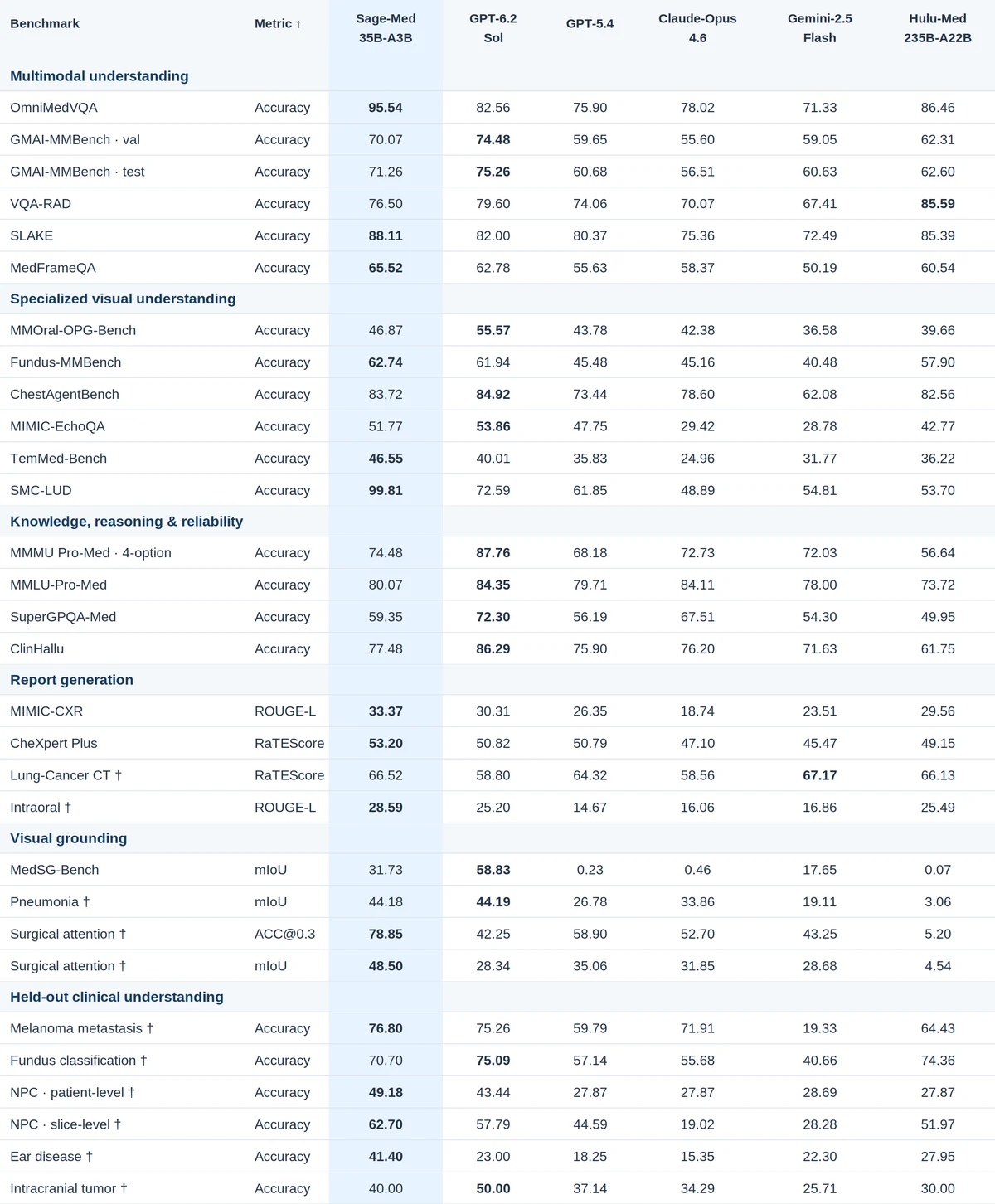
Full benchmark table from the Sage-Med technical report. Image: Shanghai AI Laboratory.
Availability
The weights are published on Hugging Face at huggingface.co/internlm/Sage-Med-Preview. The download is about 131 GiB, and the lab says the model runs on a single Nvidia H200 GPU in BF16 precision with a 32,768-token context, served through vLLM. The technical paper is on arXiv at arxiv.org/abs/2611.34575, and the code is on GitHub. A public leaderboard tracks results at sage-med-preview.github.io/leaderboard.html.
Why It Matters
Medical AI is judged on trust as much as accuracy. A model that drafts radiology reports or answers questions about a scan must be measured on held-out clinical data, not only public benchmarks, and Sage-Med-Preview’s evaluation leans on private hospital data for exactly that reason. If independent testing confirms the lab’s numbers, a 3-billion-active-parameter model that rivals frontier systems on medical tasks would be cheap enough for hospitals to run on their own hardware, keeping patient data inside their walls.
For now, the honest reading is narrower: a well-documented open release with strong self-reported results and clear weak spots, ready for the research community to test.
Sources
- Sage-Med-Preview model card, Hugging Face
- Sage-Med: Scaling Medical Multimodal Intelligence, arXiv
- Sage-Med project page, Shanghai AI Laboratory
- Sage-Med-Preview repository, GitHub