Sber has released GigaAM-v4 and GigaAM Multilingual-v2, two open speech recognition models under the MIT license, the company announced on November 27. The smaller model, GigaAM-v4, transcribes Russian and English speech with 238 million parameters, while the multilingual version covers 21 languages with 776 million parameters. Both models stream transcriptions live, returning partial text before a speaker finishes a sentence.
The release continues a busy week for Sber’s AI team, which unveiled the GigaChat 4 language model on November 26 and the multimodal GigaChat 3.5 Omni on the same day as GigaAM-v4. The weights for both speech models are published on Hugging Face under Sber’s ai-sage organization, and the code is on GitHub.
What Was Announced?
GigaAM-v4 is built on a Zapformer acoustic encoder, which replaces the Conformer encoder used in earlier versions. According to the official model card, “GigaAM-v4 is a Zapformer-based speech foundation model pretrained on 7 million hours of unlabelled audio and trained on 58,000 hours of supervised speech.” The multilingual model was pretrained on 10 million hours of unlabelled audio and trained on 155,000 hours of supervised speech.
Both models support full-context transcription and streaming with latencies of 160, 320 or 640 milliseconds, and they return both a raw transcript and a formatted, punctuated version. GigaAM-v4 ships with RNN-T and CTC decoder options, and both models can be exported to ONNX for on-device use. Developers can load them through the Transformers library.
GigaAM Multilingual-v2 covers Russian, English, German, French, Spanish, Italian, Dutch, Polish, Portuguese and Romanian, plus Central Asian and Caucasus languages including Kazakh, Kyrgyz, Uzbek, Tajik, Turkmen, Tatar, Azerbaijani, Bashkir, Belarusian, Armenian and Georgian.
How Accurate Is It?
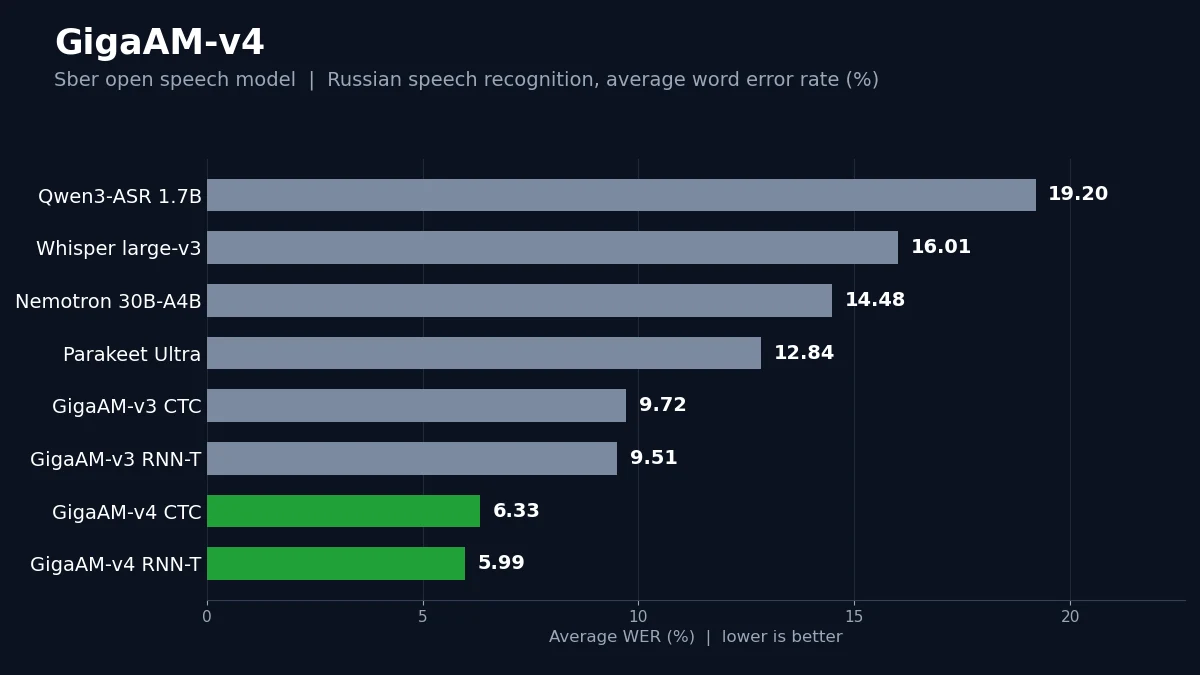
On Russian speech, GigaAM-v4 posts an average word error rate of 5.99% across four public and five in-house test sets, down from 9.51% for GigaAM-v3 and far below OpenAI’s Whisper large-v3 at 16.01%. Word error rate measures the share of words transcribed incorrectly, so lower is better. The result means the new model makes roughly two and a half times fewer errors in Russian than Whisper large-v3.
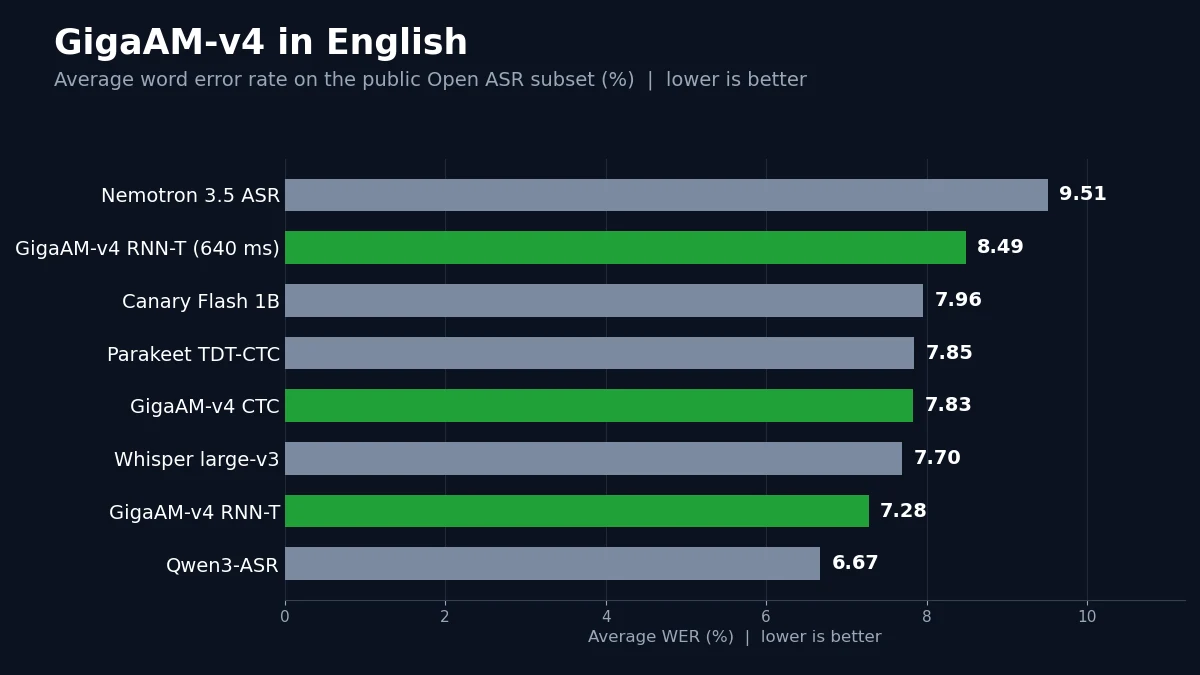
GigaAM-v4 beats Whisper large-v3 in English, but trails Alibaba’s Qwen3-ASR. Chart: GPTOnline, using data from the Sber GigaAM-v4 model card.
In English, the picture is closer. GigaAM-v4 averages 7.28% word error rate on the public portion of the Open ASR benchmark, edging Whisper large-v3 at 7.70%, but trailing Alibaba’s Qwen3-ASR at 6.67%. The streaming version at 640 milliseconds latency averages 8.49% in English.
The multilingual model shows the widest gap. Across 21 languages it averages 3.96% word error rate in full-context mode and 5.58% while streaming, against 44.09% for Whisper large-v3. The gap is driven by low-resource languages: on Bashkir, for example, Whisper large-v3 scores 96.49% while GigaAM Multilingual-v2 scores 2.74%.
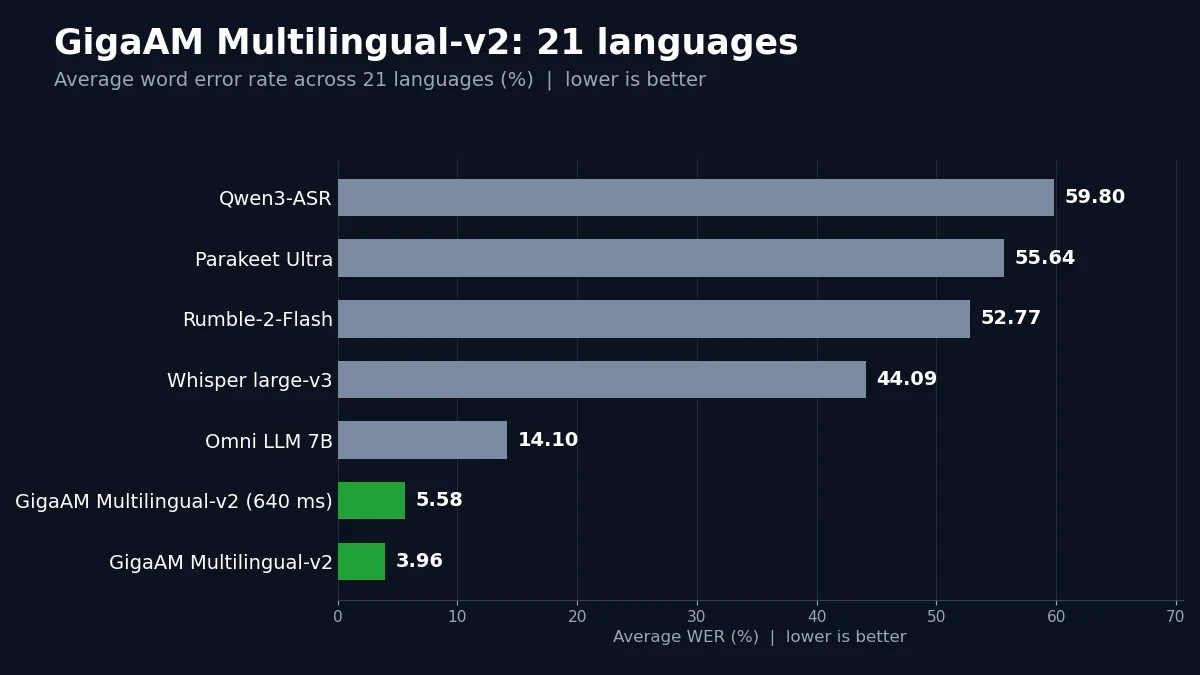
The multilingual model’s lead is widest on low-resource languages, where rival models top 100% error rates on some languages. Chart: GPTOnline, using data from the Sber GigaAM Multilingual-v2 model card.
All of these figures are Sber’s own measurements from its model cards, not independent evaluations, and the company has not published results on Hugging Face’s Open ASR Leaderboard. Readers should treat the rankings as the developer’s claims until third-party testing confirms them.
Why It Matters
Speech recognition is one of the most practical corners of AI, powering subtitling, voice assistants, call-center analytics and meeting transcription. A 238-million-parameter model that runs on-device and under a permissive MIT license gives developers a free alternative to hosted APIs, with no usage fees and no data leaving their own infrastructure.
The release also matters for Sber’s own stack: GigaAM supplies the audio encoder inside GigaChat 3.5 Omni, the company’s new multimodal model. Improving the speech model therefore improves the whole GigaChat family at once.
Pricing and Availability
Both models are free to use, including in commercial products, under the MIT license. GigaAM-v4 is available at huggingface.co/ai-sage/GigaAM-v4 and GigaAM Multilingual-v2 at huggingface.co/ai-sage/GigaAM-Multilingual-v2. Source code and usage examples are in the GigaAM repository on GitHub.
Sources
- GigaAM-v4 model card, Hugging Face
- GigaAM Multilingual-v2 model card, Hugging Face
- GigaAM repository, GitHub
- Sber introduces multilingual speech recognition model, ixbt.pro, November 27, 2026
- GigaAM-v4: streaming recognition and 21 languages, NeuralBridge, November 27, 2026