PrismML has released Ternary Bonsai 2.5 27B, an upgrade to its compact coding model that keeps the same 5.9 GB footprint while closing most of the performance gap to the full-precision model it is based on. The weights are available now under the Apache 2.0 license, free for commercial use. PrismML announced the release on November 24, 2026, pitching it as the strongest model of its memory footprint for agentic work: “The result is by far the strongest AI model of its memory footprint for agentic workloads.”
Bonsai 2.5 is based on Qwen3.8 27B and uses ternary weights, compressing the model to about 1.76 bits per weight. The most compact file, at 5.93 GB, is about nine times smaller than the 53.8 GB full-precision reference. The point of the release is not the compression alone but what survived it: the previous Bonsai 2 lost much of its agentic ability in compression, and version 2.5 recovers most of it through retraining rather than a larger file.
Benchmarks: the agentic gap narrows sharply
PrismML evaluated Bonsai 2.5 against Bonsai 2 and the full-precision Qwen3.8 27B base model, and reports the results in its announcement and whitepaper. Across agentic coding benchmarks, the new model averages 54.2, up from 37.9 for Bonsai 2. The headline number is SWE-bench Verified, a test of fixing real GitHub issues, where Bonsai 2.5 scores 75.6, up from 60.8 for Bonsai 2 and close to 80.6 for the full-precision base model.
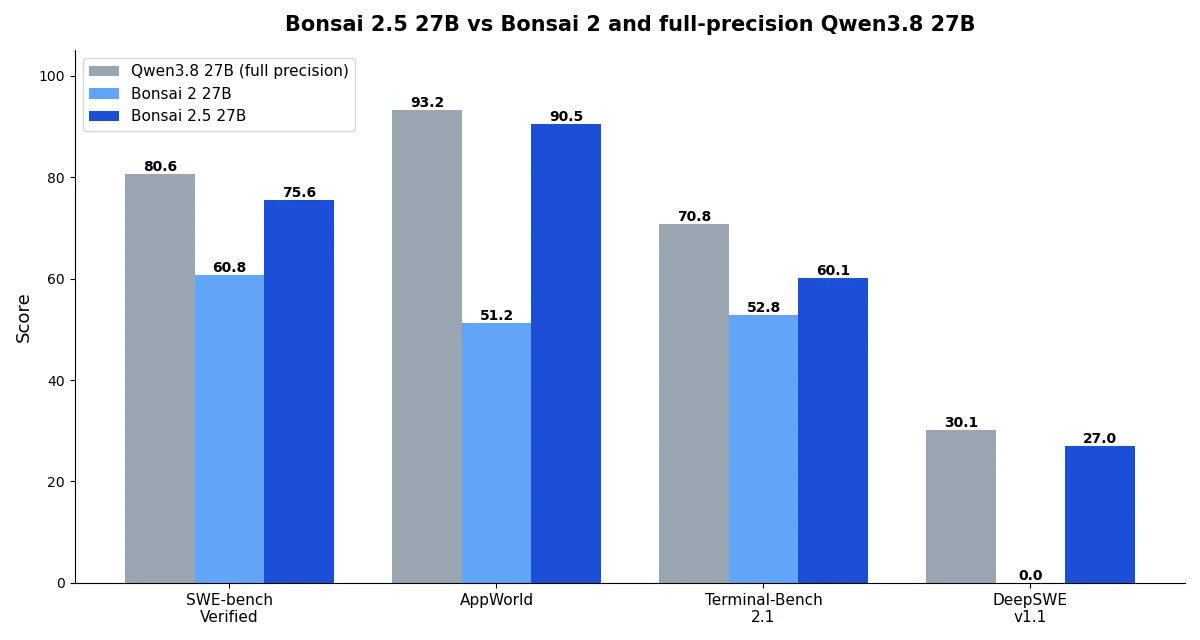
Bonsai 2.5 27B against Bonsai 2 and full-precision Qwen3.8 27B on four agentic benchmarks. Chart: GPTOnline, based on PrismML data.
The gains are broad rather than concentrated in one test. On DeepSWE v1.1, Bonsai 2 scored zero; Bonsai 2.5 scores 27, against 30.1 for full precision. On AppWorld, a tool-use benchmark, the score jumps from 51.2 to 90.5, near the 93.2 of the full model. On Terminal-Bench 2.1 it rises from 52.8 to 60.1. Not every number improves: on LiveCodeBench v6, Bonsai 2.5 scores 83.0, slightly below Bonsai 2 at 83.8. All scores are company-reported and have not been independently reproduced.
Speed and where it runs
On a single NVIDIA H100, Bonsai 2.5 generates 291 tokens per second with multi-token prediction and processes a 2,000-token prompt at 3,200 tokens per second. On a consumer RTX 4090, it delivers 204 tokens per second with multi-token prediction and about 3,060 tokens per second of prompt processing. That makes it practical for local coding agents on hardware developers already own.
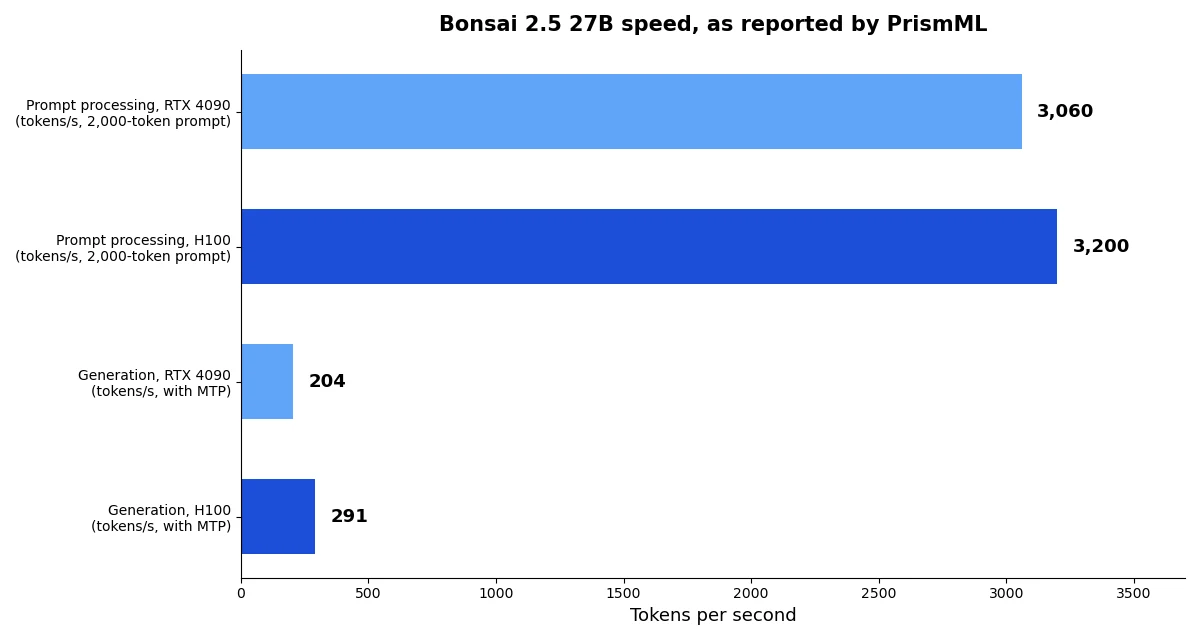
Bonsai 2.5 27B generation and prompt processing speed on H100 and RTX 4090. Chart: GPTOnline, based on PrismML data.
The model runs on NVIDIA and Intel GPUs through llama.cpp and on Apple devices, Mac, iPhone, and iPad, through MLX. One practical catch: the smallest 5.93 GB file loads only in PrismML’s own llama.cpp build, while stock builds need the larger 7.67 GB Q2_0 file. PrismML also says the release addresses excessive thinking and repetitive loops in the previous model, completing tasks in fewer turns and with fewer tokens.
Why it matters
Agentic workflows punish small errors: a mistake in one tool call compounds across the next ones and can derail a whole task. That is why compressed models have struggled with agents even when their chat scores looked fine. Bonsai 2.5 matters because it shows ternary compression can now preserve most of the agentic behavior of a 27B model in a file small enough to run locally, keeping private code and documents on the device instead of sending them to a remote API. For developers building coding assistants into products that handle sensitive material, a 5.9 GB model that scores 75.6 on SWE-bench Verified changes what can ship on local hardware. The remaining gap to full precision, about five points on that benchmark, is the price of the compression, and PrismML’s whitepaper gives the full method for anyone who wants to check the trade-off.