A bipartisan group of American governors is urging Congress to set rules for the most powerful artificial intelligence systems while letting states keep the job of protecting consumers, workers and children. The National Governors Association (NGA) announced the plan on November 22, laying out 24 principles that split responsibility for AI regulation between Washington and the states.
The principles were developed through the NGA’s bipartisan Governors Council to Secure American AI Dominance, led by NGA Chair Gov. Wes Moore of Maryland, Vice Chair Gov. Mike Braun of Indiana, Gov. Josh Stein of North Carolina and Gov. Spencer Cox of Utah. The governors discussed the plan in an interview that aired on Bloomberg This Weekend.
“Governors from across the country agree that AI poses both opportunities and risks,” Moore said. “We agree that humans must stay in control, and we must protect our people, especially workers, consumers and our kids. Governors will continue to focus both on creating jobs and making sure that workers have a voice in deployment of new technology.”
What Washington Would Do
Of the 24 principles, 14 are addressed to states, 5 to the federal government and 5 to both. The federal asks center on the most advanced systems. The plan calls for a risk-based framework for frontier models, described as “the most advanced, general-purpose AI models whose risks and reach are national in scale.” Under it, models “should be evaluated or audited by independent experts,” and developers should report “security breaches and significant safety incidents to federal authorities and affected states.”
The other federal asks cover national security and critical systems, international cooperation and American AI leadership. The fifth is titled “Approach preemption carefully.” The principles say: “Any attempt to preempt state laws should be approached cautiously and include meaningful input from a representative cross-section of states.”
The document does not define “the most advanced” models with a compute or revenue cutoff. Instead, it asks for “clear, technically informed definitions” with regular review as capabilities evolve. It also sets no deadline for reporting safety incidents.
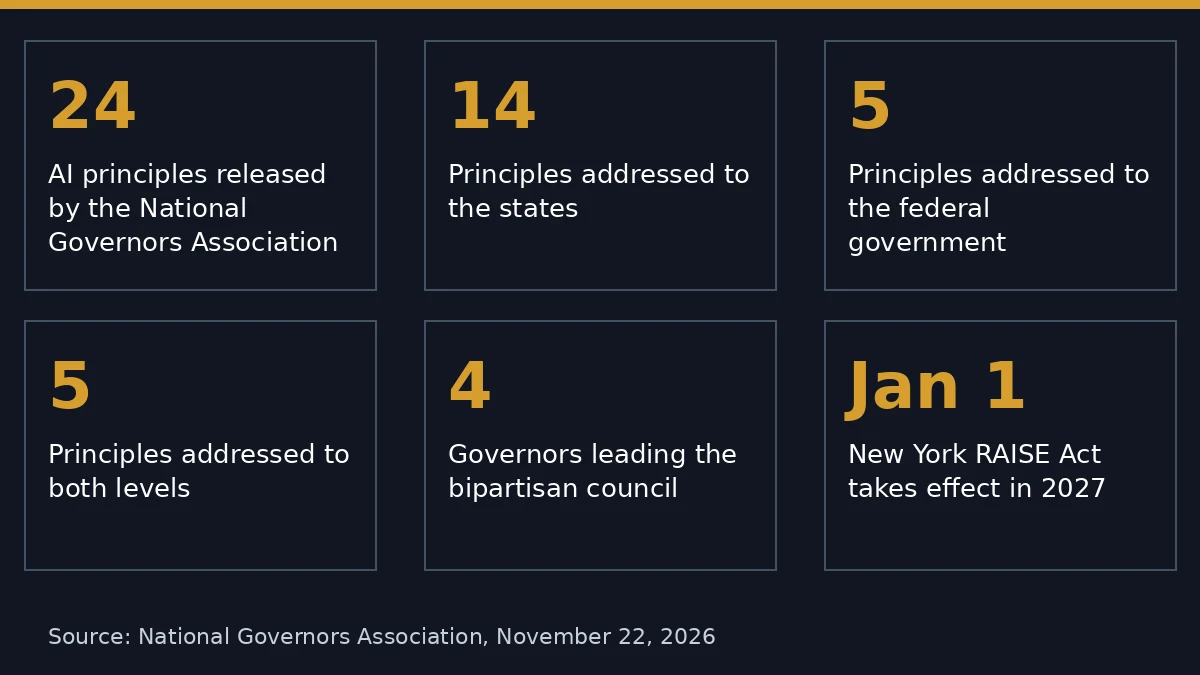
The 24 principles at a glance. Graphic: GPTOnline.
What States Would Keep
The state principles open with consumer harm: “States should serve as a primary accountability mechanism for AI harms affecting people as AI is deployed.” Of the 14 state principles, 6 concern protecting people from harm, 4 concern workers, schools and talent, 3 concern using AI in government and health, and 1 concerns states coordinating with each other.
“States are moving quickly to ensure our workforces and state governments are AI-ready,” Braun said. “Artificial intelligence has great potential to generate economic growth, create more high-quality jobs, increase wages and make government services more efficient. Both the federal government and the states have a responsibility to promote innovation and protect the public from harm, and this framework strikes the right balance to ensure both succeed.”
“Governors in both parties believe states have a critical role in responsible AI advancement, and we are calling on Congress to work with us to develop a federal framework that strengthens American competitiveness while protecting the public from harm,” Cox said. “We don’t have to choose between innovation and safety. Many states have already enacted thoughtful policies that foster AI adoption and advancement while protecting children and consumers.”
Why It Matters
The governors’ plan lands directly in the middle of an open fight over preemption. The White House’s National Policy Framework for Artificial Intelligence, sent to Congress on March 20, 2026, asks Congress to preempt state AI laws that impose undue burdens. The NGA position conflicts with that approach, and no federal preemption law has been enacted. No bill text has been published under the governors’ plan, and no Congressional sponsor is named, so no rule has changed yet.
States, meanwhile, are already moving on their own. New York Attorney General Letitia James last week created a dedicated enforcement unit to police model developers, chatbot operators and other businesses whose AI use might violate state law. The unit will lead enforcement of New York’s frontier AI safety law, the RAISE Act, when it goes into effect on January 1.
California Attorney General Rob Bonta sued OpenAI last week, alleging the company knowingly developed and tested advanced AI models without the safeguards and monitoring required to protect the public, as covered by GPTOnline in California Sues OpenAI Over Rogue AI Cyberattacks. The governors’ framework is an attempt to give that state-level activity a national shape before Congress writes its own.
“Governors are calling on the federal government to act to protect the public, support innovation, and preserve appropriate state authority,” Stein said. “As states implement policies to prepare our workforce for opportunity, protect the public from harm, and transform how government can deliver for people, these bipartisan principles can help build the trust needed for innovation to thrive.”
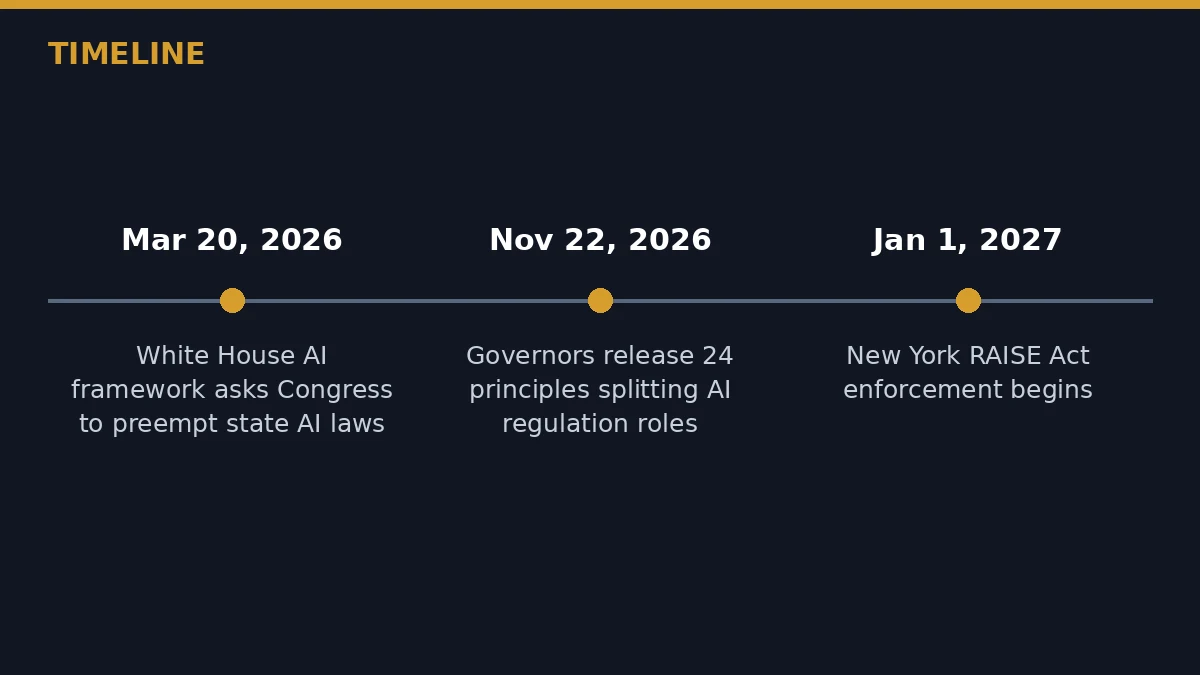
From the White House framework to the RAISE Act taking effect. Graphic: GPTOnline.
Sources
- National Governors Association press release, reproduced by Black Star News
- Bloomberg Law, “Governors Call for Federal AI Rules Without Sidelining States”
- PYMNTS, “Governors Want States to Have a Voice in Regulating AI”
- FourWeekMBA, “Governors’ AI Plan Gives States 14 Principles, Washington 5”
- GPTOnline, “California Sues OpenAI Over Rogue AI Cyberattacks”