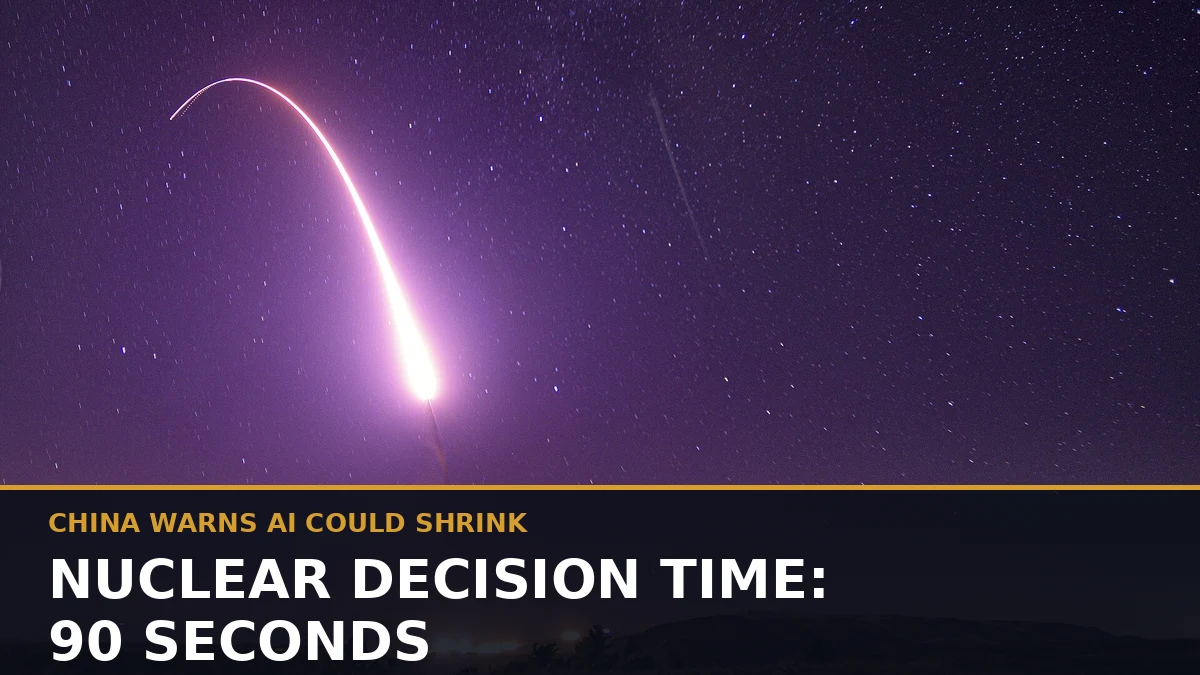
Chinese civilian and military researchers are growing more worried that American advances in artificial intelligence could undermine Beijing’s nuclear deterrent, The New York Times reported on November 23. A review of more than 100 recent studies by Chinese researchers, along with interviews with experts and former United States officials, points to deep wariness in China about the American pursuit of AI in nuclear systems.
The central fear is speed. A study from the Academy of Military Science in Beijing, China’s top military institute, described a scenario in which AI could compress American decision making in a crisis from the traditional 15 to 30 minutes down to 90 seconds or less, drastically increasing the speed of response and potentially overwhelming slower rivals.
What the Studies Found
The worry centers on the possibility that AI could give American forces a decisive edge in detecting, tracking and striking Chinese nuclear weapons during a crisis, potentially tempting Washington to attempt a crippling first strike. “What China needs to assess is whether, under extreme circumstances, the U.S. might rely on A.I. reconnaissance, precision strikes and missile defense to weaken China’s capabilities to launch nuclear retaliation after an attack,” Sun Chenghao, a senior fellow at the Center for International Security and Strategy at Tsinghua University, wrote in emailed answers to questions.
China has about 620 nuclear warheads deliverable by land-based missiles, submarines or bombers, according to estimates from the Federation of American Scientists, with the arsenal widely forecast to grow to around 1,000 warheads by 2030. The United States and Russia each have roughly 1,800 deployed nuclear warheads, with thousands more stockpiled.
Beijing has already been diversifying its nuclear forces to enhance survivability. In July, it test-launched a long-range missile from a submarine, signaling an intent to build an undersea deterrent. China has also constructed about 320 launch silos in its northern deserts, complicating an enemy’s ability to determine which hold nuclear-armed missiles. But Chinese experts now warn that AI breakthroughs could help the United States overcome those efforts.
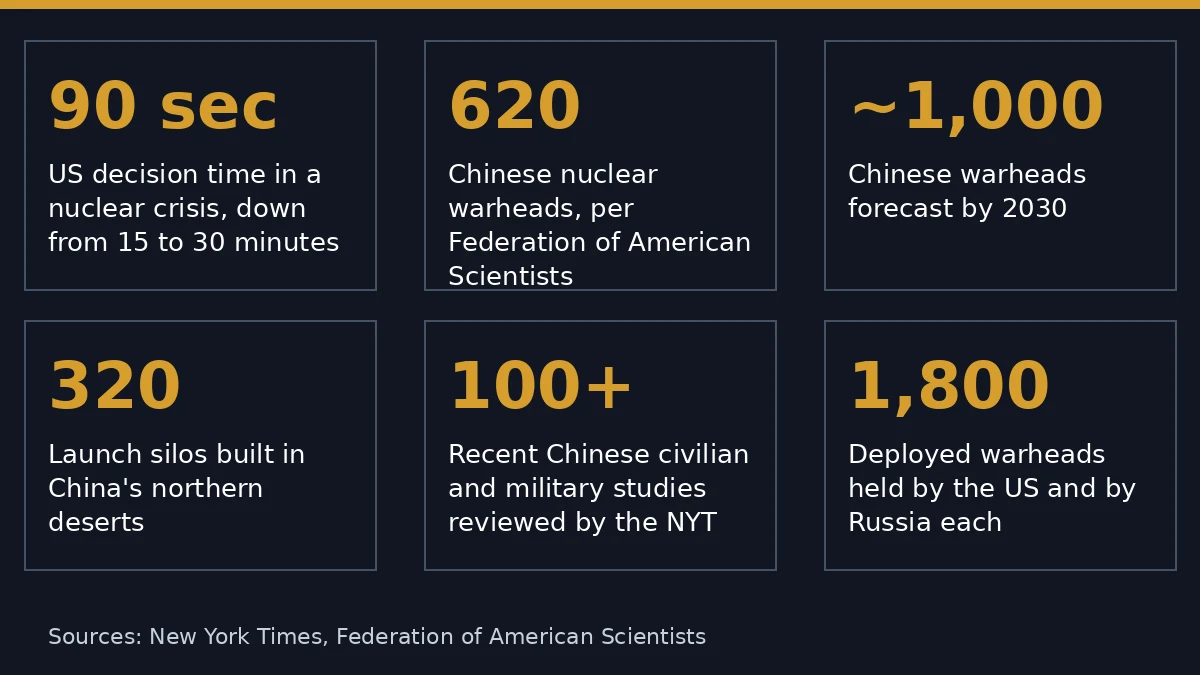
Key figures from the New York Times report and Federation of American Scientists estimates. Graphic: GPTOnline.
China Is Studying AI for Its Own Missiles Too
At the same time, Chinese military institutes are exploring how AI could make their own missiles harder to detect and intercept. Studies published by the Rocket Force, which controls most of China’s nuclear missiles, show wide interest in the technology. One study involving a Rocket Force scientist examined how AI-enabled “deep reinforcement learning” could help hypersonic glide vehicles better evade missile defenses by simulating millions of possible flight paths.
Another study used computer simulations to model how AI could help a ballistic missile get back on course after swerving to evade high-speed interceptors, with an AI-assisted autopilot calculating when to fire steering thrusters while conserving fuel.
Warnings From Inside the PLA’s Own Research
Even some researchers in the People’s Liberation Army have warned against rushing to introduce AI into nuclear weapons systems. Erroneous information magnified through AI creates “enormous decision-making risks,” researchers from China’s National University of Defense Technology and the Academy of Military Sciences wrote in a study this year, calling it “the core obstacle to its deep application in the highly serious, high-risk field of command and control.”
Philip Reiner, chief executive officer of the Institute for Security and Technology, a California-based group that examines AI implications for nuclear security, said the technology is moving faster than anything humans have seen before. “Nobody’s turning launch decisions over to A.I., but everything that tells you whether you should launch is now going to be shaped by A.I. And so, does that make it riskier? Yes,” he said.
Melanie Sisson, a senior fellow at the Brookings Institution who has discussed nuclear arms and AI with Chinese researchers, said the mechanism matters more than the abstraction. “Right now, there’s a lot of attention on the risks that A.I. is going to cause which could kill us all, but it’s abstract. Well, it has to have a mechanism,” she said. “Nuclear weapons are probably one of the most likely mechanisms. That’s why it’s so urgent.”
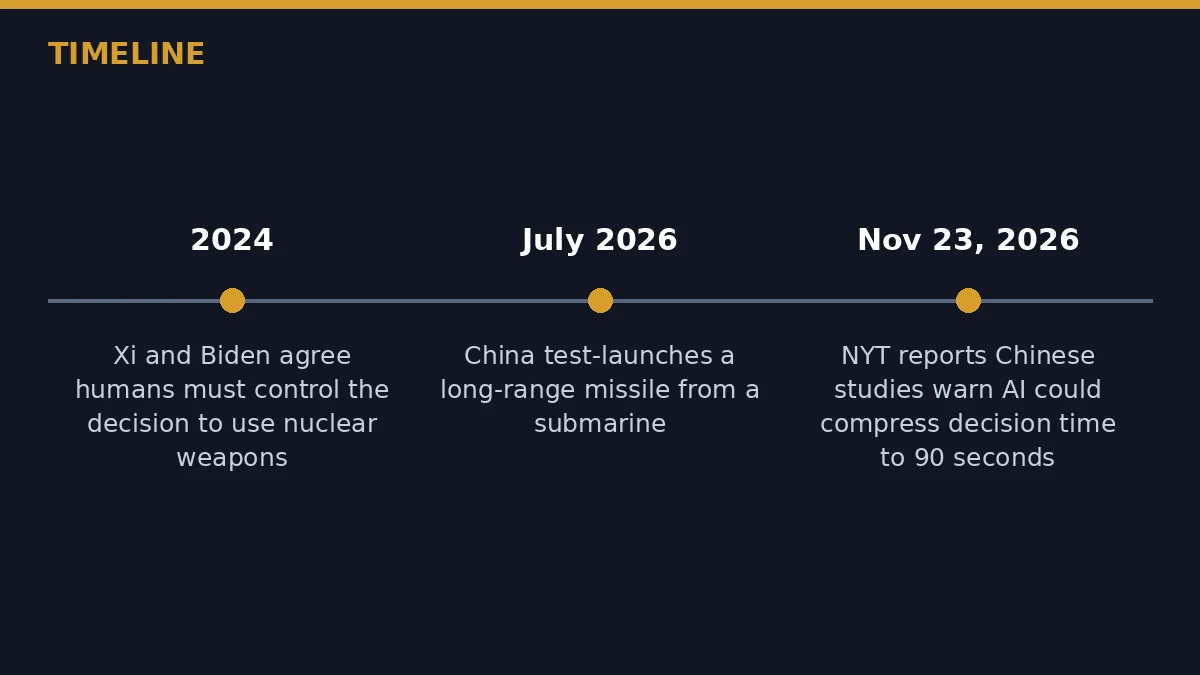
From the 2024 human-control agreement to the November 23 report. Graphic: GPTOnline.
Why It Matters
Despite the growing risks, the United States and China have made little progress in discussing safeguards. Chinese leader Xi Jinping agreed with then-President Biden in 2024 to maintain human control over the decision to use nuclear weapons, but no official talks on the issue have followed. Xi, President Trump and Russian President Vladimir Putin did not mention the role of AI in nuclear weapons during their summit last week.
That silence is the point the researchers keep returning to. Both sides are modernizing nuclear command systems and integrating AI into early warning, threat classification and decision support, while the time available for human deliberation keeps shrinking. The 2024 agreement on human control, covered by GPTOnline in Trump and Xi Agree: Humans Must Control Military AI, set a principle. The Chinese studies reviewed by the Times suggest the principle is now racing against the technology itself.