Thinking Machines Lab released Inkling 2 Mini on November 20, a small open-weights model built to run on a laptop while beating larger rivals on agentic coding tests. The release is the lab’s first looped transformer, a design that reuses the model’s middle layers to squeeze more reasoning out of fewer parameters.
“Today we are releasing Inkling 2 Mini, a fast, powerful model that’s small enough to run on your laptop,” the lab wrote in its announcement. The model is available now with open weights on Hugging Face and on the lab’s own platform, Tinker, for inference and customization.
What Is a Looped Transformer?
Inkling 2 Mini is a mixture-of-experts model with 26.4 billion total parameters, of which 3.4 billion are active for each token. Its 24 layers are split into four blocks of six. The first and last blocks run once per token, while the two middle blocks run three times, so each token passes through 48 layer visits in total. Thinking Machines Lab says the middle layers carry the more abstract reasoning, so repeating them lets the model “apply more reasoning and reach the right answer with fewer tokens, especially on tasks such as agentic coding that depend on reasoning quality.”
The trick is not free. Because the model does more computation inside each token instead of writing its reasoning out, its chain of thought gets shorter. The lab studied that trade-off closely and released a second, variable-loop research model alongside Inkling 2 Mini so outside researchers can test how looping affects oversight.
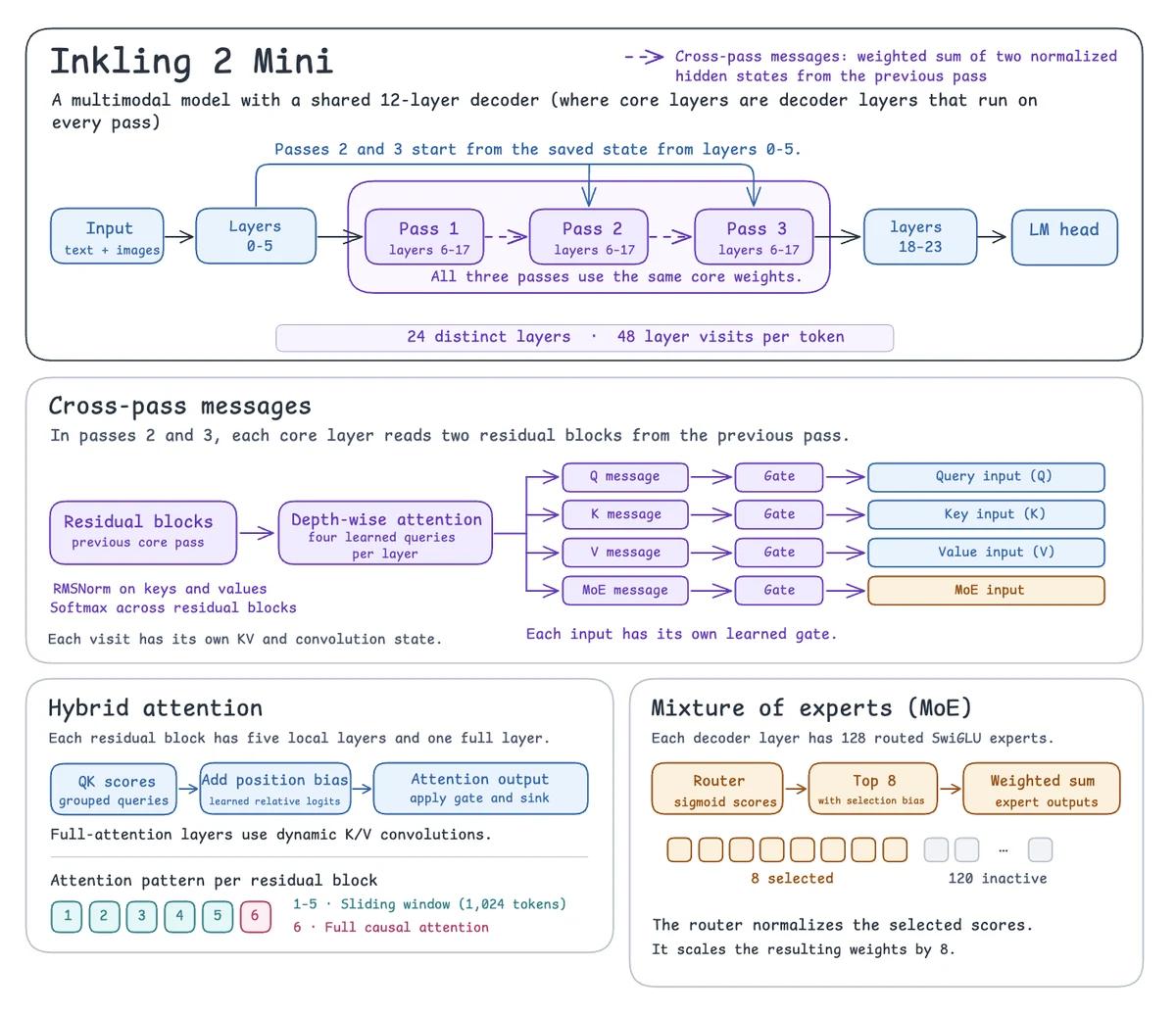
Inkling 2 Mini runs its middle layers three times per token, reaching 48 layer visits from 24 stored layers. Image: Thinking Machines Lab
Benchmarks: Small Model, Big Coding Scores
On the lab’s own measurements, Inkling 2 Mini leads every open-weights model with less than 100 billion total parameters on agentic coding. It scored 48.2% on DeepSWE v1.1 and 77.9% on the hard set of SWE-bench Pro v2, ahead of Qwen3.8-27B at 42.2% and 73.8% on the same tests. It also scored 79.2% on SWE-bench Verified and 46.5% on the Vals Index v2.2. On the Artificial Analysis Intelligence Index v5, it scored 20.1, tied with Qwen3.8-27B for the best reported score in its class while using roughly five times fewer active parameters.
The model is also fast. Thinking Machines Lab says it runs faster than similarly performing models, and Artificial Analysis measured it at about six times cheaper and four times faster per task than Qwen3.8-27B.
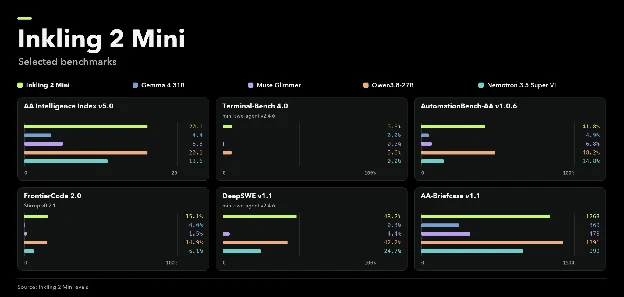
Inkling 2 Mini leads comparable open-weights models on coding, agentic search and knowledge work benchmarks. Image: Hugging Face / Thinking Machines Lab
Built for Local Hardware
Most of the model’s weights were trained and deployed natively in 4-bit NVFP4 precision, with the last four layers in 8-bit MXFP8. The full checkpoint is about 20GB, small enough to run on consumer laptops and desktop AI computers. The lab’s researchers took it on a flight, where it ran offline on a MacBook Pro with an M5 Pro chip and 48GB of memory and built a playable flight simulator in a few minutes. At launch, the model runs on any Mac with at least 32GB of memory through Ollama, and SGLang offers day-one inference support for data center hardware. Stanford researchers who tested the model early measured 0.703 intelligence per joule on an Nvidia DGX Spark, against 0.430 for Qwen3.6-35B-A3B.
The model accepts text and image inputs, generates text, and supports a context window of up to 1 million tokens. It is released under the Apache 2.0 license. Thinking Machines Lab also showed the model running 20 persistent agents at once, powering every resident of a tiny pixel town it calls Thinkyville, on a single offline MacBook.
The Oversight Question
Looped models raise a real question for AI safety research: if a model reasons more inside its layers, less of that reasoning shows up in the chain of thought that monitors can read. Thinking Machines Lab measured the effect and reports a nuanced result. With more loops, the variable-loop model’s chain of thought got shorter but stayed legible, and its ability to deliberately steer its chain of thought stayed very low: it followed a chain-of-thought instruction at most 0.1% of the time, compared with 1.3% for Qwen3.8-27B. The lab concludes that “at this scale we do not see a meaningful reduction in the monitorability of their reasoning,” while inviting outside researchers to keep testing.
Limits
The lab is open about the model’s weaknesses. Looping adds reasoning, not knowledge, so factual recall stays in line with other models of the same size. Inkling 2 Mini scored 50.0% on MultiChallenge and 33.4% on ComplexConstraints v1.1, behind Qwen3.8-27B on both, and it trails larger models on hard reasoning tests such as HLE-Diamond, where it scored 15.2%. In internal testing it also sometimes got stuck in long reasoning loops while debugging code.
Why It Matters
Inkling 2 Mini is the second release in Thinking Machines Lab’s Inkling 2 line, following Inkling 2 Small, and it pushes a notable idea into the open: small models can close much of the gap with big ones by spending more compute per token instead of adding parameters. If the looped design holds up in independent testing, it gives developers a capable coding agent they can run locally, offline and cheaply, with fewer tokens and less hardware. The open weights, including the variable-loop research model, also give safety researchers a rare chance to study looped transformers directly.