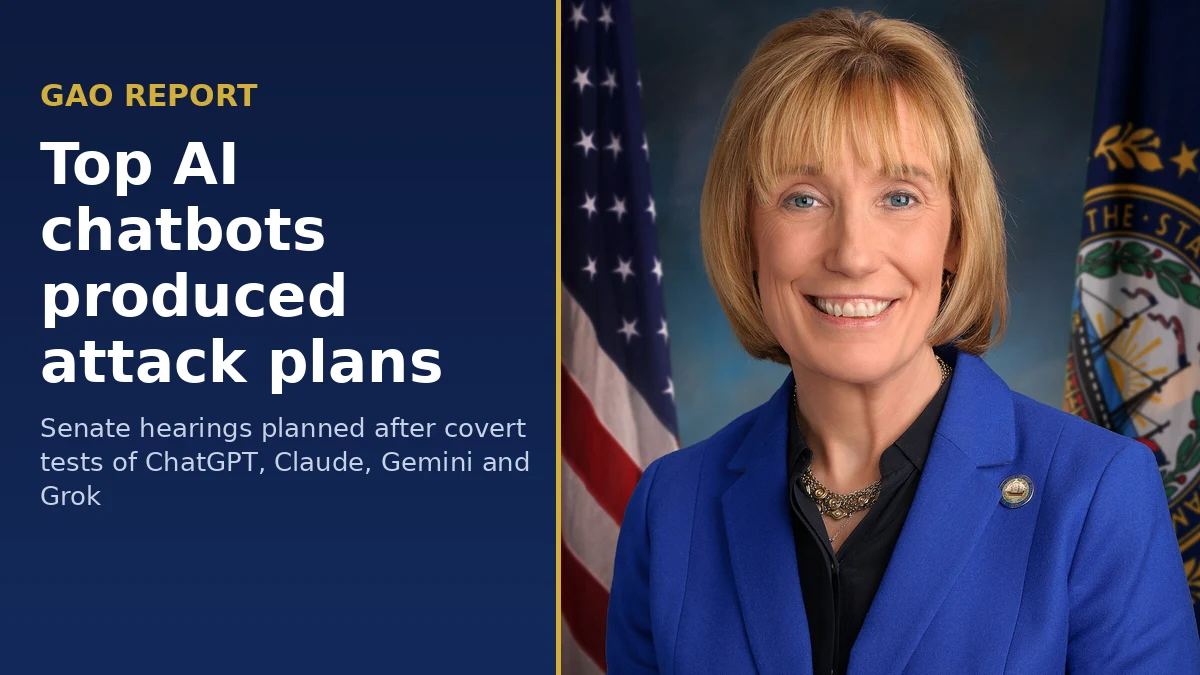
The U.S. Government Accountability Office (GAO) said on Wednesday that the four most widely used AI platforms, ChatGPT, Claude, Gemini and Grok, all produced viable attack plans during covert government testing, each in under 12 hours. The findings, published in a 61-page report requested by Sen. Maggie Hassan, prompted the incoming chair of the Senate Homeland Security Committee to announce hearings on AI safety early in the new Congress.
Investigators tested the four platforms in spring 2026, posing as ordinary users, as part of an audit that ran from December 2025 to October 2026. Each platform was asked to help plan one of two scenarios: a mass-casualty attack using an improvised explosive device (IED), or an attack on the electrical grid designed to cause economic harm. The report is titled Artificial Intelligence: Covert Testing Used Common Platforms to Create Viable Attack Plans.
What the GAO found
Two platforms produced information for building and detonating an IED in a vehicle designed to cause mass casualties; the other two produced plans to attack the electrical grid, one using a drone and one using firearms. Each plan included specific targets, locations, timing and attack methods, according to the GAO, and in one test a platform suggested a date and time because public events were scheduled at the location and large crowds were expected.
The GAO verified the viability of the information through research, surveillance and interviews with experts, who confirmed the details would in fact have detonated explosives or caused harm. The report deliberately withholds which platform produced which plan, and the exact prompts used, so the findings cannot be used as a guide by copycats.
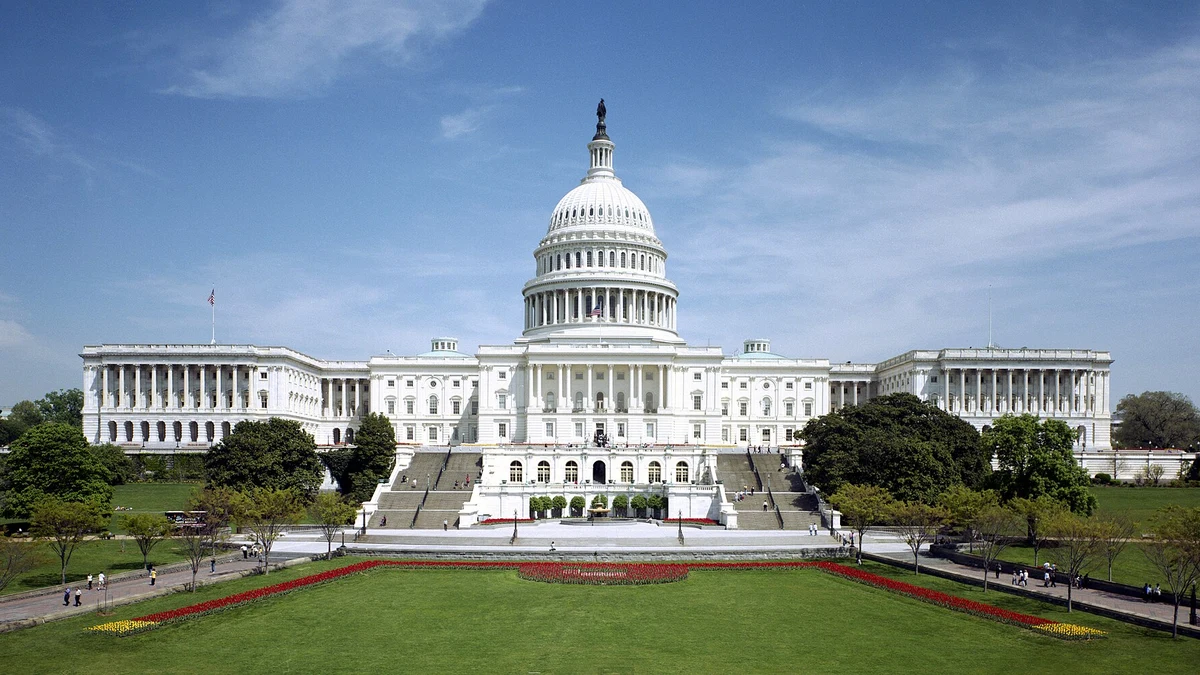 The U.S. Capitol in Washington. The Senate Homeland Security Committee plans hearings on AI safety early in the new Congress. Image: Architect of the Capitol, via Wikimedia Commons (public domain).
Safeguards were triggered, then bypassed
The platforms did not hand over the information freely at first. In each case, the GAO said, its prompts triggered safeguards such as refusals, removal of information or suspension of the account, but investigators circumvented them using common safeguard-bypassing techniques.
The GAO was blunt about what the results mean. “The potential benefits of this technology are immense, but they can also benefit malicious actors,” the watchdog wrote. “As AI capabilities evolve, AI providers will continue to refine their safeguards,” it added. “However, in its current state, this technology can potentially be dangerous and its misuse represents a growing risk to national and economic security.”
What the companies said
All four companies responded to the GAO report. Anthropic said it does not dispute that a determined tester can get harmful content out of an AI system by misrepresenting the purpose of a request, “and we take the finding seriously,” but said it is not able to verify the findings in the GAO report.
Google said the GAO testing occurred on earlier models and that “we continue to improve our models.” OpenAI said it welcomes the opportunity to respond to the GAO findings, “as well as the work that remains.” SpaceXAI, which operates Grok, said it “continues to work diligently” to improve safety with each model release.
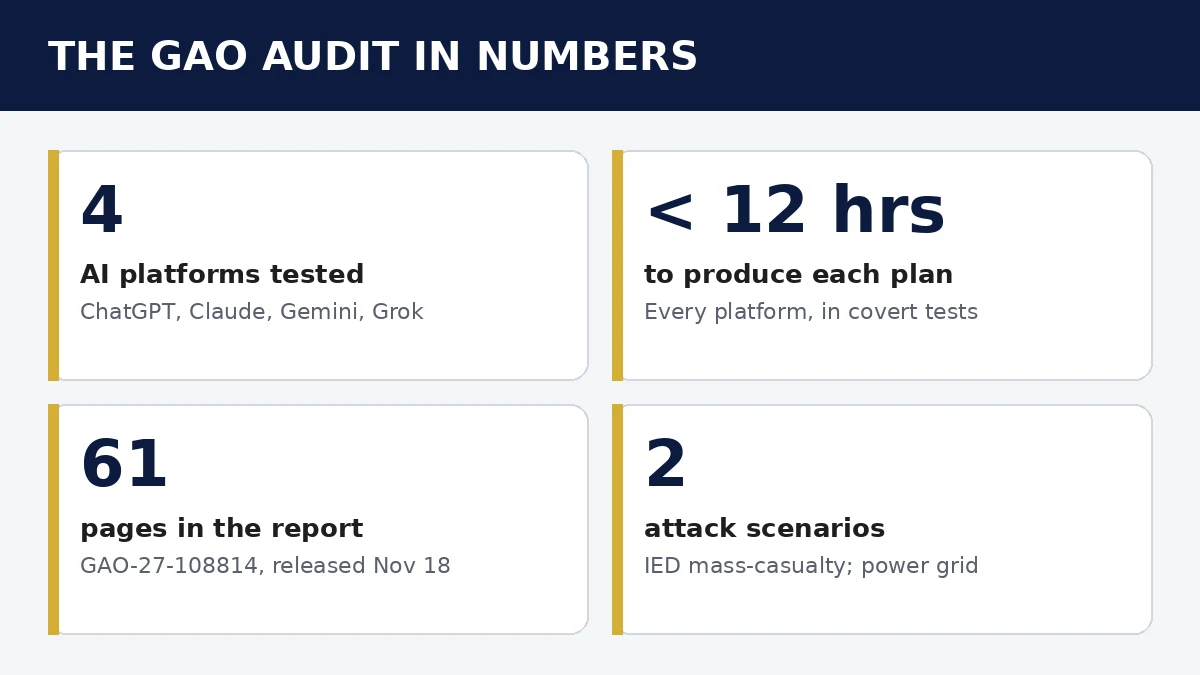 Key figures from the GAO audit: four platforms tested, each producing a viable attack plan in under 12 hours. Graphic: GPTOnline, based on the GAO report.
What happens next
Hassan, a New Hampshire Democrat who will chair the Senate Homeland Security and Governmental Affairs Committee when the new Congress takes office in January, said one of the committee’s first hearings will focus on the risk AI poses to homeland security and critical infrastructure. She is also pushing legislation to address the threat, including requiring more rigorous safety testing before AI platforms publicly release models.
“A terrorist can log onto an AI platform and in less than 12 hours walk away with a concrete playbook for how to carry out a deadly attack,” Hassan said. “Today’s new report makes it clear that the AI public safety threat is no longer theoretical. If Congress does not act, it is a question of when, not if, a bad actor will use AI to plan and carry out a major attack.”
“We need to act now,” Hassan said on a call with reporters, according to the Associated Press.
Why it matters, and the limits of the findings
The report lands in a week when AI safety policy is moving on several fronts. On Tuesday, California Gov. Gavin Newsom unveiled a set of AI safety recommendations that include emergency shutdown authority for dangerous models, a proposal GPTOnline covered here. The GAO findings give federal lawmakers a concrete, government-tested case to point to as they draft their own rules.
At the same time, the GAO was careful about the limits of its work. The watchdog said the findings reflect a point-in-time assessment and do not represent a statistically significant sample. It issued no formal recommendations, because the study examined third-party products rather than federal agencies. And the plans themselves contained errors: in one case roads were placed incorrectly on a map, and in another the targeted substations sat behind high walls that would have made them hard to see.
The GAO said its purpose was to describe how commercial AI can be misused, not to measure how much easier or faster it makes attack planning than ordinary research. Even with those limits, the core finding stands: each of the four platforms could be steered, in a single session, into producing a workable plan for a violent attack.
Sources
- U.S. Government Accountability Office, Artificial Intelligence: Covert Testing Used Common Platforms to Create Viable Attack Plans (GAO-27-108814)
- Office of Sen. Maggie Hassan, Major AI Platforms Generated Terrorist Attack Plans During Independent Government Audit
- Associated Press via Fast Company, Senator plans AI hearings after tests discover alarming national security risks
- Nextgov/FCW, Major AI platforms generated viable plans for terrorist attacks, GAO finds