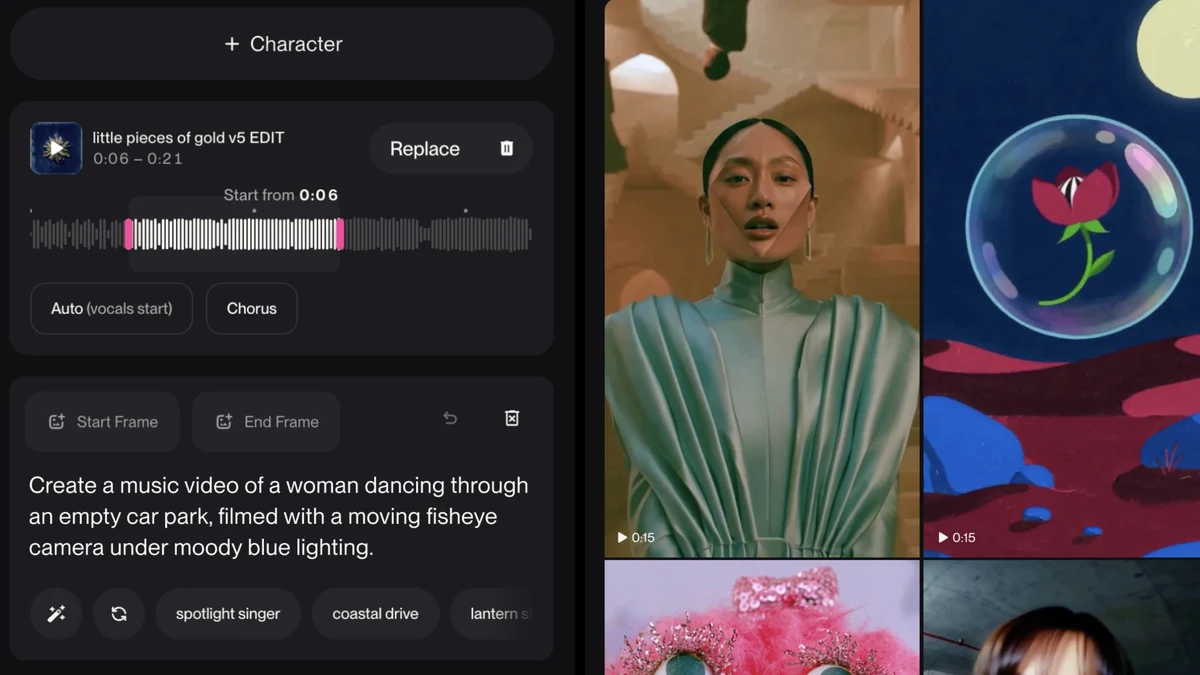
Suno has launched Visuals, a tool that turns songs made on its platform into AI-generated music videos. The feature went live on the web on Tuesday, November 17, and Suno says versions for iOS and Android will follow in the coming weeks. It is the AI music company’s biggest step beyond audio, and it arrives built on a video model from MiniMax, a Chinese AI firm currently being sued by three Hollywood studios.
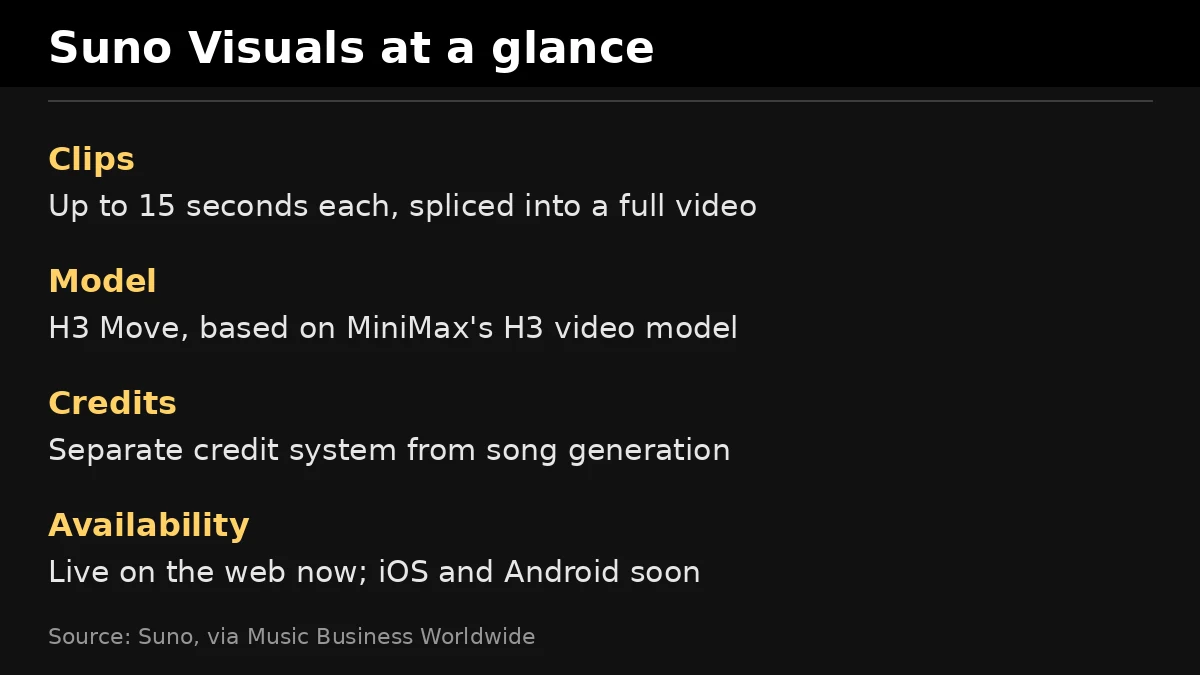
Visuals works from a song in the user’s Suno library. It generates video clips of up to 15 seconds, which users can extend, edit, or re-prompt with text, then splice together into a full music video. Users can start from a set of original characters Suno has created, or upload an original image of their own. The company lists lyric videos, album art, and video clips built from a user’s own photo among the outputs Visuals can create. Finished clips can be exported in 9:16, 1:1, and 16:9.
Graphic: GPTOnline, based on Suno.
The Model Behind Visuals
Visuals runs on a model Suno calls H3 Move, based on MiniMax’s H3 model, according to Suno’s help center. MiniMax launched H3, also known as Hailuo 03, on July 31, describing it as a general purpose multimodal generation model that produces video with native stereo sound at up to 2K resolution and up to 15 seconds in length. Suno says it “optimized” the model for its community, including by adding “additional protections and safeguards.”
Suno Chief Product Officer Jack Brody wrote in the company’s launch post that prompts built for other video tools will not necessarily transfer. “Prompts that work on other video platforms may not work on Suno and that’s by design,” Brody wrote. He added that the model is tuned to the music itself: “We’ve optimized the model behind Visuals to complement your music. Video clips follow your song’s structure, pick up on your lyrics and lip sync right along with them.”
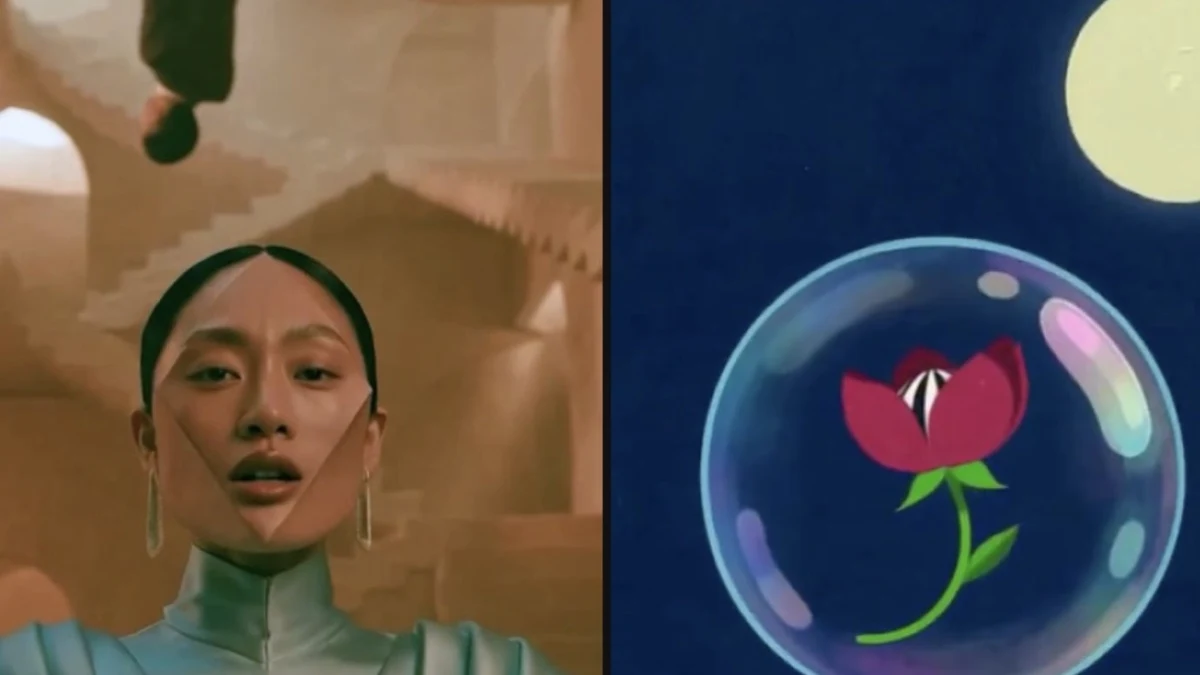
Two clips generated by Suno Visuals. Screenshot: Suno, via Music Business Worldwide.
Pricing and Credits
Visuals runs on a separate credit system from the one Suno uses for song generation. The number of credits each Visual costs depends on factors including clip duration and quality setting, with users choosing between “fast” and “standard” modes, according to Suno’s FAQ. Music Business Worldwide reported that Pro and Premier subscribers are being given an allocation of Visual credits to try the product for a limited period, and any user can buy credit packs, which do not expire.
Suno has also introduced Platinum, a new top subscription tier that includes everything in Premier, more song credits and downloads, and Visual credits. The plan is currently available on the web only.
Safeguards and the Copyright Question
Suno says it built Visuals with “additional safeguards to protect artists from unauthorized use of their likenesses or works, on top of the ones we already have in place for music.” The company says it adopted new text and visual filters intended to block uploads and prompts that try to use or create visual representations of specific artists, public figures, copyrighted works and intellectual property. The same filters, together with third-party tools, screen generated videos and images for breaches of Suno’s Community Guidelines before users see them.
Suno also says it will embed watermarks in Visuals, using its labeling tools, before any clip can be shared outside the platform, and that it will keep working with Audible Magic, ACRCloud and Musixmatch to stop users from uploading copyrighted audio and lyrics. Users uploading a video or image to Visuals for the first time will be reminded that the tool is meant for “original creation” and asked to confirm they have the rights to the file.
The safeguards matter because both companies behind Visuals are fighting copyright cases. Disney, Comcast’s Universal and Warner Bros. Discovery sued MiniMax in a California federal court in September 2025, claiming its Hailuo AI image and video service can generate images and videos of characters such as Darth Vader and the Minions from a simple text prompt. On May 22, US District Judge Stanley Blumenfeld Jr. refused to throw out the case, writing that when prompted with the name of one of the studios’ famous characters, Hailuo AI generates “a near-perfect likeness” of it. Suno, for its part, is being sued for copyright infringement by two of the three major labels, and Universal Music Group and Sony Music Entertainment filed a second case on September 18 alleging that Suno’s v6 music model is “the fruit of the same poisoned tree.”
Why It Matters
“Video had always been the logical next step in our vision, but until recently video generation was slow and too expensive for anyone to create but enterprises,” Brody wrote. “A new generation of models changes that and opens video generation up to creative entertainment for everyone.” Visuals follows Speech, a tool for spoken audio that Suno launched in beta on October 1, and Bridge, an app that drops AI-generated instrument and vocal parts into Ableton Live sessions, launched on November 13. Suno already lets users generate short videos with its cover art tool, and its Hooks feature, launched in September 2025, pairs users’ own footage with their songs.
For Suno, video is also a new revenue line at a moment when its core business is under legal pressure. Visual credits are sold separately from song credits, and the new Platinum tier bundles them with the company’s most expensive plan. Whether creators embrace a tool whose clips last 15 seconds at a time will depend on how well H3 Move follows a song, and on whether Suno’s safeguards hold up under the same scrutiny its music models now face in court.