
Security researchers at Calif have disclosed Java4Shell (CVE-2026-114938), a critical memory corruption flaw in OpenJDK’s Base64 decoder that can let an unauthenticated attacker run code remotely on vulnerable Java applications. The flaw scores 9.2 out of 10 under CVSS 4.0, the highest severity band. OpenJDK and Oracle shipped fixes on November 17, the same day Calif published its findings. The discovery itself is the story for the AI world: Calif says an AI coding agent did the searching, with a human researcher directing it, and the whole find took about an hour.
Calif calls the flaw “write once, RCE everywhere,” a play on Java’s old slogan. The bug sits not in an application or a library but in the Java runtime itself, in hand written x86-64 assembly code that speeds up Base64 decoding with AVX-512 VBMI processor instructions. A malformed input, a string of 64 A characters followed by a single equals sign, makes the decoder miscalculate the length of its output. OpenJDK allocates a 50 byte result array, then writes 64 bytes into it, sending 62 bytes past the end of the allocation. Java eventually rejects the input, but by then neighboring memory may already be corrupted. On older OpenJDK 17 builds the trigger uses 128 A characters instead.
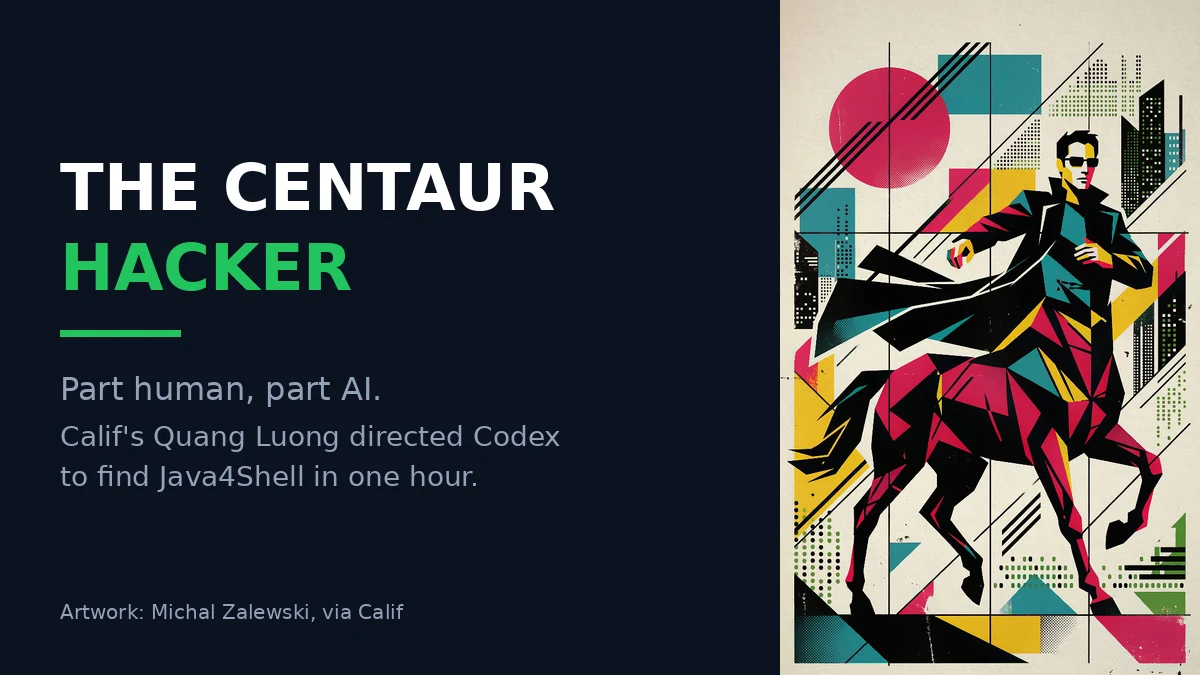
Artwork: Michal Zalewski, via Calif
What Is Affected
The flaw affects OpenJDK from version 17.0.6 onward, and every distribution built from it, including Amazon Corretto, Eclipse Temurin, Microsoft Build of OpenJDK, Azul Zulu, BellSoft Liberica, SAP SapMachine, Red Hat OpenJDK, Oracle OpenJDK, Oracle Java SE and Oracle GraalVM for JDK. Oracle lists its vulnerable builds as 8u511b33-perf, 17.0.21.0.3, 21.0.13.0.3, 25.0.5.0.3 and 27.0.1.0.3. Because the bug lives in hardware specific code, it also requires an x86-64 processor with AVX-512 VBMI support, including Intel Xeon Ice Lake, Sapphire Rapids, Emerald Rapids and Granite Rapids, and AMD EPYC and Ryzen chips based on Zen 4 or newer. ARM64 processors are not affected.
Calif demonstrated remote code execution against widely deployed Java applications in their default configurations, without authentication, in Keycloak, Atlassian Jira, Atlassian Confluence, JFrog Artifactory, Jenkins and PingFederate, and after authentication in Apache Kafka Broker, Apache Solr, Elasticsearch, Gerrit and Spinnaker. The firm also demonstrated the attack in sample applications built on Apache Struts and Spring Boot, and says ordinary features such as authentication and file uploads can expose the vulnerable decoder. The researchers note there is no universal exploit: each target needs its own chain. No exploitation in the wild has been reported so far, and Calif says it is holding back the application specific exploit chains until organizations have had a chance to upgrade.
Found by AI, Directed by a Human
The discovery is a showcase for AI assisted security research. Calif says researcher Quang Luong directed Codex, OpenAI’s coding agent, to audit the JIT compiler, intrinsics, widely accessible APIs and cryptography inside OpenJDK HotSpot. The New York Times reported that the flaw was uncovered using GPT-6 Cyber. Luong writes that most of the agent’s early results were unusable, until persistence paid off with a finding in the Base64 decoder itself. “I came looking for copper and found gold,” he writes. Discovery took one hour, the first working exploit took two more hours, and the total token cost was under $200, according to Calif.
The firm frames the work as the rise of the “centaur hacker,” part human, part AI. “AI brings the horsepower. Our researchers bring the context. The best hacker today is neither AI nor human. It is the centaur hacker, part human, part AI,” Calif writes. The same approach found PHP2Shell, a critical PHP flaw Calif disclosed earlier, and the firm argues the method can also be turned to defense, combing large codebases to flag dead code and needless optimizations for removal.
Fixes and Mitigations
OpenJDK published a security advisory and Oracle released its patch at 1:00 p.m. Pacific time on November 17, 2026. Oracle’s November Critical Patch Update contains 11 new Java SE patches, and Oracle’s release notes credit Quang Luong of Calif and Albert Yang for CVE-2026-114938. All Java users should update immediately, Calif says.
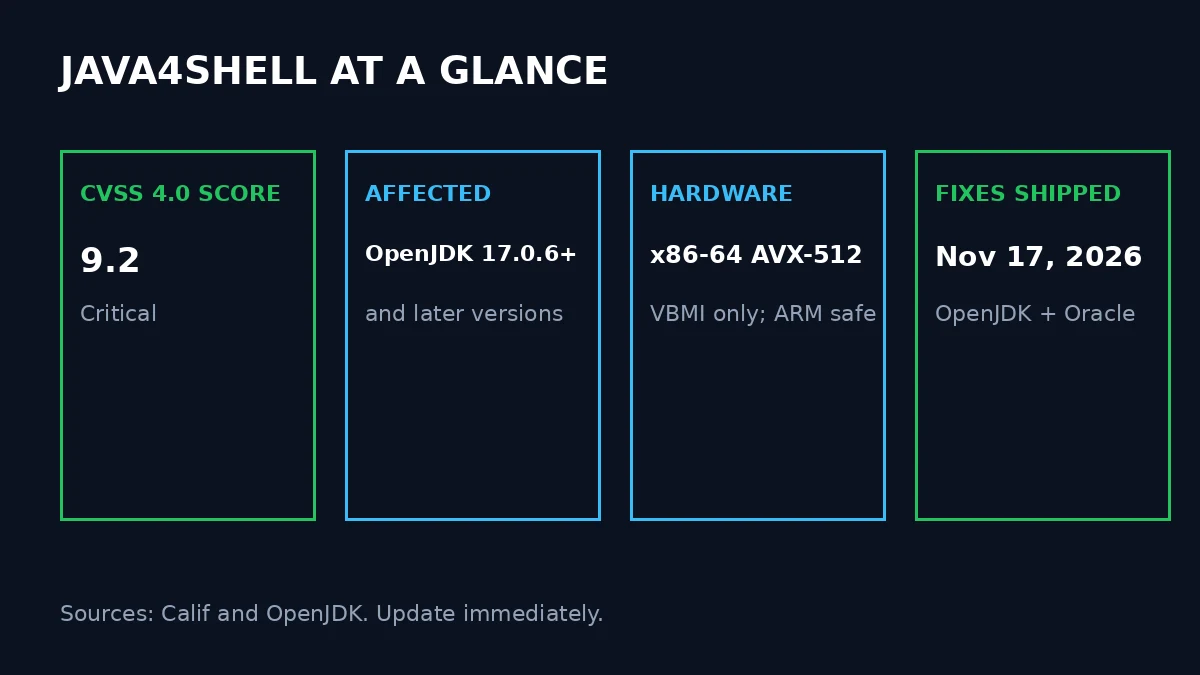
Chart: GPTOnline, based on Calif and OpenJDK
For systems that cannot be patched right away, Calif lists two temporary mitigations: start OpenJDK with the flag -XX:-UseBASE64Intrinsics to disable hardware accelerated Base64 encoding and decoding, or -XX:UseAVX=2 to disable AVX-512. The second flag applies only on x86-64 hosts; OpenJDK on ARM does not recognize it and will fail to start.
Why It Matters
Java4Shell matters for three reasons. First, scale. Java is the world’s third most popular programming language, according to the TIOBE index cited by Calif, and powers 90% of Fortune 500 companies. A flaw in the runtime reaches banking, aviation, telecommunications and national security systems at once. Second, invisibility. Because the bug sits in native JVM code rather than a library, standard dependency scanners that check software manifests cannot flag exposed workloads; teams need an inventory of their actual Java runtimes instead. Third, speed. An AI agent found in an hour what human auditors had missed for years in one of the most reviewed codebases in software, and the exploit chain followed in two more hours. That compresses the window between disclosure and weaponization, which is why Calif, OpenJDK and Oracle all coordinated on same day fixes. The patch is out. The remaining question is how fast the world’s Java estate applies it.



[…] AI Finds Java4Shell, a Critical Flaw in Java’s Base64 DecoderNovember 17, 2026 […]