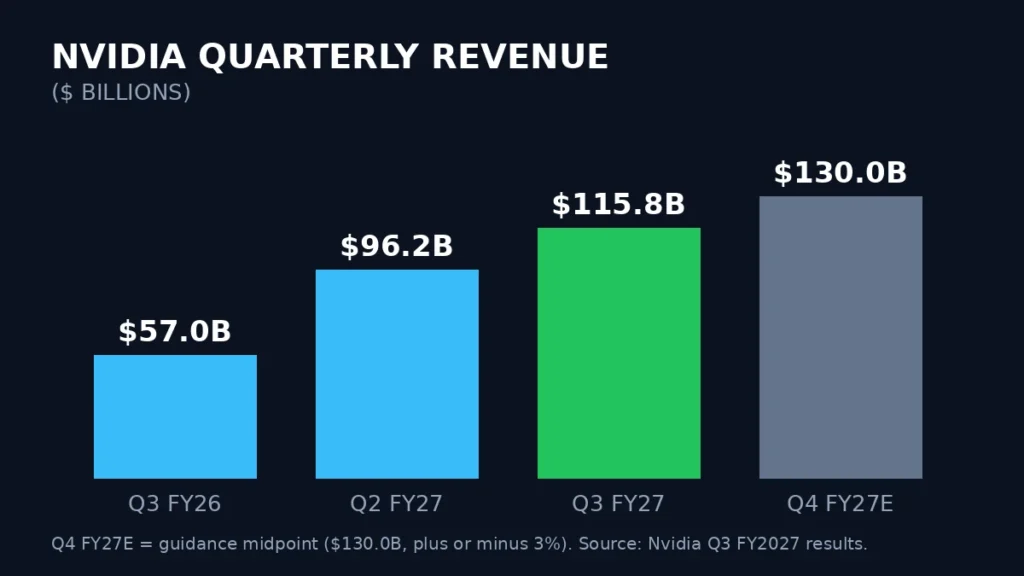
Nvidia reported Nvidia Q3 revenue of $115.8 billion for the third quarter of fiscal 2027, up 103% from a year earlier, in the company’s first earnings report since Jensen Huang resigned as chief executive on November 12. The result beat Wall Street estimates of about $109 billion, and the chipmaker forecast fourth quarter revenue of $130.0 billion, plus or minus 3%, also above expectations. The quarter ended October 25, 2026.
Interim chief executive Colette Kress, who also serves as chief financial officer, struck a confident tone in the release. “Our momentum is real. NVIDIA is an exceptional technology leader, powered by the relentless innovation of our people,” Kress said. “Vera Rubin is off to an explosive start, our roadmap is on track and our ambition has never been greater.”
What Nvidia Reported
The headline numbers left little room for doubt about demand for AI hardware. Revenue rose 20% from the previous quarter and 103% from a year ago. GAAP net income reached $65.3 billion, up 105% year over year, while GAAP earnings per diluted share came in at $2.70. On a non-GAAP basis, earnings per share were $2.68, ahead of the consensus estimate of $2.47. Gross margins held near recent highs at 74.8% on a GAAP basis and 74.9% on a non-GAAP basis. Nvidia’s official results release carries the full figures.
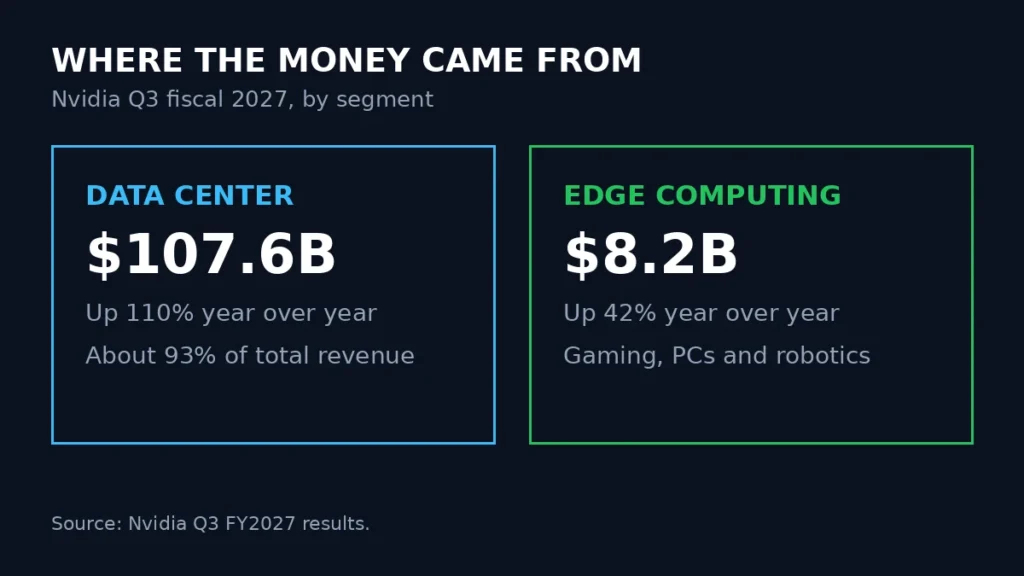
Data center sales did almost all of the work. The segment generated $107.6 billion in the quarter, up 110% from a year ago and 21% from the previous quarter, accounting for about 93% of total revenue. Within data center, hyperscale revenue was $60.1 billion, up 71% year over year, while AI clouds, industrial and enterprise revenue reached $47.5 billion, up 195% year over year. Edge computing, which covers gaming, PCs and robotics, contributed $8.2 billion, up 42% from a year ago.
Nvidia also returned cash at scale. The board approved a $150 billion increase to the share repurchase authorization in September 2026, and the company returned $28.1 billion to shareholders through buybacks and dividends during the quarter, leaving about $227.3 billion under the authorization. The next quarterly dividend of $0.25 per share is payable on December 23, 2026, to shareholders of record on December 2.
Vera Rubin Leads the Product Story
The quarter’s product headline was Vera Rubin. Nvidia said it ramped production and began shipping the Vera Rubin NVL72 rack-scale platform, calling it the fastest product ramp in the company’s history, with racks running at CoreWeave, Google Cloud, Microsoft Azure, Oracle Cloud Infrastructure and Nebius, and coming online soon at SpaceXSI. The company also introduced the NVIDIA Rubin HPC GPU for scientific computing, a chip designed for simulation and data processing in science, engineering and analytics.
The release listed a long set of ecosystem moves around the new platform, including general availability of Vera Rubin systems on Oracle Cloud Infrastructure and Google Cloud, an open architecture effort joined by Cisco, Google, Meta, Microsoft and Visionbay, and expanded access for Anthropic to Grace Blackwell and Vera Rubin capacity through cloud providers. Nvidia also said it swept every MLPerf Training and Endpoints benchmark, and announced an agreement to acquire Hugging Face, the open AI platform, to scale its reach with developers.
Guidance and the Road Ahead
For the fourth quarter of fiscal 2027, Nvidia expects revenue of $130.0 billion, plus or minus 3%, with GAAP and non-GAAP gross margins between 71.0% and 72.0%. The outlook topped the consensus estimate of about $125.3 billion. The quarter includes an additional week, so the $130 billion midpoint implies about 12% sequential growth on a headline basis. Nvidia said it is not assuming any data center compute revenue from China in its outlook.
The results arrive at a turbulent moment for the company. Huang resigned last week after revelations about his personal conduct, and Nvidia’s board is not considering bringing him back, CNN reported. The board has opened an independent investigation, and on Tuesday Nvidia said it formed a National Security and Export Control Oversight Committee. Hours before the earnings release, The Wall Street Journal reported that the Securities and Exchange Commission is investigating Nvidia, including whether the company’s disclosures misled investors. Nvidia shares were down about 16% since November 8, according to the Journal. Kress was due to face analysts on the earnings call at 2 p.m. Pacific time on Tuesday.
Why It Matters
This was the report the AI trade had been waiting for, and it delivered on the numbers that matter most. Data center revenue crossed $100 billion in a single quarter for the first time, growing more than twice as fast as the broader company did a year ago, and the guidance points to another record quarter ahead. The Vera Rubin ramp is the clearest evidence yet that Nvidia’s next platform is converting orders into revenue at scale, with the largest cloud providers already running the systems.
The numbers do not erase the questions hanging over the company. Investors still want answers on succession, on the board’s investigation, on the regulatory scrutiny in Washington and on the hundreds of billions of dollars in financing deals Nvidia has struck with partners and customers. But the quarter itself gives Kress a strong hand: demand for AI infrastructure, at least as measured by Nvidia’s order book, has not slowed. The test now is whether the company can keep shipping fast enough, and keep its leadership stable enough, to turn that demand into the $130 billion quarter it just promised.
Sources
- NVIDIA Announces Financial Results for Third Quarter Fiscal 2027 (official release via GlobeNewswire)
- NVIDIA Investor Relations
- CoinDesk: Nvidia tops estimates, issues strong guidance, adds $150 billion to buyback authorization
- GamesBeat: Nvidia’s October quarter earnings hit $115.8B, up 103%, with data center revenue up 110%
- GPTOnline: NVIDIA Unveils Rubin HPC GPU With More Than 50,000 CUDA Cores for Science
- GPTOnline: Jensen Huang to Testify Before House Committees on December 1