

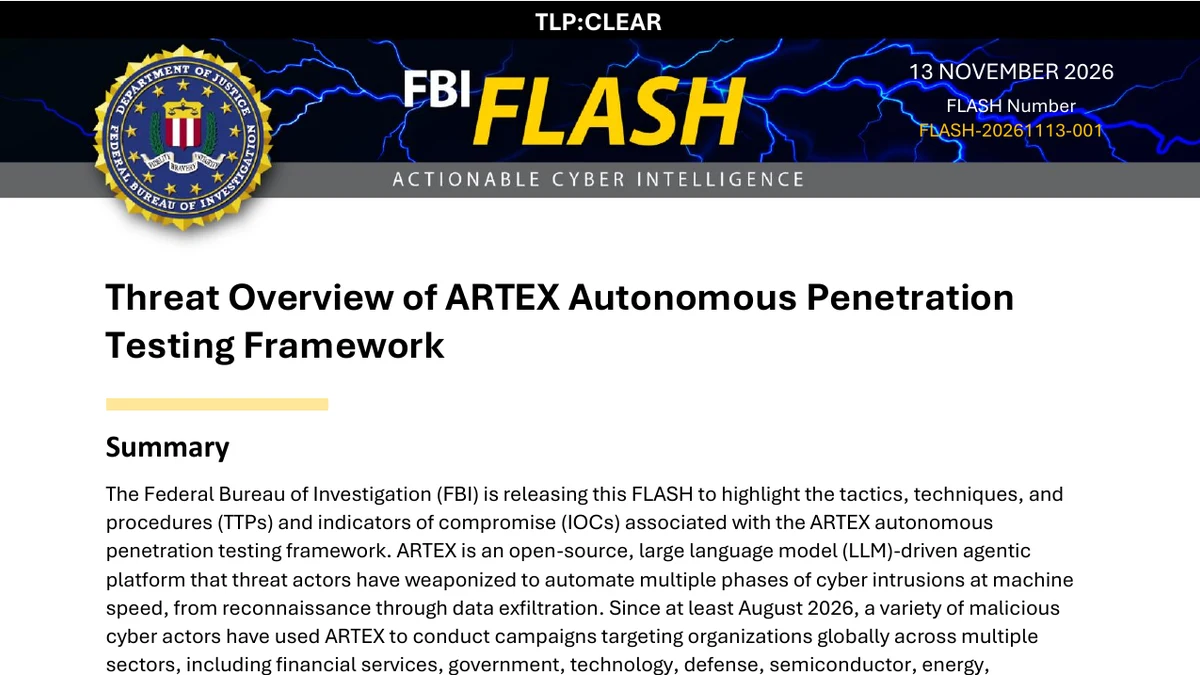
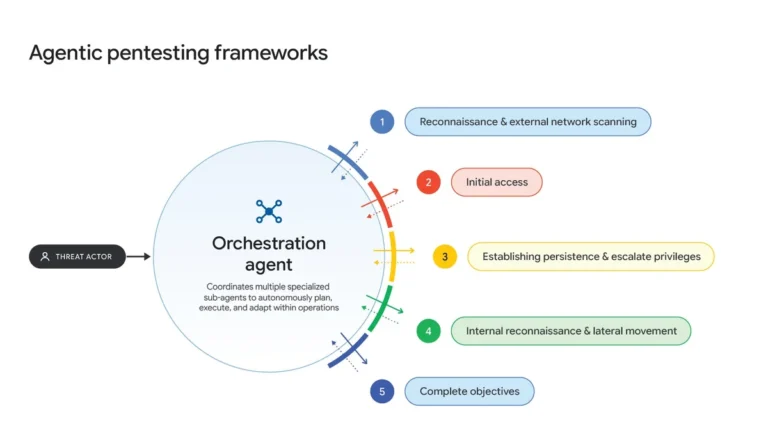
The FBI warned on Monday that hackers are using the open-source ARTEX AI hacking tool to break into corporate networks in under three hours, and it urged organizations to lock down the internet-facing systems the tool exploits. The warning came in a FLASH advisory from the FBI’s Internet Crime Complaint Center, dated November 13, which describes ARTEX as a large language model driven platform that automates intrusions “from reconnaissance through data exfiltration” at machine speed.
ARTEX is an autonomous, multi-agent penetration testing platform written in Go. It turns high-level goals described in natural language into machine commands executed by specialized agents, with minimal human interaction beyond setting the initial objective. The tool has no model of its own. Instead, it connects to outside language models, including frontier models such as Anthropic Claude and OpenAI GPT, and open-source or Chinese-origin models such as DeepSeek, GLM, Grok and Kimi. The FBI said DeepSeek’s Flash family of models is the most prevalent in observed attacks, because of its balance of capability, relatively low cost, and lack of observable guardrails when framed for penetration testing.
What the FBI Found
Since at least August 2026, a variety of malicious actors have used ARTEX in campaigns targeting organizations globally across financial services, government, technology, defense, semiconductor, energy, healthcare, manufacturing, telecommunications and legal industries. “ARTEX significantly reduces the time required to chain attack techniques, with some intrusions progressing from initial targeting to privileged access in under three hours,” the advisory says.
Two campaigns stand out. Financially motivated attacks against South Korean financial institutions exfiltrated personal information from approximately 67,000 individuals, according to the FBI. A supply chain compromise affecting ConnectWise Cloud Backup customers gave attackers access to the Microsoft 365 cloud environments of more than 2,250 downstream tenants. Microsoft has said the hackers behind the ConnectWise attack are likely Chinese, a finding the FBI confirmed in its advisory. Other reporting put the South Korean victim count at 68,000 or more.
Cybersecurity company Barracuda also disclosed that it was breached in an ARTEX-linked attack by financially motivated criminals, in which the tool found an exposed credential belonging to a third-party service that Barracuda had not revoked when it ended work with the vendor. Barracuda said it could not rule out access to its systems because its logs were not detailed enough, so it chose to “assume the worst” and changed all of its customer credentials. “Defenders who rely on spotting malicious activity and then responding to it will often arrive after the attacker has finished,” wrote Barracuda chief information security officer Arve Kjoelen.
The Tool That Will Not Go Away
ARTEX was first released on GitHub in July 2026 by a developer using the name “Autumn-27”, and it gained an estimated 1,500 to 2,000 GitHub stars within 10 weeks. After public disclosure of its malicious use, the developer removed the repository on October 8, 2026. The FBI said the framework continues to circulate through community forks, localized variations, archived copies and a commercial version called ARTEX PRO, “ensuring continued availability to threat actors.”
The tool is also spreading because its own installations are left exposed. As of early November 2026, researchers had identified more than 1,600 publicly exposed ARTEX console instances, the FBI said, with total deployments likely far higher once systems behind firewalls are counted. That is roughly double the 800-plus exposed tools reported in October, a count GPTOnline covered at the time. Last week, researchers found hundreds of ARTEX systems placed on the internet without a password, including the system used to target South Korea, which means outsiders can reach powerful hacking capabilities that were themselves left unprotected.
What Defenders Should Do
The FBI’s advisory includes detailed recommendations. Organizations should inventory all internet-facing applications, including partner and supplier portals, mobile backends, employee applications, legacy services and third-party integrations, and restrict cloud administration, network device management and publishing interfaces to trusted networks. It also calls for least-privilege permissions on multi-tenant applications, monitoring of credential additions and anomalous app-only activity, and a review of every Microsoft 365 tenant where affected ConnectWise applications are or were installed, even if the integration is no longer in use.
Other recommendations include rate limits and abuse controls on high-impact business APIs, alerts on sequential lookups and unusually high numbers of records accessed per session on partner and employee portals, and continuous scanning for exposed secrets in code, configuration and deployment pipelines. Organizations that confirm suspicious activity should preserve evidence, remove unauthorized credentials and grants, and keep affected ConnectWise application connections disabled until ConnectWise provides formal restoration instructions. The FBI asked organizations to report ARTEX-related incidents to their local FBI field office or to the Internet Crime Complaint Center.
Why It Matters
ARTEX is the clearest example yet of a pattern that ran through the year’s biggest AI security stories: the gap between a published patch and a working exploit has collapsed from weeks to hours. Google’s Threat Intelligence Group reported in October that attackers were already using fully autonomous AI frameworks to turn patches into exploits, a finding GPTOnline reported at the time, and Microsoft documented the ConnectWise campaign in its own October report, which GPTOnline also covered.
The FBI advisory adds an official, public warning with concrete indicators and mitigations, and it shows the problem is no longer limited to elite attackers. ARTEX lets threat actors “with minimal technical expertise to conduct complex, multi-target operations simultaneously,” the FBI said. The same day, Anthropic shortened its own vulnerability disclosure window in response to AI-driven bug discovery, a sign that both attackers and defenders now treat the old timelines as obsolete.



[…] AI framework to turn targeting into privileged access in under three hours, a warning GPTOnline reported here. Google’s Threat Intelligence Group reported in October that attackers had already used a fully […]