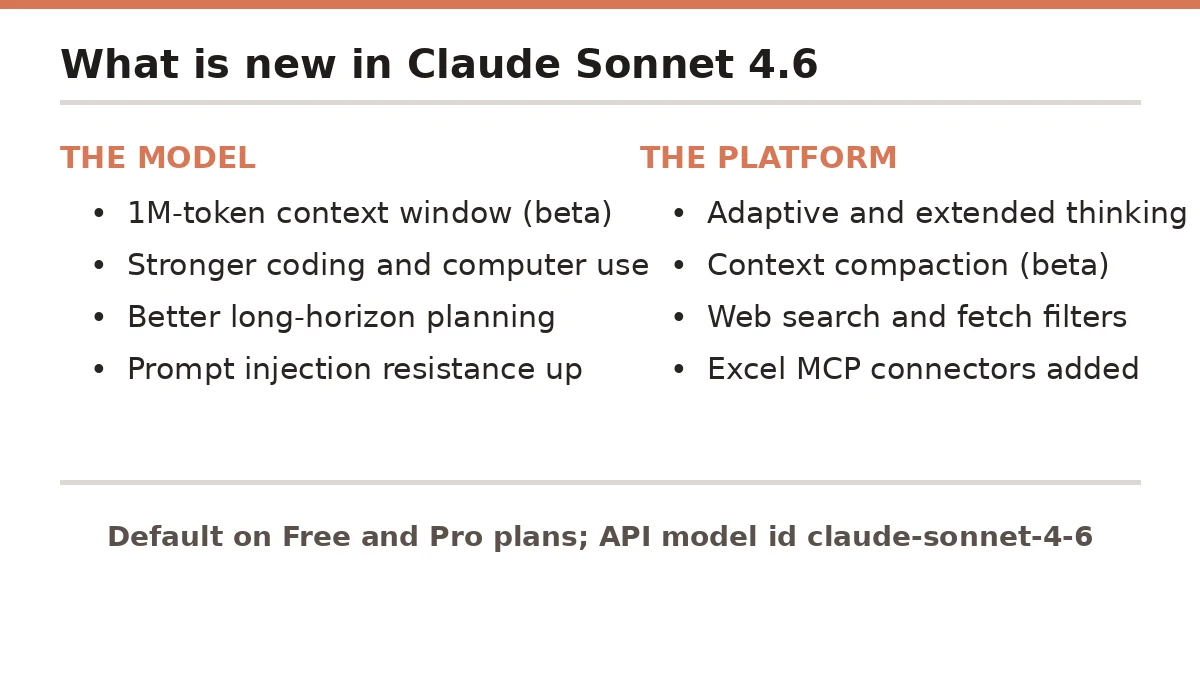
Anthropic has launched Claude Sonnet 4.6, its most capable Sonnet model yet, with a 1M-token context window in beta, stronger coding and computer use, and the same pricing as its predecessor. The model is now the default on Free and Pro plans in claude.ai and Claude Cowork, Anthropic announced on Friday.
“Claude Sonnet 4.6 is our most capable Sonnet model yet,” Anthropic wrote. “It’s a full upgrade of the model’s skills across coding, computer use, long-context reasoning, agent planning, knowledge work, and design.”
What Was Announced?
Sonnet 4.6 succeeds Sonnet 4.5 across the whole Claude lineup. It is available now on all Claude plans, Claude Cowork, Claude Code, the API and all major cloud platforms, using the model ID claude-sonnet-4-6. Anthropic also upgraded its free tier to Sonnet 4.6 by default, with file creation, connectors, skills and context compaction included.
The headline change is the context window. Sonnet 4.6 offers a 1M-token context window in beta, enough to hold entire codebases, lengthy contracts or dozens of research papers in a single request. Anthropic said the model also reasons effectively across all of that context, which makes it much better at long-horizon planning.
Coding Gains That Rival Opus
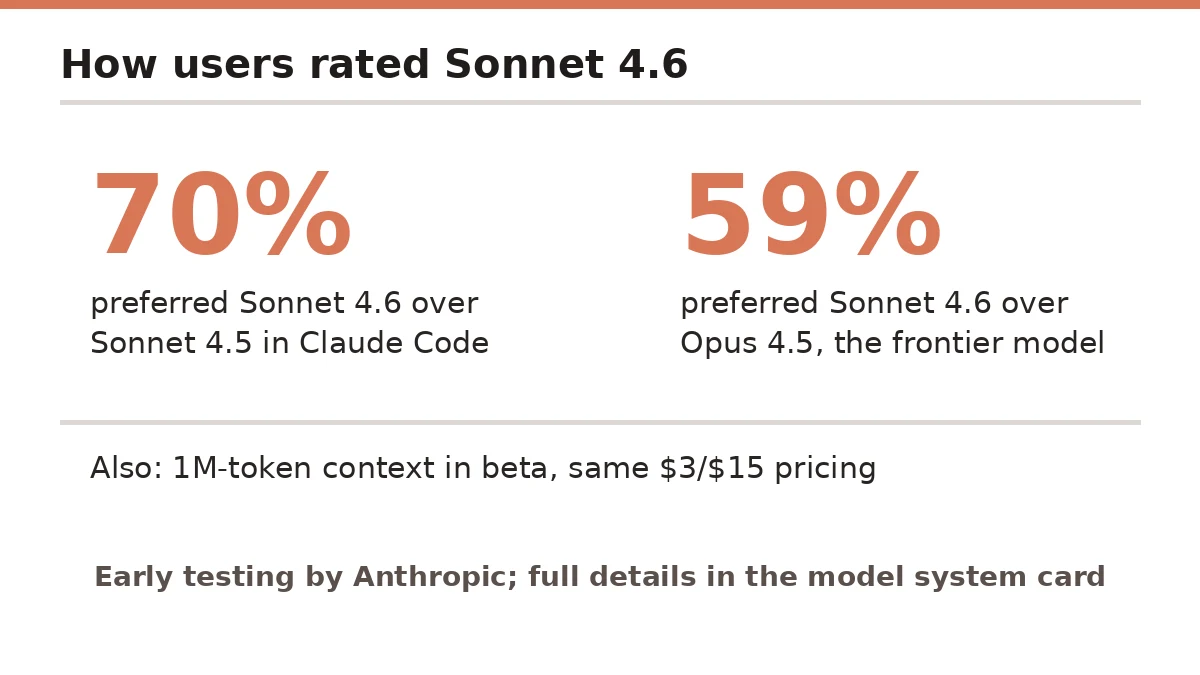
The most striking claim in the announcement is how users rated the new model against Anthropic’s frontier tier. In Claude Code, early testing found that users preferred Sonnet 4.6 over Sonnet 4.5 roughly 70% of the time. They said it read context more effectively before modifying code and consolidated shared logic rather than duplicating it.
Users even preferred Sonnet 4.6 to Opus 4.5, Anthropic’s frontier model from November 2025, 59% of the time. They rated it as significantly less prone to overengineering and “laziness,” and meaningfully better at instruction following. They also reported fewer false claims of success, fewer hallucinations and more consistent follow-through on multi-step tasks.
Early customers reported broad improvements, with frontend code and financial analysis standing out. Customers described visual outputs from Sonnet 4.6 as notably more polished, with better layouts, animations and design sensibility, and said they needed fewer rounds of iteration to reach production-quality results.
Computer Use and Long-Horizon Planning
Computer use is the other big step forward. Anthropic first introduced a general-purpose computer-using model in October 2024, and the standard OSWorld benchmark shows steady gains across sixteen months of Sonnet models. Anthropic said early Sonnet 4.6 users are seeing human-level capability in tasks like navigating a complex spreadsheet or filling out a multi-step web form, before pulling it all together across multiple browser tabs.
The model also resists prompt injection better. Anthropic said its safety evaluations show Sonnet 4.6 is a major improvement compared with Sonnet 4.5, and performs similarly to Opus 4.6, on resisting hidden instructions planted on websites. The company still cautioned that computer use carries risks, since malicious actors can try to hijack a model by hiding instructions on a page.
Pricing and Availability
Pricing is unchanged from Sonnet 4.5, starting at $3 per million input tokens and $15 per million output tokens. That matters because the announcement positions Sonnet 4.6 as doing work that previously required an Opus-class model, including real-world office tasks, at a Sonnet price point.
On the Claude Platform, Sonnet 4.6 supports adaptive thinking and extended thinking, plus context compaction in beta, which automatically summarizes older context as conversations approach limits. On the API, the web search and fetch tools now automatically write and execute code to filter and process search results, keeping only relevant content in context. Code execution, memory, programmatic tool calling, tool search and tool use examples are now generally available.
For Claude in Excel users, the add-in now supports MCP connectors, letting Claude pull in data from tools such as S&P Global, LSEG, Daloopa, PitchBook, Moody’s and FactSet without leaving the spreadsheet. That feature is available on Pro, Max, Team and Enterprise plans.
Why It Matters
Sonnet is the workhorse tier of the Claude lineup, the model most developers and paying users actually run day to day. A Sonnet that users prefer over the previous frontier model changes the value calculation: teams can keep Opus-class work on a cheaper, faster tier, and reserve Opus for the deepest reasoning. Anthropic itself drew that line, saying Opus 4.6 remains the strongest option for tasks that demand the deepest reasoning, such as codebase refactoring and coordinating multiple agents in a workflow.
The launch comes a day after Google rolled out Gemini 4 Hydrogen, its fast model for agentic workflows, so the two labs are now competing head to head on the same ground: capable models that run agents quickly and cheaply. It also lands in the middle of Anthropic’s IPO roadshow, with pricing set for November 18 and trading expected to begin November 19, giving the company a fresh product story to tell investors.
On safety, Anthropic said its evaluations showed Sonnet 4.6 to be as safe as, or safer than, its other recent models. Its safety researchers concluded the model has “a broadly warm, honest, prosocial, and at times funny character, very strong safety behaviors, and no signs of major concerns around high-stakes forms of misalignment.”
The limits are the usual ones for a launch announcement. The preference figures come from Anthropic’s own early testing, the 1M-token window is still in beta, and the benchmark details sit in the model’s system card rather than the announcement itself. But the core facts are clear: a stronger Sonnet, at the same price, now the default for most Claude users.