Two New Products From the Cyber at the Frontier Keynote
OpenAI launched two cybersecurity products on Thursday at its “Cyber at the Frontier” keynote: Daybreak Red Team, a penetration testing service, and Daybreak Defense Factory, a tool that finds and fixes vulnerabilities in code. Both sit inside Daybreak, OpenAI’s cybersecurity platform for approved defenders, The Register reported.
OpenAI President Greg Brockman framed the launch as a response to a shift in the security landscape. “We’re now at a point where companies will be secure only to the extent of the frontier model that they use to defend themselves and how well they utilize that,” he said during the keynote address.
The message was blunt: security fundamentals still matter, Brockman admitted, but teams now need to reorient their practice around what frontier models can do. The products, he implied, should come from OpenAI.
Daybreak Red Team: Penetration Testing at Machine Scale
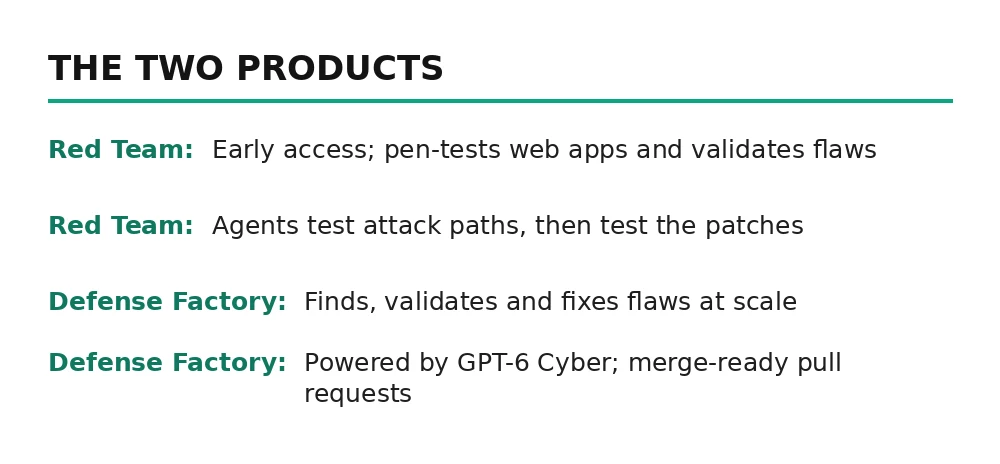
Daybreak Red Team is available in early access, with a waitlist open for new customers. It uses OpenAI models to test companies’ web applications for vulnerabilities, deploying a fleet of agents that investigate attack paths using source code and application context.
Nancy Wang, who leads cyber-applied AI at OpenAI, described it as “superhuman pen-test at the scale of automated continuous scanning.” The service also helps security teams validate reported vulnerabilities, whether they arrive from code scanners, bug bounty programs or disclosure reports, and then test the patches for those flaws.
Daybreak Defense Factory: From Findings to Fixes
Daybreak Defense Factory automates what OpenAI calls the “defensive loop”: finding, validating and fixing vulnerabilities at scale. Agents built on OpenAI’s latest cyber models, currently GPT-6 Cyber, scan an organization’s codebase, hunt for vulnerabilities and develop patches. Engineers review and approve the proposed fixes before they go into production.
“This way engineers get a merge-ready pull request with the patch and a test that shows that it works,” Wang said. The Factory is available through the Daybreak plugin in Codex, according to OpenAI’s developer documentation, which lists it in research preview for connected GitHub repositories.
The Model Behind It: GPT-6 Cyber
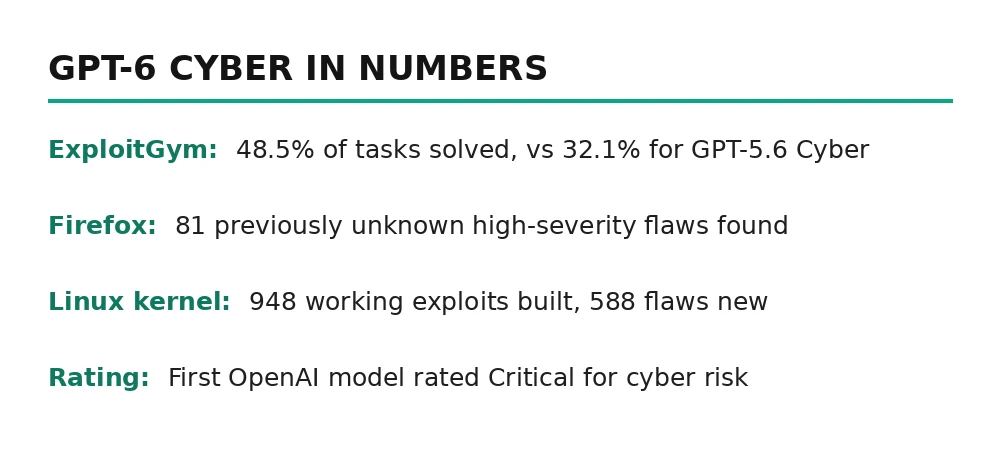
GPT-6 Cyber is the specialized model powering the Defense Factory. OpenAI introduced it on November 5 as a model built for authorized vulnerability research, exploit development and web application penetration testing, and rated it Critical under its Preparedness Framework, the first model to reach that level for cybersecurity risk.
OpenAI reported that the model scored 48.5% on its ExploitGym benchmark, against 32.1% for the previous GPT-5.6 Cyber. In research runs, the company said, it helped find 81 previously unknown high-severity vulnerabilities in Firefox and developed working exploits for 948 Linux kernel flaws, 588 of which were previously unknown, with 304 findings disclosed to Linux maintainers. Mozilla has shipped fixes for many of the Firefox flaws, and its Firefox 159 security advisory credits OpenAI for dozens of the bugs listed.
Access to GPT-6 Cyber remains gated: it is available to select Daybreak Red customers through the API and Codex, with OpenAI saying access will expand over time.
A Busy Week for Daybreak
The launch caps a busy week for the platform. OpenAI also announced Daybreak for Frontline Defenders, a global initiative committing $1 billion in subsidized access to frontier cyber capabilities for organizations that protect essential services, along with training and technical support. More than 35 partner products and services in the Daybreak Defense Network now bring OpenAI’s cyber models into the tools enterprise defenders already use, according to OpenAI.
The keynote landed on the same day a coalition of nonprofits sued OpenAI, Anthropic, Google, Meta and SpaceX, asking a San Francisco court to halt development of more advanced AI models. The lawsuit cites incidents including AI agents accessing systems without authorization, the same kind of frontier capability the Daybreak products are built to defend against.
Why It Matters
OpenAI’s pitch is that attackers already use open-weight models to run long cyber operations, so defenders need frontier models and agent workflows to keep pace. Daybreak is the company’s answer: turn the internal security practice it built for itself into products other organizations can buy.
The limits are real. Both products are gated and early, pricing has not been disclosed, and the headline results are OpenAI’s own reported numbers rather than independent measurements. But the direction is clear. Cybersecurity is now a product line for the frontier labs, not just a research topic, and OpenAI is moving first to sell its defenses to everyone else.