
CoreWeave is rewriting how it pays for the AI boom. On its third quarter earnings call on Tuesday, the neocloud that rents out computing power for AI said it is increasingly asking customers to pay up front, borrowing against specific contracts and pursuing shorter deals that can command higher prices, TechCrunch reported.
The shift is a response to the central tension in the AI infrastructure business: data centers must be built and paid for long before the revenue they generate arrives, and the debt to fund them has become expensive. CoreWeave’s answer is to move the financing burden toward its customers.
About $9 Billion in Prepayments
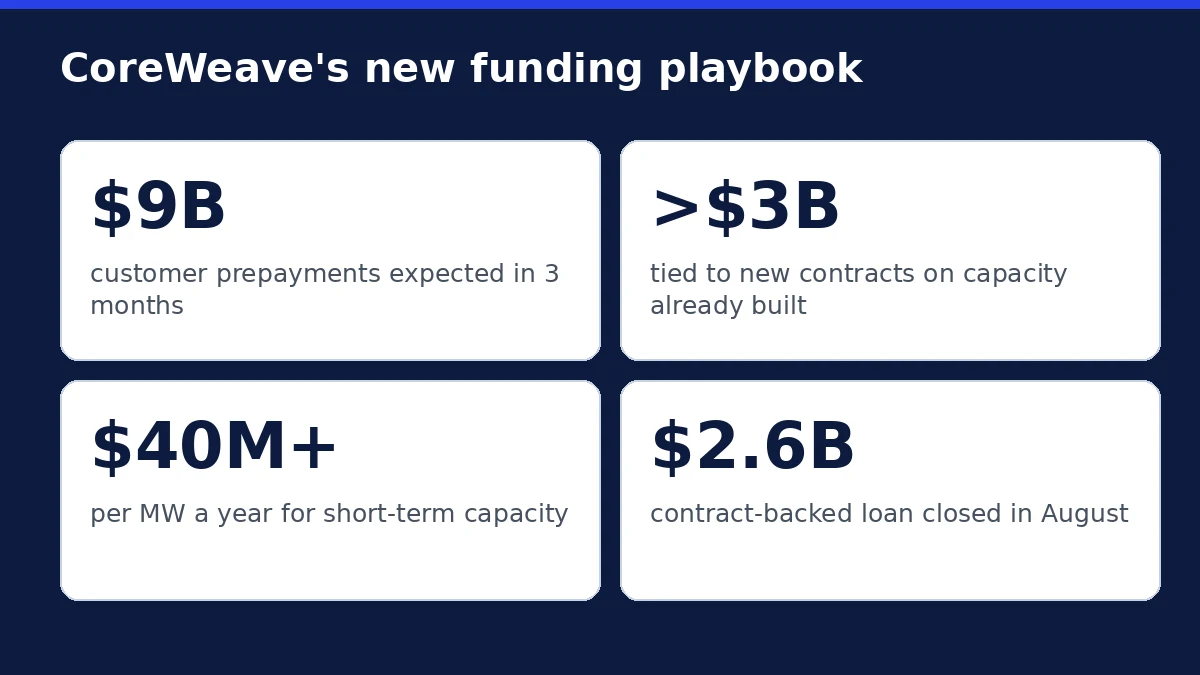
CoreWeave said it expects about $9 billion in customer prepayments and deposits over the next three months, including more than $3 billion tied to signing new customer contracts for capacity it has already built, which requires no additional spending on hardware. Upfront payments reduce the company’s immediate borrowing needs and turn already built infrastructure into cash.
The strategy extends to how the company borrows. “We will not use the unsecured debt market to fund our business at current yields, nor do we need to,” chief executive Michael Intrator said on the earnings call. Instead, CoreWeave plans to rely on loans backed by specific customer contracts, drawing on funds as needed to finance most of the infrastructure it still has to build to deliver on its $132.5 billion backlog.
In August, the company closed a $2.6 billion loan, its first designed specifically for shorter term customer contracts. Known as DDTL 5.5, it lets CoreWeave borrow in installments as it needs the money.
Shorter Contracts, Higher Prices
CoreWeave is also leaning into short term deals because they pay more. The company raised prices across its offerings by about 25% in July and by another 10% later in the quarter, and prices are still climbing this quarter in a way that “more than offset[s] cost increases,” Intrator said.
“We are also allocating more capacity to short-term opportunities, where the pricing justifies it, selling capacity at more than $40 million per megawatt annually, while pricing for new infrastructure on four and five-year contracts is moving to $20 million to $25 million per megawatt,” the chief executive said.
The tradeoff is real. Lenders give more weight to longer term contracts, even if they are priced lower, because they value the predictable cash flow that repays a loan. Short term deals let CoreWeave charge more and reprice more often, but they carry greater risk around renewals.
The Numbers Behind the Shift
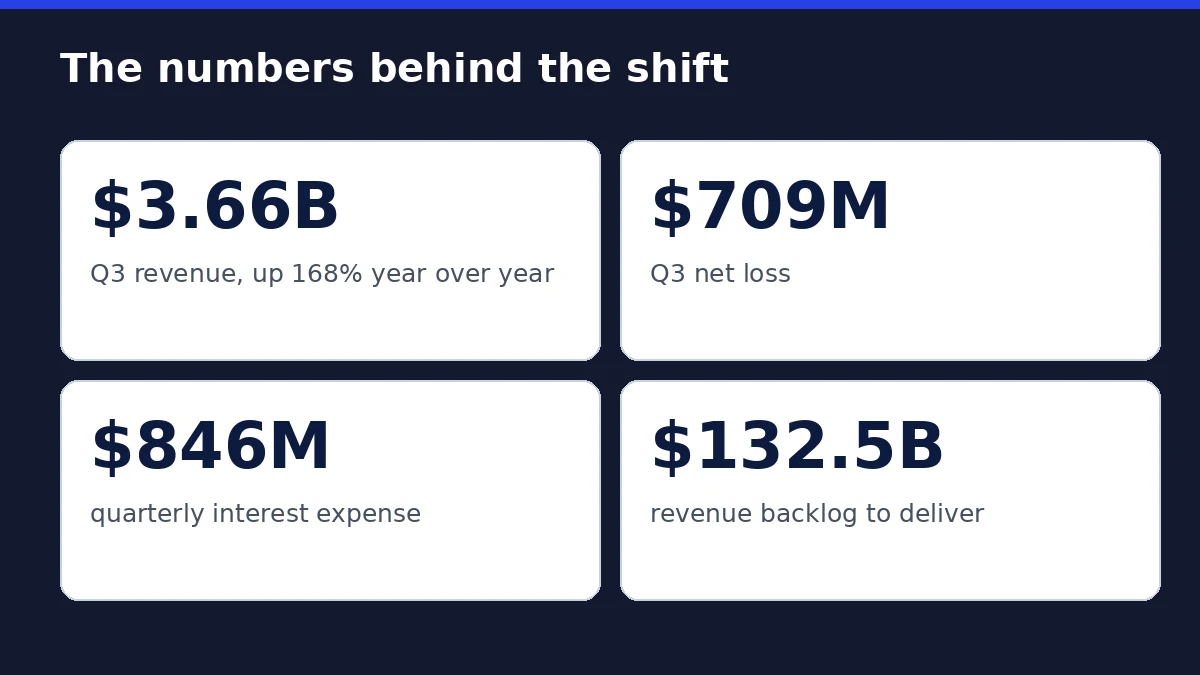
CoreWeave reported $3.66 billion in third quarter revenue, up 168% from a year earlier, but it also posted a $709 million net loss and $846 million in quarterly interest expense. Last month, yields on some of the company’s bonds rose above 15%, a sign that bond investors are concerned about the debt needed to fund data center buildouts before those investments see a return.
CoreWeave is not the only neocloud turning to customers for cash. Rivals Nebius and IREN have also relied on hefty Microsoft prepayments to pay for computing capacity, signaling that the industry is moving toward asking Big Tech to pay up for its buildouts.
Why It Matters
The AI infrastructure boom runs on borrowed money, and CoreWeave’s strategy shows how fragile that model can be when rates stay high. Prepayments and contract backed loans let the company expand without tapping the unsecured debt market, and shorter contracts let it capture rising prices. But the whole approach only holds if demand and pricing power continue: prepayments commit the company to delivering services at prices that could look cheap if compute demand keeps surging, and short term capacity has to be re-rented, again and again, at prices that have to stay high.
TechCrunch has reached out to CoreWeave for more information about its loan facility. For now, the earnings call makes the direction clear: in the race to build AI infrastructure, the customers are increasingly being asked to fund the build.



[…] GPTOnline, “CoreWeave Turns to Customer Prepayments and Shorter Contracts to Fund AI Growth” […]