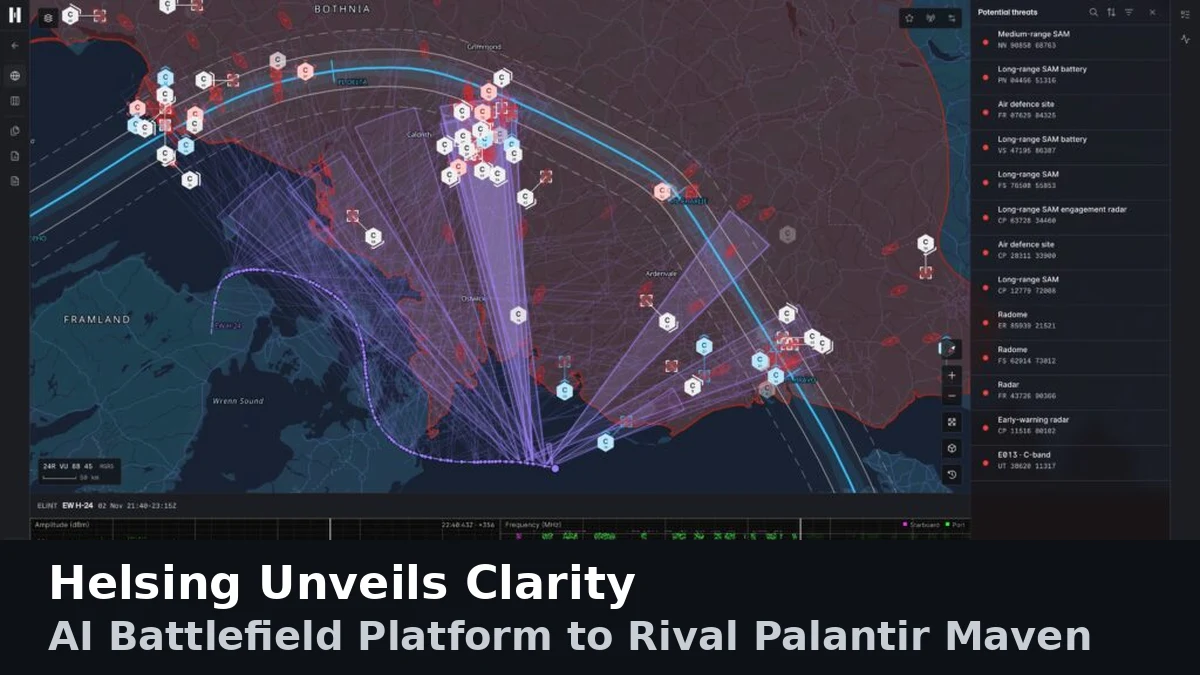
German defence technology company Helsing on Wednesday launched Helsing Clarity, an AI platform that turns the flood of battlefield data into targeting information for human review, entering a market long dominated by Palantir. The Munich-based company unveiled the system at an event in Berlin, pitching it as a European-built rival to Palantir’s Maven.
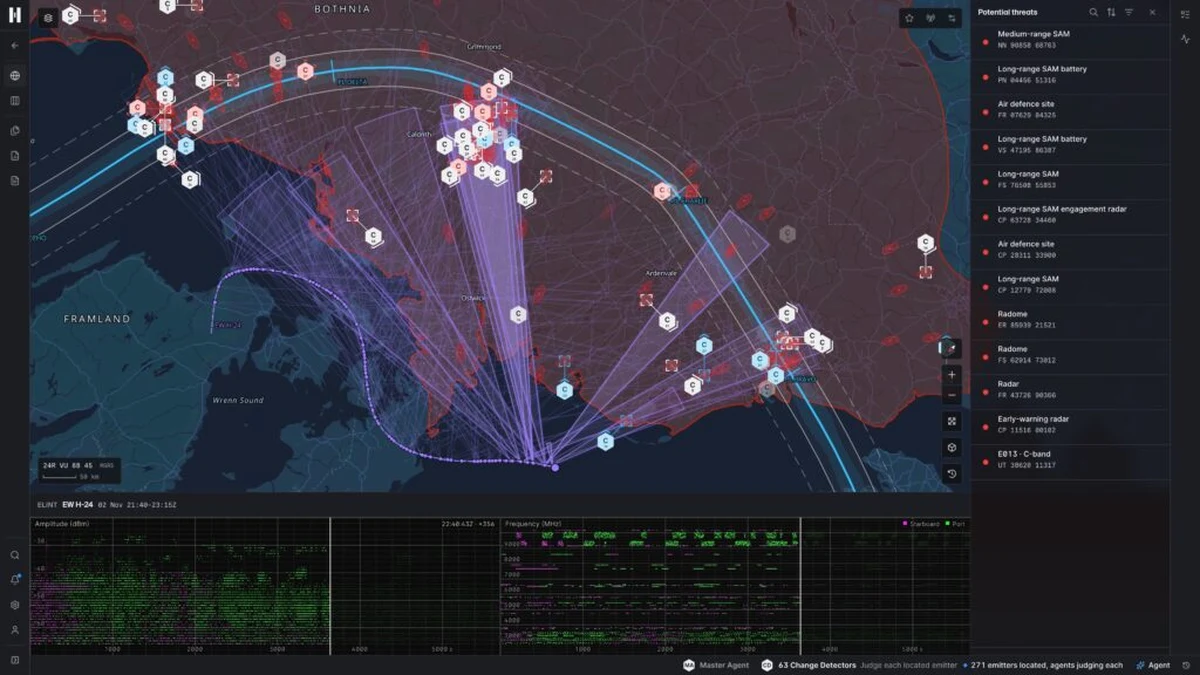
Clarity is designed to sift through information from drones, satellites, sensors, military reports and open-source intelligence, helping users identify military assets and determine how they should be engaged, Reuters reported. Human operators remain responsible for approving any strike.
What Clarity does
Modern warfare generates far more information than command staff can process. Drones alone have transformed how much commanders can see, and the flood of data can overwhelm staff, increasing the risk of missed targets, delayed responses and misallocated resources if information is not processed quickly enough.
Clarity is Helsing’s answer to that overload. The company said the platform was built around hundreds of specialised agents trained on military data. The agents work in parallel on intelligence tasks, establish links between different sources, and prepare data for the deployment of strike means, according to a company briefing shared with Militarnyi. The system can identify military positions, cross-check information from multiple sources, establish confidence levels and recommend responses, while showing users the evidence underpinning its conclusions.
Trained on combat data, run on the customer’s own systems
To train its models, Helsing uses real-world data collected during combat operations, as well as AI-generated synthetic data and simulated combat scenarios. The company says that mix lets the system prepare for situations not represented in existing datasets. Helsing, which has supplied drones and other systems to Ukraine, is among a small group of European defence technology firms able to argue it has gained access to operational experience from the conflict.
Clarity runs on the customer’s own infrastructure, from data centres to systems deployed in forward areas. It supports NATO standards, is compatible with existing military information systems, and can be integrated with weapons systems from various manufacturers, the company said.
“With Clarity, we have built a sovereign AI-native agentic intelligence platform that allows armed forces to trust the speed that AI agents bring to intelligence,” Rob Fink, Helsing’s chief technology officer, said in a statement. “Clarity combines the power of state-of-the-art AI capabilities, from multi-modal sensor data understanding to advanced reasoning and planning, with the systematic benefits of coherent, modern software systems: strong data governance and access controls, traceability and provenance, and compliant handling of classified information.”

Humans keep the final say
Helsing stressed that the decision to engage a target remains with the operator. Clarity suggests potential targets after cross-referencing independent sources, while a service member verifies the information and separately authorises its transfer to a strike system.
“All armed forces need intelligence capabilities that can keep pace with the speed of combat operations. Autonomous systems are playing an increasingly important role. That is why target detection must be integrated with the ability to strike them,” said Gundbert Scherf, Helsing’s co-founder and co-chief executive.
“We are entering an era where success on the battlefield will depend on how effectively armed forces can transform information into action,” Scherf added. “It is therefore important to connect what is seen to what is struck.”
Why it matters
Clarity enters a market where the most established systems have a head start. Palantir’s Maven sits inside Pentagon and NATO workflows and has been refined through years of operational use, while Ukraine has built its own DELTA system to collect and distribute battlefield data. Helsing’s pitch is that Europe needs its own option, built in Europe, with customers keeping ownership of their data.
European governments increasingly want greater control over military software and the data behind it, while reducing their dependence on individual suppliers. Germany has already decided against using Palantir’s Maven and is instead pursuing its own AI targeting capability. Berlin plans to roll out a national AI targeting system in 2027, with full implementation expected by 2028. Germany’s armed forces have previously said they aim to begin introducing AI-enabled systems from next year.
The launch also caps a year in which Helsing has moved closer to the German state. On November 4, one week before Clarity’s debut, the company transferred ownership of the MissionOSBw source code to Germany’s Bundeswehr. Helsing, founded in March 2021, reached an $18 billion valuation after a $1.8 billion Series E funding round in July 2026.
What Helsing has not said
Helsing did not disclose whether Clarity was already being used by military customers or when it expected the system to enter service. It also gave no pricing. Those gaps matter, because a targeting platform’s value depends on who is actually running it and under what conditions. For now, Clarity is a product announcement backed by a demonstration, not a deployment record, and the comparison with Maven will be settled by customers, not by launch events.
Sources
- Reuters, “Helsing enters market for battlefield software built on combat data”
- Militarnyi, “Helsing Unveils Clarity AI-Powered Intelligence Analysis Platform”
- Resilience Media, “Helsing launches Clarity, a competitor to Palantir’s Maven”
- Crypto Briefing, “Helsing unveils Clarity, a European rival to Palantir’s Maven AI system”