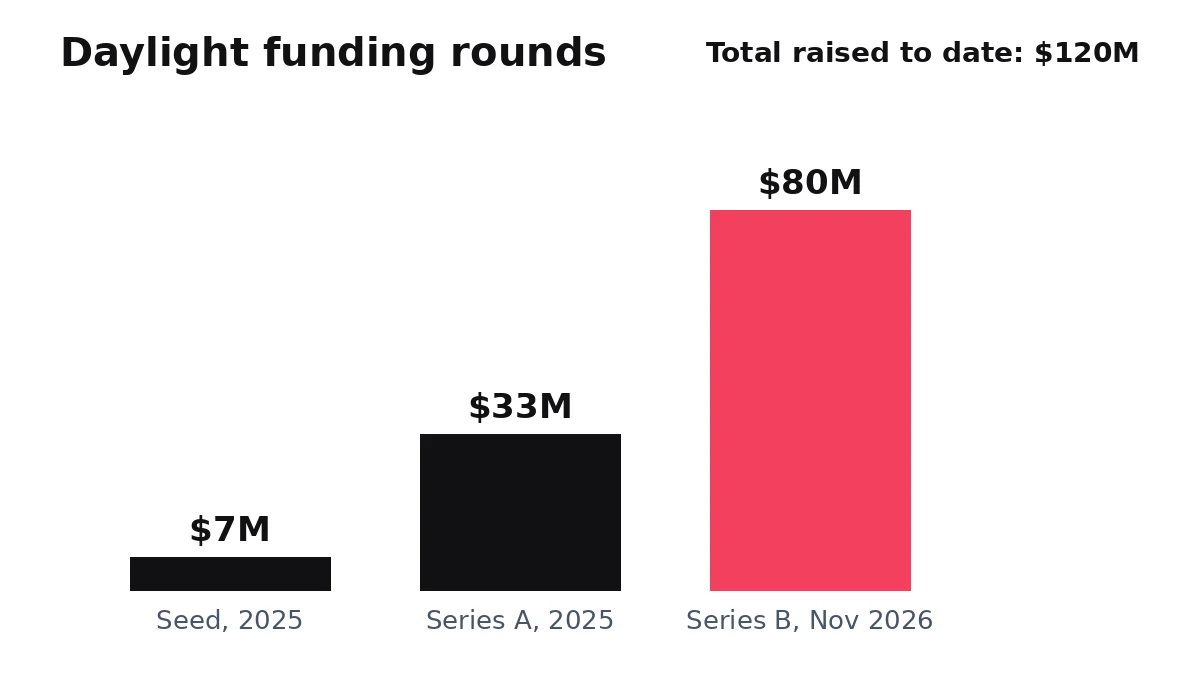
AI-powered managed security startup Daylight has raised an $80 million Series B led by Growth Equity at Goldman Sachs Alternatives, bringing its total funding to $120 million. The New York-based company says its revenue has surged more than 40 times over the past year, driven by demand from large enterprises and fast-growing AI companies.
The round, announced on November 10, included new investor Okta Ventures and existing backers Bain Capital, Craft Ventures, Vintage Partners and Maple Capital. The company did not disclose its valuation, but the Wall Street Journal reported, citing sources, that the round valued Daylight at about $400 million.
What Daylight does
Daylight combines AI agents with human security engineers to detect, investigate and respond to cyber threats. Its AI-native platform, called Aura, handles day-to-day security operations, while engineers focus on decisions that need human judgment. Customers can use Daylight as a fully managed service, combine it with their internal teams, or bring in forward-deployed engineers.
The company says it detects threats in seconds and responds to and contains them within minutes, up to 10 times faster than traditional managed security providers. Through Aura, customers can investigate their security environment using natural-language queries, access their security data in a centralized data lake and manage operations from one place.
Daylight also protects the AI platforms its customers use themselves, guarding against AI-native risks such as prompt injection, risky Model Context Protocol integrations and unusual AI-driven activity. Those detections run through the company’s full managed detection and response workflow, where AI activity is investigated alongside identity, endpoint, cloud, SaaS and business context. The capability is already in use by enterprise customers, including Miro.
Its customer base includes Lovable, LastPass, Rogo, dLocal and Miro, alongside Fortune 500 enterprises. Daylight plans to use the new funding to expand its U.S. presence, enter markets across Europe, the Middle East, Africa and Asia-Pacific, grow its security engineering and technology teams, and accelerate development of its platform.
A company built after “Black October”
Daylight was founded in early 2025 by Hagai Shapira and Eldad Rudich, who met while serving in an elite Israeli military intelligence unit. Shapira was an early product leader at cybersecurity unicorn Torq, while Rudich was Torq’s first employee and vice president of research and development. The company employs about 80 people, 43 of them in Israel, and raised a $7 million seed round followed by a $33 million Series A led by Craft Ventures a year ago.
The timing of the raise is no accident. October brought a wave of cyber incidents, dubbed “Black October,” that stretched incident response teams already under pressure. Daylight’s announcement argues that AI alone is not easing the burden: a July 2026 ISC2 survey found that 65 percent of cybersecurity professionals using AI now spend more time determining whether to trust its recommendations than they did a year earlier, while 63 percent spend more time verifying its outputs.
“The future of security operations won’t be defined by how many people a company can deploy, but by how effectively AI agents can take on increasingly complex security work,” said Hagai Shapira, co-founder and CEO of Daylight. “As these agents become more capable, they’ll fundamentally change how threats are detected, investigated, and contained, with expert security engineers implementing, governing, and continuously improving their operations.”
“Cybersecurity remains a top priority for enterprises of all sizes, and we see a significant opportunity for agentic technologies to transform how security outcomes are delivered,” said Irit Kahan, Managing Director and Global Head of Cyber Security Investing within Growth Equity at Goldman Sachs Alternatives. “By scaling human expertise with agentic technology, Daylight has the potential to enable organizations to respond at machine speed, with greater accuracy and at scale.”
Why it matters
Daylight’s pitch sits at the intersection of two trends that defined 2026 in security: attackers using AI agents to move faster, and defenders struggling to trust the AI tools they bought to keep up. The “Black October” wave showed the first trend in action, with AI developer platforms breached and their provider keys stolen for resale and model distillation. The ISC2 figures show the second, with most security professionals spending more time second-guessing AI recommendations than they did a year ago.
Daylight’s answer is to pair the agents with people, rather than replace the people, and to sell the combination as a service instead of another tool to manage. The 40-fold revenue growth suggests enterprises are buying that argument, and the Goldman Sachs-led round gives the company the capital to test it at scale across new regions. Whether agent-led security operations can deliver on the “10 times faster” claim under real attack conditions is the question the next year will answer.