Google has expanded its eighth-generation Tensor Processing Unit lineup with two new systems, TPU 8tx and TPU 8i Max, targeting two of the fastest-growing demands in enterprise AI: confidential inference and massive context windows. Google announced the systems on November 9, 2026, in a blog post from Amin Vahdat, its chief technologist for AI and infrastructure.
The additions bring Google to four TPU systems introduced in a single year, a first for the company. “This is the first time we have introduced four TPU systems in a single year,” Google said in the announcement. The eighth generation began at Google Cloud Next in April with the TPU 8t for large-scale training and the TPU 8i for real-time reasoning.
TPU 8tx: confidential inference
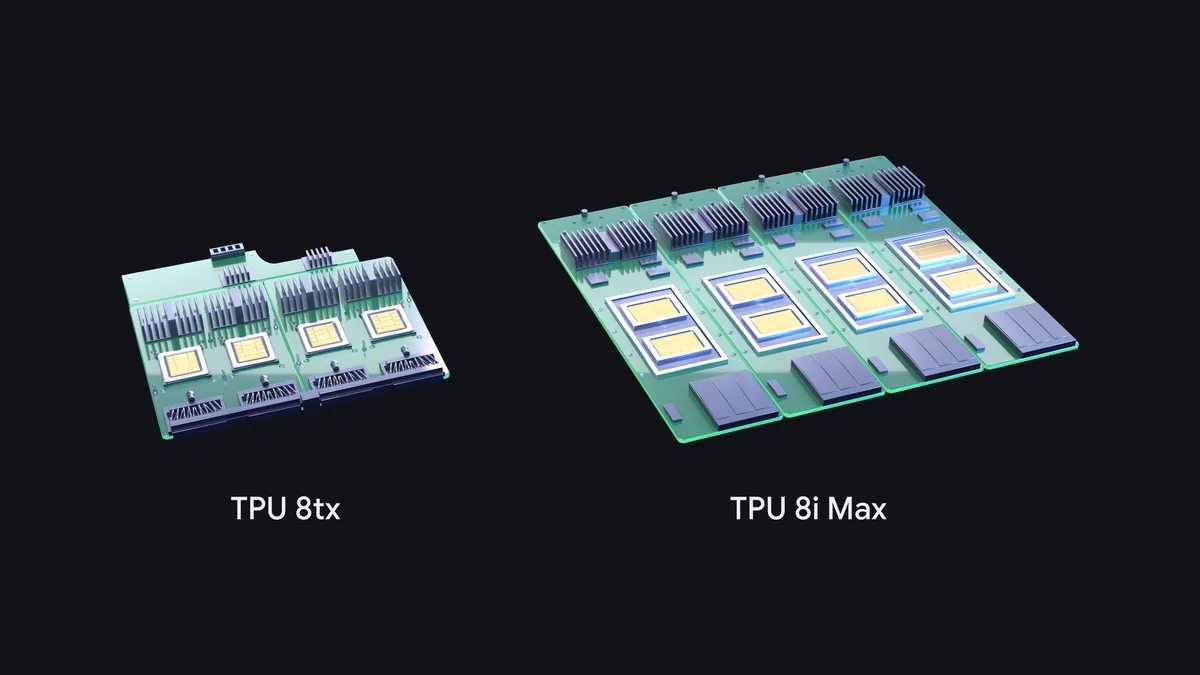
TPU 8tx, the third system in the generation, is optimized for secure and confidential inference and also handles small-scale training. It is built for regulated enterprises and governments running frontier or proprietary models and autonomous agents alongside sensitive data.
The system is built on the same silicon as TPU 8t and paired with 5th Generation AMD EPYC CPU hosts. Normally, data is encrypted when stored or sent over a network, but has to be unlocked in memory while a computer processes it. TPU 8tx builds security directly into the hardware layer, keeping sensitive data and model weights protected and isolated even while in active use. Google says it delivers up to 2x lower latency than TPU 8t, with a near-zero performance penalty, using the low-latency Boardfly network developed for real-time reasoning.
Because the system pairs training-grade compute with a fast inference network, teams can fine-tune models on private data, distill large models into smaller ones, and train agents through reinforcement learning on a single system, without moving sensitive data between clusters.
TPU 8i Max: breaking the memory wall
TPU 8i Max takes a different approach. When dozens of AI agents work together across an entire software codebase or hours of video at once, memory bandwidth becomes the bottleneck. Google’s answer is to place two TPU 8i chips on a single package, delivering double the compute, double the SRAM, and double the HBM bandwidth of TPU 8i.
The result is a system built for massive context windows and the highest compute density per rack in the lineup. Because TPU 8i Max fits twice the silicon within the existing rack footprint, data centers can deploy more computing power per square foot and per watt, Google said.
Four systems, four jobs
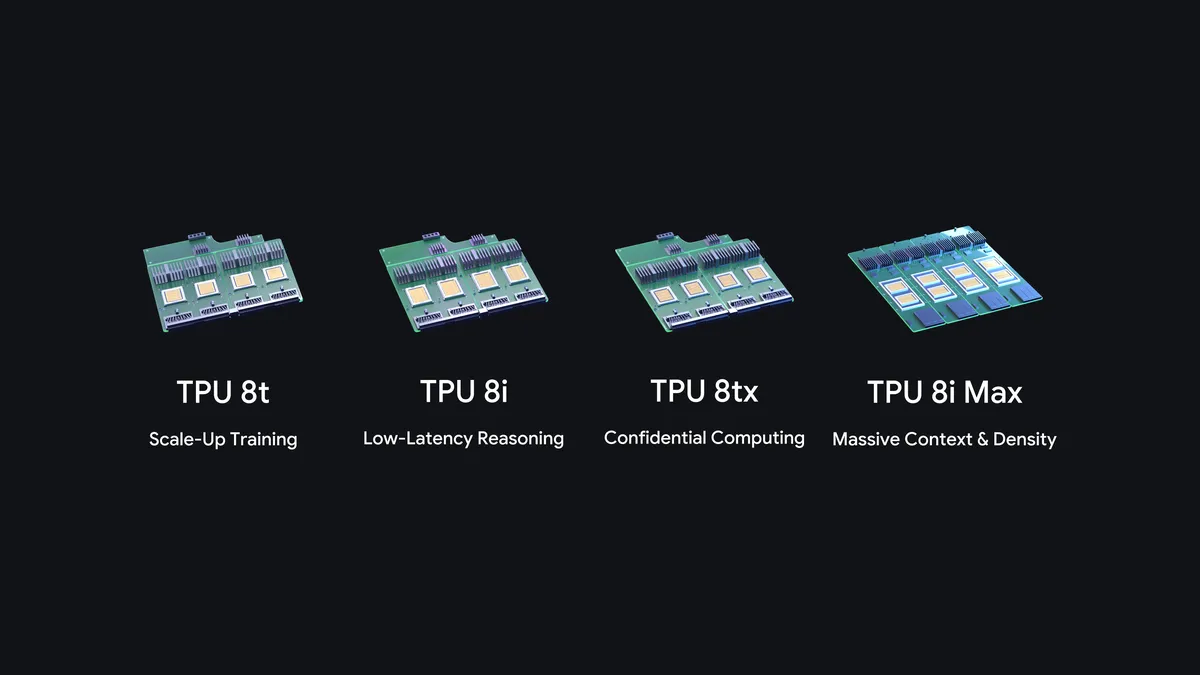
Google positions each eighth-generation system for a distinct stage of the AI lifecycle: TPU 8t for scale-up training, TPU 8i for low-latency reasoning, TPU 8tx for confidential computing, and TPU 8i Max for massive context windows and the highest compute density per rack.
The company says the eighth-generation chips offer up to 2.7 times better training performance and 80% better inference price performance than the previous TPU generation, figures that apply to the 8t and 8i systems announced in April. All performance figures in the announcement are Google’s own, and the company published no independent benchmark results for the two new systems.
No price or launch date yet
Google’s announcement gives no price and no availability date for either new system. Coverage of the announcement reports that Vahdat told Bloomberg the systems will arrive next year, which would put both in the market in 2027.
The launch comes as Google pushes TPUs beyond its own infrastructure. The company says its TPU business now serves nearly 100 customers, including frontier labs, trading firms, retailers, and universities, and that customers can now deploy TPUs directly into their own data centers.
Opening TPUs to more developers
Alongside the hardware, Google announced a set of software moves aimed at making TPUs easier to use. Last month it open-sourced TorchTPU, so PyTorch code and Hugging Face models now run natively on TPUs. A new open-source TPU agent suite, now in preview, plugs into coding tools such as Claude Code, Cursor, and Google Antigravity to automate TPU onboarding. Google also open-sourced TPU Sync, a model-state layer for TPU clusters that it says cuts KV transfer latency and time to first token by more than 90%.
Google also said its native vLLM-TorchTPU software stack achieved state-of-the-art price-performance marks on the industry-standard InferenceX and AgentX benchmarks, which test agentic coding and long-context work.
Why it matters
The two new systems show Google splitting its accelerator strategy by workload instead of chasing one general-purpose chip. Confidential inference targets regulated industries that have been slow to run frontier models on sensitive data, while the dual-chip 8i Max targets the memory bottleneck that appears when agents reason across million-token contexts. Both are direct challenges to Nvidia’s dominance in AI accelerators, and they arrive as enterprises move from testing agents to running them in production.
What remains unanswered is how much the systems will cost, when customers can buy them, and how they perform outside Google’s own benchmarks. Those answers will decide whether the eighth generation becomes a real alternative to Nvidia hardware or stays a Google Cloud showcase.