DeepSeek’s open source agent app Harness reached 1.54 million daily active users on November 4, less than three months after its first release, the Harness team said on November 5. The figures, reported by Bloomberg, put a number on one of the fastest adoption curves in the young market for AI agents that can use tools and carry out multi-step work on a user’s own machine.
Harness users are also running an enormous amount of compute. The app processed about 92 trillion tokens a day, or roughly 60 million tokens per active user, according to the team’s disclosure. The count covers only people connecting through DeepSeek’s official API, so it leaves out users running Harness with other model providers.
The growth has been steep. Daily users stood at 271,000 on September 30, measured as a seven-day average, then rose to 429,000 on October 7 before reaching 1.54 million on November 4, an increase of more than one million users in about a month, and roughly 5.7 times the September figure.
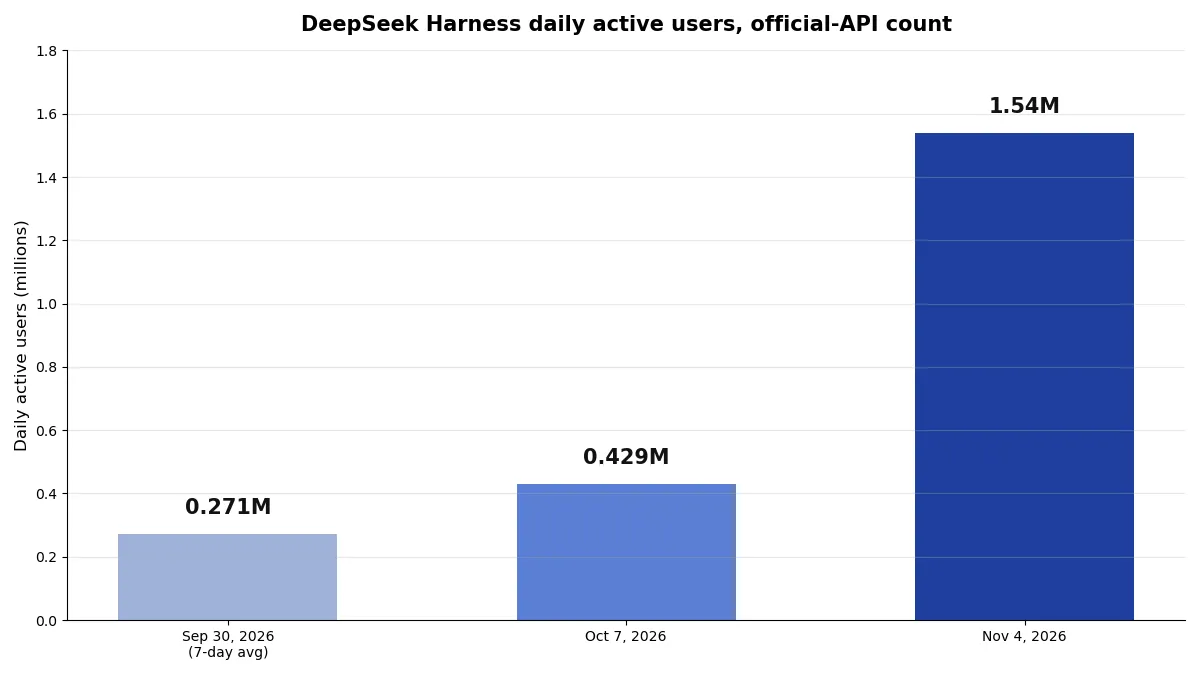
DeepSeek Harness daily active users, official-API count. Data: DeepSeek Harness team, November 5, 2026. Graphic: GPTOnline.
What Harness is
DeepSeek Harness, known as dsh, is an open source agent harness DeepSeek released on August 13 under the MIT license. It turns a model into an agent that can plan, use tools, run code, and manage files, sessions, and sandboxes, with everything built as a replaceable plugin. A desktop app followed on September 29. Users start it from the terminal with npx @deepseek-ai/dsh web, and the project now carries more than 276,000 stars on GitHub.
The plugin model is the heart of the product. The team reported about 35,000 third-party plugins, and said roughly 60 percent of active users have created or installed at least one. DeepSeek now plans an official marketplace for publishing and finding plugins, plus a support program for plugin creators, though it gave no launch date for either.
GPTOnline covered Harness’s Creator Mode on November 2, which lets users ask for custom plugins in plain language for tasks such as gaming and professional work.
The caveats
The numbers are DeepSeek’s own, not independently verified, and the daily user count covers only official-API users. Harness is also still experimental. Its safety notice says the software “has not undergone a security audit and must not be treated as secure or production-ready,” and warns that it can run model-generated code, load third-party plugins, and reach files, credentials, and the network. The project describes itself as a developer preview, with compatibility-breaking changes still coming.
Why it matters
Harness shows how quickly open agent infrastructure can spread when the software is free and the plugin system lets anyone extend it. In under three months it has built a user base and a plugin catalog that closed ecosystems took years to assemble, and its token appetite, 60 million tokens per user per day, hints at why agent workloads could become a major new source of demand for model providers.
The open question is whether DeepSeek can turn that usage into a durable platform. A marketplace would give plugin authors a reason to stay, and stronger security would matter for users who let agents touch real files and credentials. For now, Harness is the clearest sign yet that the agent race is not only about who builds the smartest model, but about who builds the scaffolding developers actually use.
Sources
- DeepSeek says agent app tops 1.5M daily users, plans plugin marketplace, Seeking Alpha (Bloomberg), November 8, 2026
- DeepSeek Harness, GitHub
- DeepSeek Harness safety notice, GitHub
- DeepSeek Harness usage figures, 36Kr, November 5, 2026 (in Chinese)
- DeepSeek Harness reaches 1.54 million daily users, AI Daily Insights, November 6, 2026
- DeepSeek Harness Launches Creator Mode for Building Custom Plugins, GPTOnline, November 2, 2026