
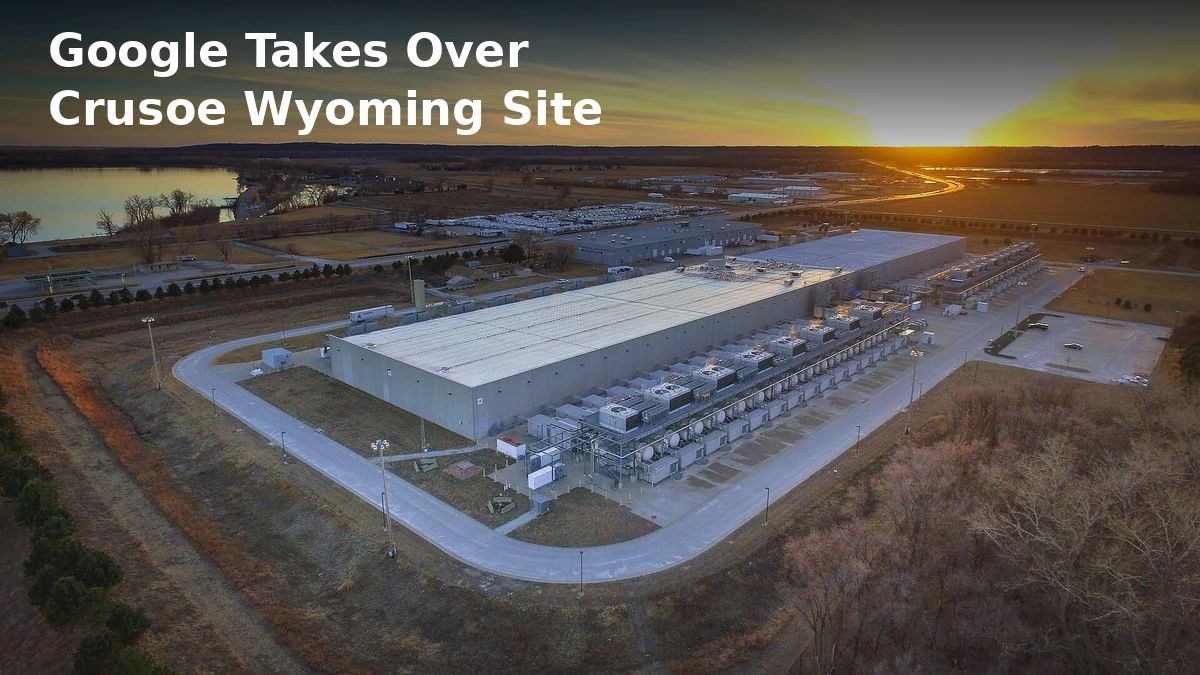
Google has acquired Crusoe’s data center site in southeast Wyoming, Crusoe announced on Friday, November 6, taking over a campus the AI infrastructure startup pitched last year at 1.8 gigawatts with room to grow to 10 gigawatts. The deal came a day after Google announced a $17 billion long-term investment to build its first data center in Wyoming, as GPTOnline reported.
Crusoe said the transaction completes its pre-development work on the project, which covered site selection, government approvals and power strategy. The financial terms were not disclosed. Bloomberg reported that Google opted to take the project on itself after Crusoe failed to lock in customers for the campus, including Google.
What Google is taking over
Crusoe and Tallgrass Energy launched the Wyoming campus in July 2025, pitching a site that could eventually expand to 10 gigawatts of power capacity, enough to supply electricity to roughly 7.5 million homes. The campus was developed around a hybrid power strategy combining fuel cells, grid power and natural gas turbines, with a long-term roadmap for carbon capture through Tallgrass’s regional carbon dioxide sequestration hub.
Google’s announcement a day earlier set out the scale of its commitment. The company will build its first Wyoming data center with Tallgrass Energy, Black Hills Energy, American Electric Power and Related Digital, anchored by a planned 702-megawatt fuel-cell development with carbon capture and storage. Google has said it will pay for 100% of the power the data center uses and expects the project to generate hundreds of millions of dollars in local property taxes.
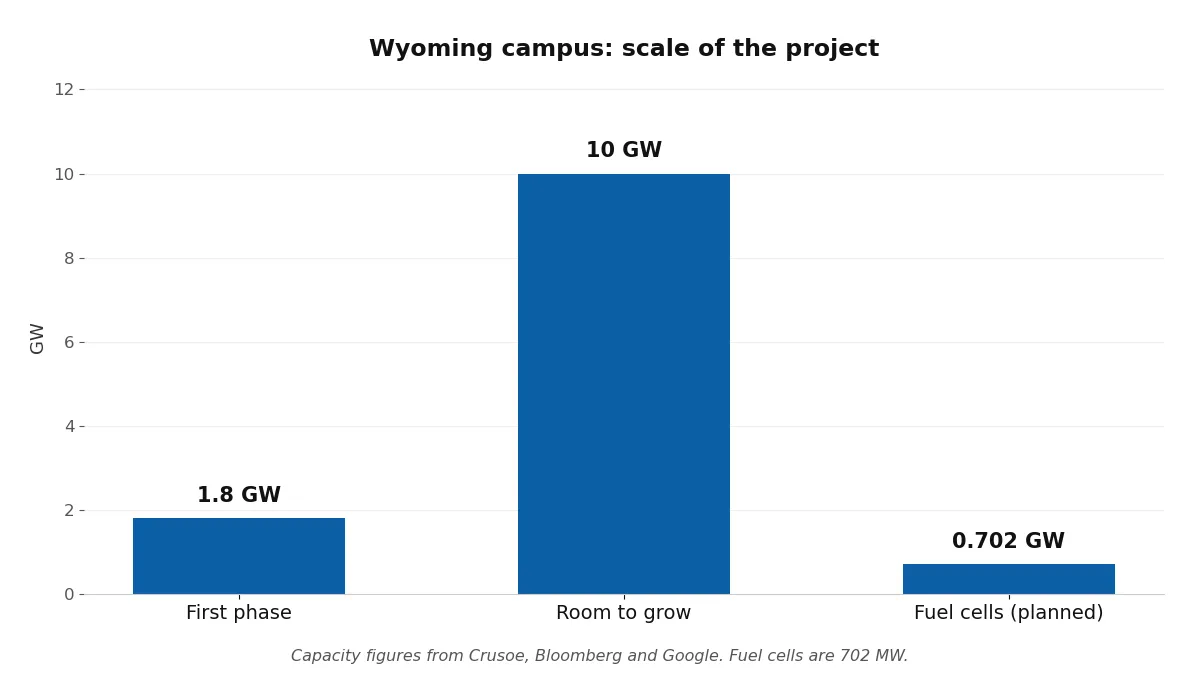
Chart: GPTOnline, based on figures from Crusoe, Bloomberg and Google.
Why Crusoe stepped aside
Crusoe framed the exit as the completion of its role rather than a retreat. “Crusoe’s pre-construction efforts, origination, entitlement, and de-risking, have set up the Wyoming project for construction and eventual operation,” said Chase Lochmiller, Crusoe’s co-founder and chief executive. “Crusoe is in the business of activating gigawatts for intelligence. With more than 6 GW contracted and over 40 GW in our pipeline, we are eager to steward the development and energization of the foundational infrastructure of AI.”
The handover does not end the relationship between the two companies. Crusoe said it is also the developer of another Google data center campus under construction in Armstrong County outside Amarillo, Texas. For Crusoe, the Wyoming exit frees up a team that had spent more than a year trying to line up customers for a site whose anchor tenant, it turned out, wanted to own the project outright.
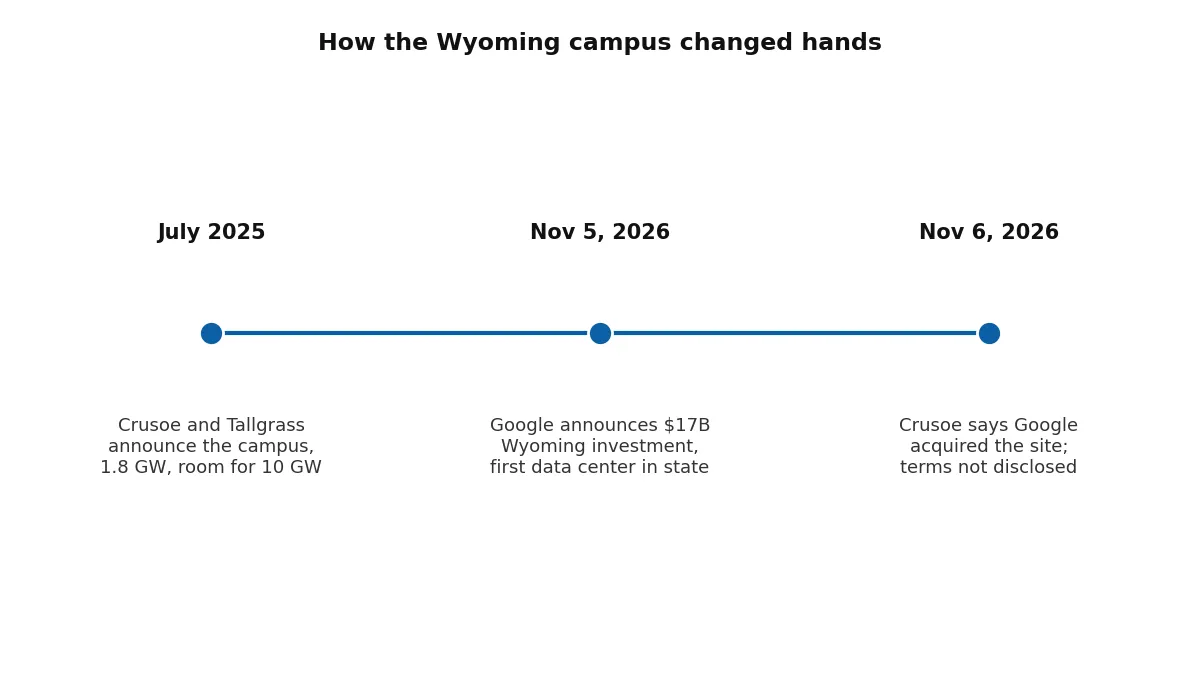
Chart: GPTOnline, based on the reported timeline of the Wyoming campus.
Why it matters
The deal shows how the AI infrastructure buildout is consolidating around the hyperscalers themselves. A year ago, Crusoe pitched the Wyoming campus as an independent AI factory that would sell capacity to the biggest names in the industry. In the end, the customer it most wanted became the owner, and the project will now be built as a Google facility rather than a shared one.
It also lands at a moment of growing political resistance to data centers. Voters approved limits on data center projects in 40 of 41 local ballot measures in last week’s midterm elections, according to Ballotpedia figures cited by Bloomberg. Google’s Wyoming package, with locally built fuel cells, carbon capture, air cooling and a pledge to pay for all of its power, is the company’s answer to that backlash. Whether the formula wins over residents in Cheyenne will be a test case for the industry’s next wave of data center siting, and Google now owns the site outright.
Sources
- Crusoe: Crusoe Announces Wyoming Data Center Campus Update (November 6, 2026)
- Reuters: Google acquires Wyoming data center site from AI infrastructure firm Crusoe (November 6, 2026)
- Bloomberg via Swissinfo: Chip Stocks Climb After Rout, But AI Doubts Linger (November 6, 2026)
- TipRanks: Google Takes Over Crusoe’s Wyoming AI Project in $17 Billion Expansion (November 6, 2026)
- GPTOnline: Google to Build First Wyoming Data Center in $17 Billion Investment (November 5, 2026)
[…] will spend $17 billion on its first Wyoming data centre, a project covered in our earlier report on Google’s Wyoming site purchase. Microsoft itself is reassessing billions of dollars in cloud partnerships, and has begun winding […]