What Was Announced?
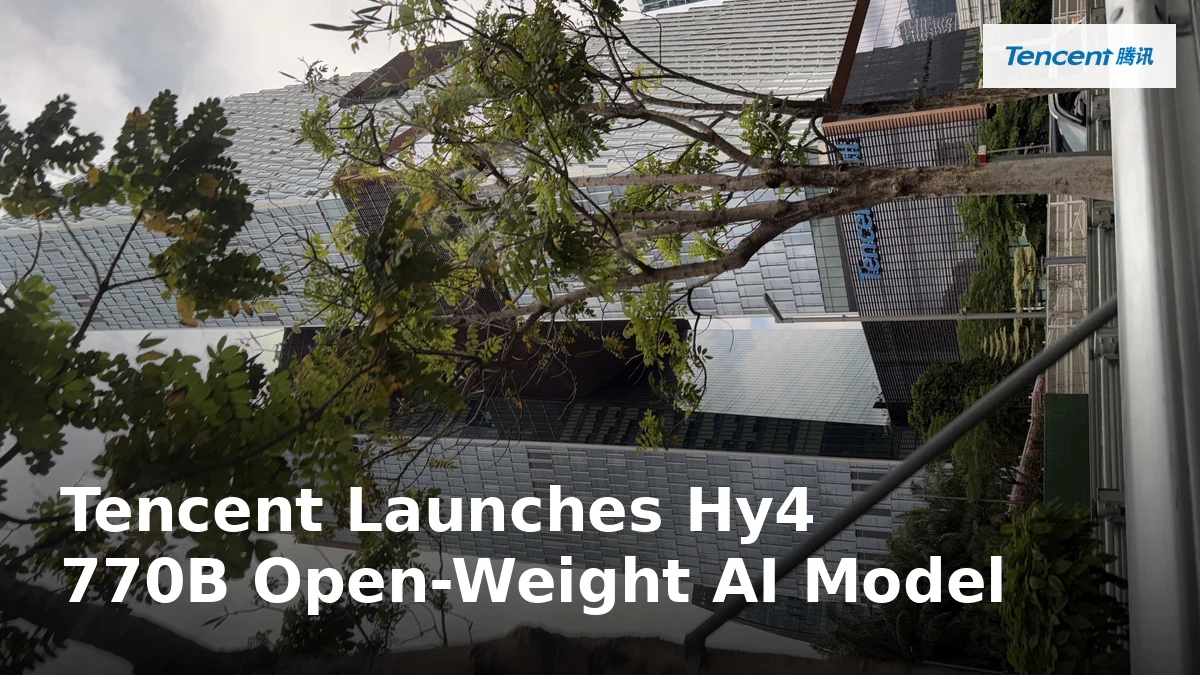
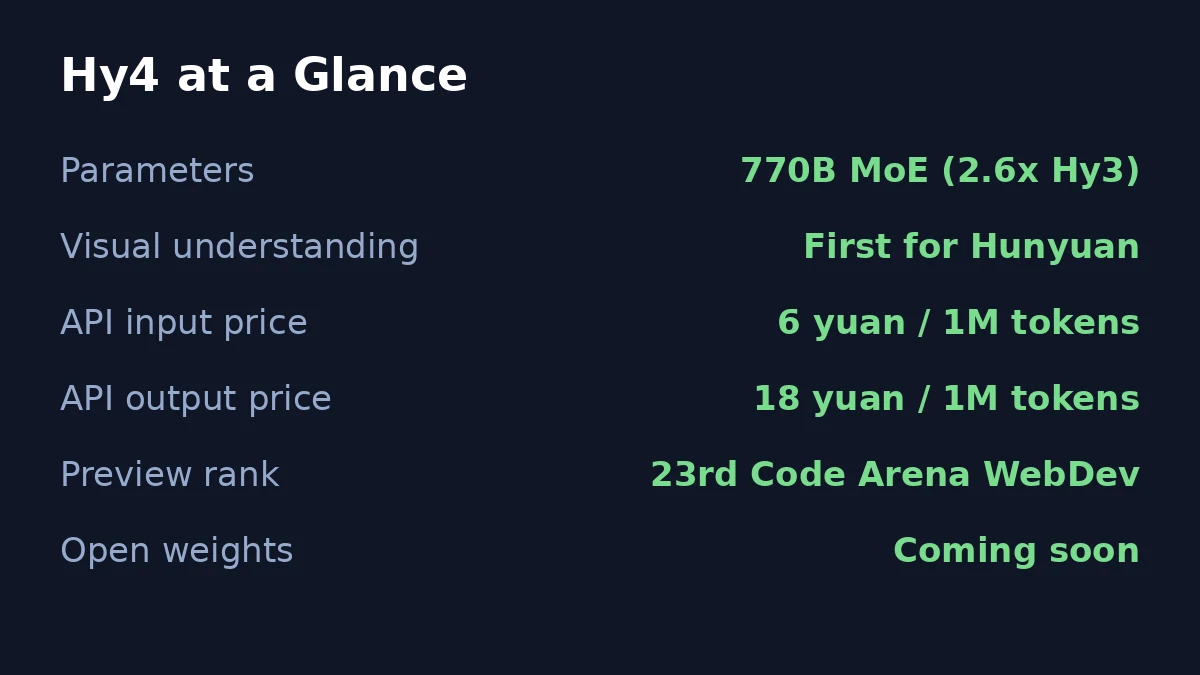
Tencent has officially released Hy4, the next-generation flagship of its Hunyuan large language model family, marking the first time the company says its AI lineup ranks among “one of the strongest open-weight models available today”. The release, announced Wednesday, November 4, 2026, builds on the Hy4 preview released in late August and scales the Hy4 series to 770 billion parameters, a 2.6-fold jump from the 295 billion parameters in its predecessor, Hy3.
The headline upgrade is vision. Hy4 introduces visual understanding for the first time: it can process images, analyze complex charts, and conduct visual mathematical reasoning, combining perception, reasoning, and tool invocation to handle tasks such as fine-grained image recognition, according to the company via the South China Morning Post. Hy4 also adds Computer Use, allowing it to execute complex tasks by combining command-line and graphical interfaces, ChainCatcher reported citing the official announcement.
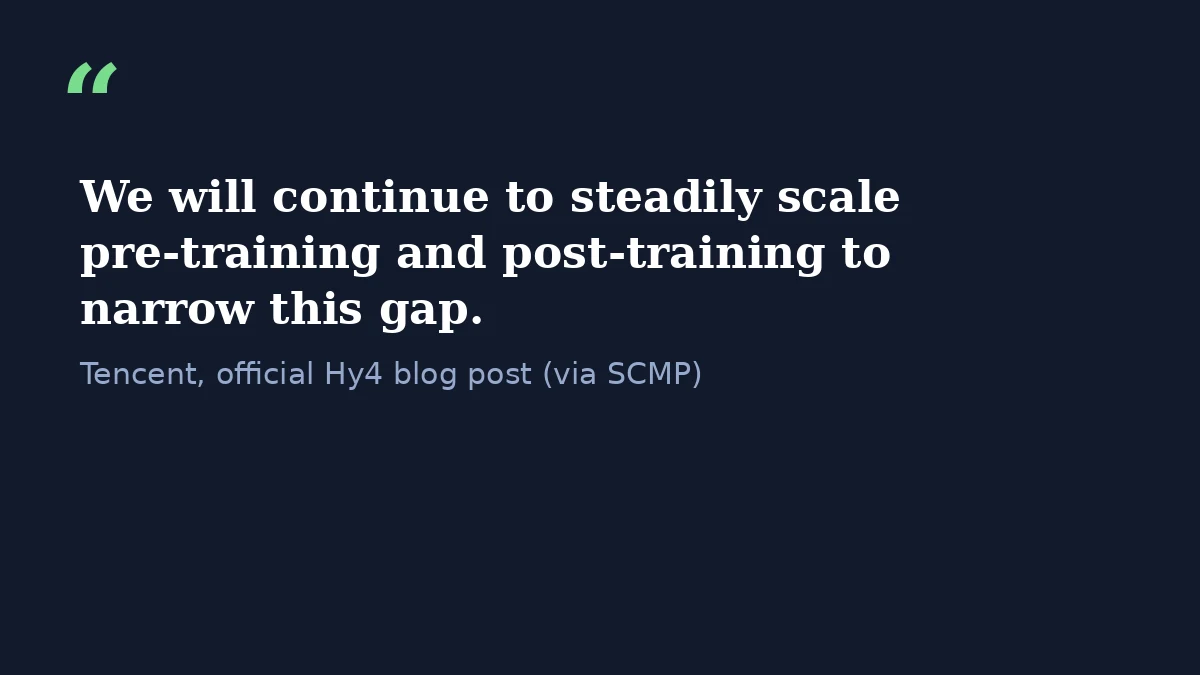
Tencent was candid about where the model still falls short. The company acknowledged that Hy4 trails the world’s leading closed-source systems on challenging internal benchmarks for research-level mathematics, long-horizon coding, model self-improvement, and advanced visual question answering. “We will continue to steadily scale pre-training and post-training to narrow this gap,” Tencent said in a blog post on Wednesday.
Key Features and Benchmarks
According to Tencent’s published internal evaluations, the official Hy4 significantly outperforms the August preview across 12 tasks spanning agentic capabilities, coding, and workplace automation. Compared with the preview, Hy4 improved scores on the GameDev and GameLogic tests by 19.1% and 9.8%, respectively, per the official announcement.
Tencent’s technical blog claims Hy4 outperformed Z.ai’s GLM-5.3 and the DeepSeek-V4.1-Flash-1017 model across all tested tasks, while trading wins with Moonshot’s Kimi K3.1 Pro, the SCMP reported. These are vendor-reported figures and have not been independently benchmarked.
Tencent is leaning on a “co-design” strategy, building the model alongside the products it will power. The company says Hy4 achieved an average score of 83.18 and a pass rate of 96.15% in internal evaluations for tasks in its workplace AI tool WorkBuddy, and ran financial crowd-testing with 213 experts, 153 of whom came from leading external financial institutions, Zhitong Finance reported.
On safety, Tencent said it restricted Hy4’s hacking capabilities during training by filtering out content related to exploit development, reverse engineering, and penetration testing, “to avoid amplifying potential offensive capabilities”.
Pricing and Availability
Hy4 is available for model invocation now through Tencent Cloud and OpenRouter, and has been integrated into Tencent Cloud TokenHub, WorkBuddy, CodeBuddy, Yuanbao, ima, and the WeCom intelligent assistant, according to the announcement.
API pricing stays at the preview level: 6 yuan per million input tokens, 18 yuan per million output tokens, and 0.3 yuan per million cache-hit tokens, ChainCatcher reported. Tencent is offering a 50% discount on Hy4 via TokenHub from November 4 through December 31, 2026, and free WorkBuddy and CodeBuddy usage from November 4 to 15. The company plans to open-source the official version’s model weights and system card soon, and to launch Hy4 Flash, a lighter version focused on inference speed and cost.
Why It Matters
The launch is Tencent’s most aggressive move yet in China’s open-weight AI race, where DeepSeek, Z.ai, and Alibaba are already challenging global peers. Tencent aggressively increased capital expenditure by 176% year on year to 52.8 billion yuan (about US$7.9 billion) in the second quarter to fund its AI efforts, per the SCMP, and has indicated its next-generation Hy5 will scale further. With Kimi K3.1 Pro’s promised open-weight release still pending, Tencent’s early open-source commitment positions it to court the enterprise and developer audiences its competitors are chasing.
Sources
- South China Morning Post, “Tencent launches Hy4 in bid to break into AI’s top tier of open-weight models,” Nov 4, 2026
- Zhitong Finance via Longbridge, “Tencent Hunyuan Officially Releases New-Generation Large Language Model Hy4,” Nov 4, 2026
- Wedoany, “Tencent Releases Official Version of Hunyuan Hy4 with New Visual Operation Capabilities,” Nov 4, 2026
- ChainCatcher, “Tencent Hunyuan Releases Hy4: Ranks Among Strongest Open-Source Models,” Nov 4, 2026
- GPTOnline, “Tencent Previews Hy4 And Hy4 Flash Models At Cloud Summit,” Oct 30, 2026