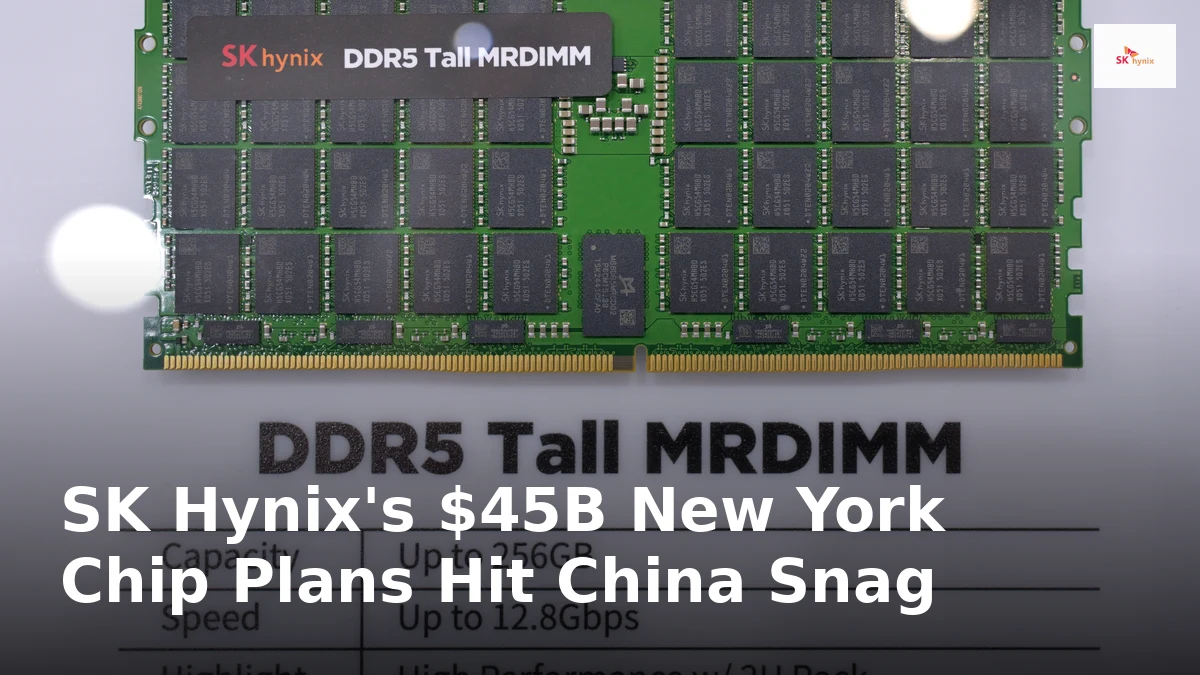
U.S. officials have held up approval for American chipmaking equipment that SK Hynix needs to expand production in China, complicating the South Korean chipmaker’s plans for new memory-chip plants in New York, Reuters reported on November 3, citing people familiar with the matter.
SK Hynix is seeking U.S. export licenses to equip its Dalian plant, arguing that increased production there would help fund its planned American expansion. The Commerce Department has yet to approve the new licenses, and negotiations are continuing, the sources said.
What Happened
According to the Reuters exclusive, the standoff centers on the Commerce Department’s reluctance to greenlight American chipmaking tools for SK Hynix’s facility in Dalian, China. The company says it needs to ramp up production and develop more sophisticated NAND chipmaking in China to generate the revenue required to build a U.S. facility and stay competitive.
NAND is memory that retains data even when power is turned off and is widely used for storage in data centers, a market growing fast as AI infrastructure expands.
In a meeting last week, Commerce Under Secretary Jeffrey Kessler held to his position that the United States would not allow more American chipmaking tools to upgrade or expand capacity, one person told Reuters. The department has not formally denied a license to export American equipment to fill empty clean space in Dalian, and the two sides are also negotiating a separate license for 2027 for equipment to keep up the Dalian facility.
The $45 Billion New York Bet
SK Hynix’s U.S. subsidiary, Solidigm, plans to invest about $45 billion and build two NAND plants in Marcy, New York, according to two people familiar with the discussions, with investment potentially reaching about $100 billion over time.
Executives from Solidigm have met nearly 10 times with Commerce Department officials since late August as the two sides try to find a path forward, one person said.
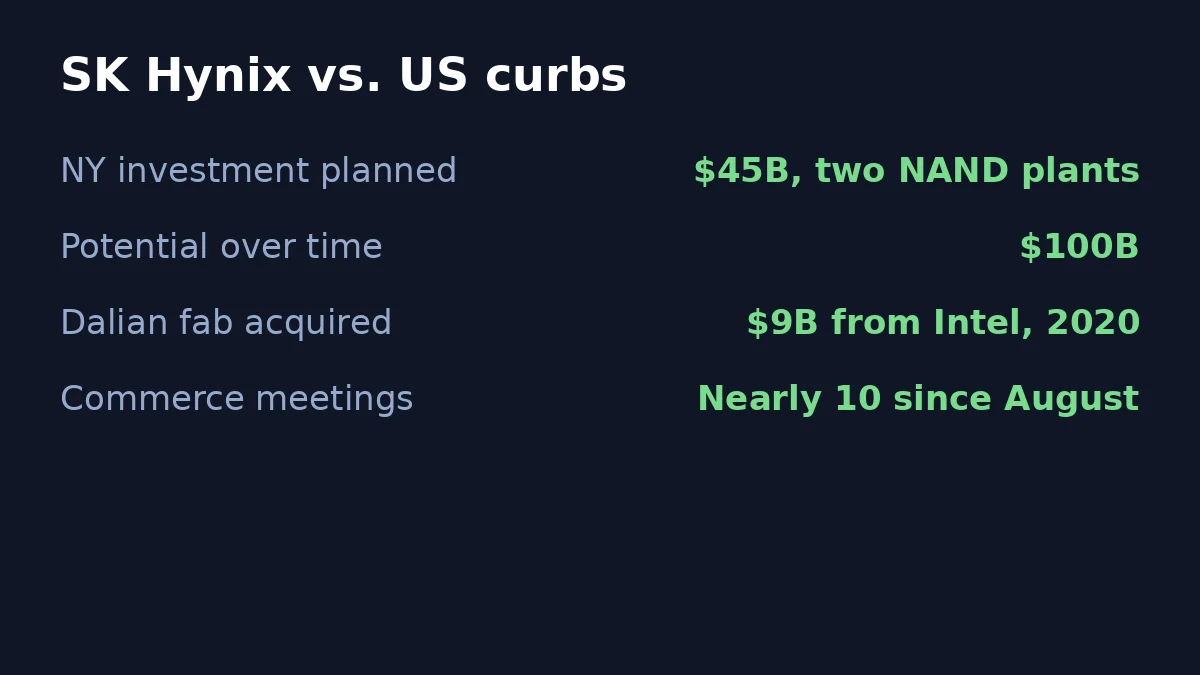
Key figures in the SK Hynix standoff. Graphic: GPTOnline.
In a statement last week, Solidigm said: “As a US-founded and headquartered company, Solidigm regularly evaluates strategic alternatives to best serve its customers and enhance its long-term competitiveness. The company is currently exploring options for building a NAND memory fab at potential locations around the world. No decision regarding any specific course of action has been made.” Solidigm stuck to that statement this week. SK Hynix did not immediately respond to a request for comment outside business hours.
Background: Dalian and the Export-Control Clampdown
SK Hynix agreed to acquire Intel’s NAND factory in Dalian, China, for $9 billion in 2020, taking control of the facility and the solid-state drive storage business shortly before the United States instituted sweeping export controls on American chipmaking equipment for what it deemed advanced chip factories in China.
At first, Washington waived the restrictions on foreign-owned chipmaking facilities in China. But last year, the Commerce Department revoked those authorizations, calling them a “Biden-era loophole,” and replaced them with annual licenses that allowed suppliers to ship certain equipment and technology to the facilities with quantity limits. In a 2025 statement, the department said it did not intend to issue licenses to upgrade technology or expand capacity.
SK Hynix has argued that installing equipment to fill empty clean space in Dalian would not expand capacity, because it built the cleanroom in 2023.
What the Key Voices Said
Leland Miller, a member of the U.S.-China Economic and Security Review Commission, a bipartisan panel created by the U.S. Congress, told Reuters: “Ultimately, none of this is going to go forward without a green light from the White House.”
Leland Miller on the White House’s role in the decision. Graphic: GPTOnline.
The negotiations raise questions about how far the Trump administration is willing to bend national security guardrails established to keep U.S. technology from aiding China’s military, in order to bring foreign investment and chipmaking onshore.
The White House did not immediately respond to a request for comment. A spokesperson for the Department of Commerce did not immediately respond to a request for comment.
Why It Matters
Memory chips are a cornerstone of the AI data-center buildout, and the outcome of these negotiations will shape where a significant share of future NAND capacity gets built. If Washington holds the line, SK Hynix’s $45 billion American bet stalls. If it bends, critics will ask whether national-security controls are being traded for investment announcements. Either way, the White House now sits at the center of one of the largest semiconductor decisions of the year.