xAI will switch on invisible statistical watermarking for Grok API text by default on November 7, 2026, the company announced on October 31, reversing its earlier position that AI-generated text should remain unaltered.
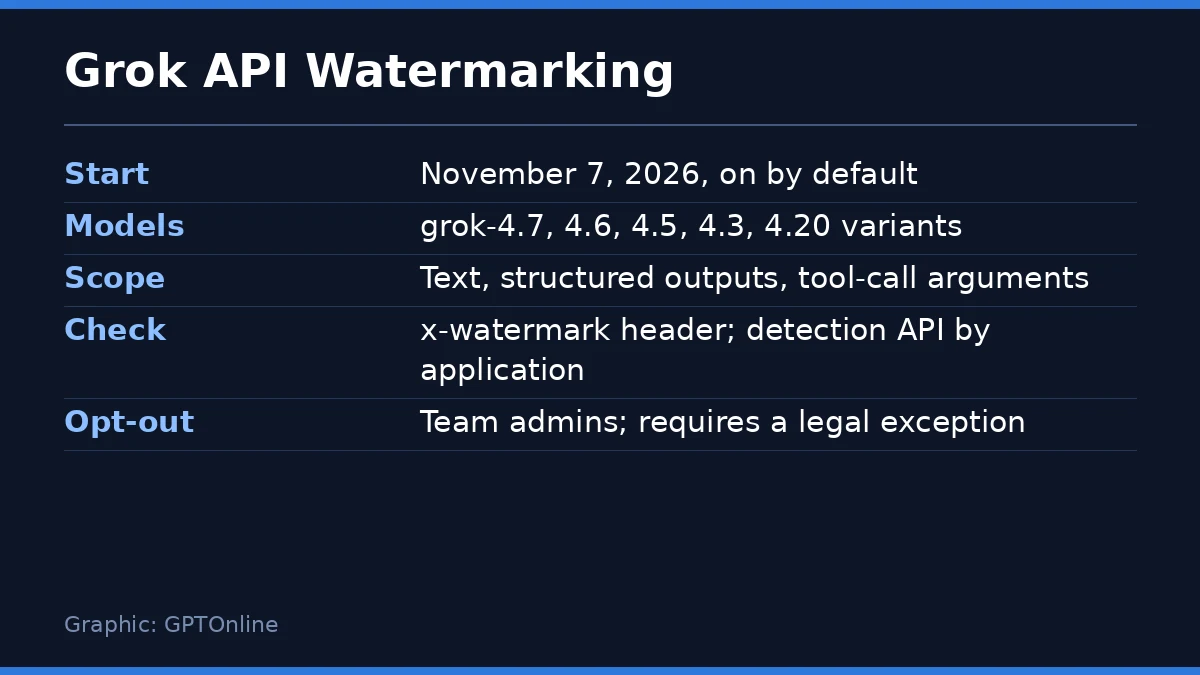
Starting that Saturday, output from seven Grok API models will carry the hidden mark with no code changes required, according to xAI’s output watermarking documentation. The change covers grok-4.7, grok-4.6, grok-4.5, grok-4.3, and the three grok-4.20 variants (reasoning, non-reasoning, and multi-agent).
What changes on November 7
The default applies across every text-generation endpoint: the global api.x.ai endpoint, regional endpoints, the Responses API, and the Chat Completions API. Inside a response, the mark touches three kinds of generated text: ordinary text responses, structured outputs, and tool-call arguments, the generated inputs a model supplies for a tool call.
There is no request parameter to add. xAI says the response format stays the same apart from a new x-watermark response header: a value of true means that request’s output was generated with the mark.

How the mark works
The watermark is applied while the model generates text by slightly shaping which tokens the model picks, steering choices toward a statistical pattern. It adds no characters, markup, or hidden text, and xAI says it does not change response quality or speed, a claim with no independent testing cited in the documentation.
Detection is statistical: xAI’s system scores a passage and returns watermarked, not watermarked, or uncertain, with longer samples giving a stronger signal. Access to the detection API is by application only, not open to the public by default.
The opt-out
Team administrators can turn watermarking off per model in the xAI Console, under a “Model output watermarking” setting. But the exit is narrow: disabling requires confirming that an exception under applicable law covers the team’s use, and the team accepts responsibility for any other marking or disclosure obligations. Changes take effect for new requests within five minutes and are recorded in the team audit log.
Why now, and who is left
xAI cites EU AI Act compliance as the reason. The Act’s Article 50 transparency obligations, in effect since August 2, 2026, require providers of generative AI systems to put machine-readable marks on synthetic outputs and make them detectable as AI-made.
The move follows Anthropic’s similar rollout of Claude text watermarking this week, and Crypto Briefing reports the xAI announcement frames ChatGPT as the remaining major North American model without text watermarking. xAI had previously pushed back publicly on watermarking outputs, making the default-on switch a notable reversal.
Sources
- xAI will add invisible watermarks to Grok API text Nov. 7, TokenPost, October 31, 2026
- xAI adds invisible text watermarking to Grok API models, Crypto Briefing, October 31, 2026
- SpaceXSI (xAI) will watermark Grok API text output by default from November 7, 2026, New Runtime, October 31, 2026
- xAI will watermark Grok API text by default starting November 7, Superpower Daily, October 31, 2026